12th Plenary Meeting of the Minimum Wage Commission Held
Agreement Reached After KCTU Walkout and Prolonged Negotiations
First Agreement in 17 Years Since 2008
Labor Unions Express Concern Over Low Increase Rate
Business Community: "Agreement to Overcome Complex Crisis"
Commission Chair: "Achievement Demonstrates Strength of Social Dialogue"
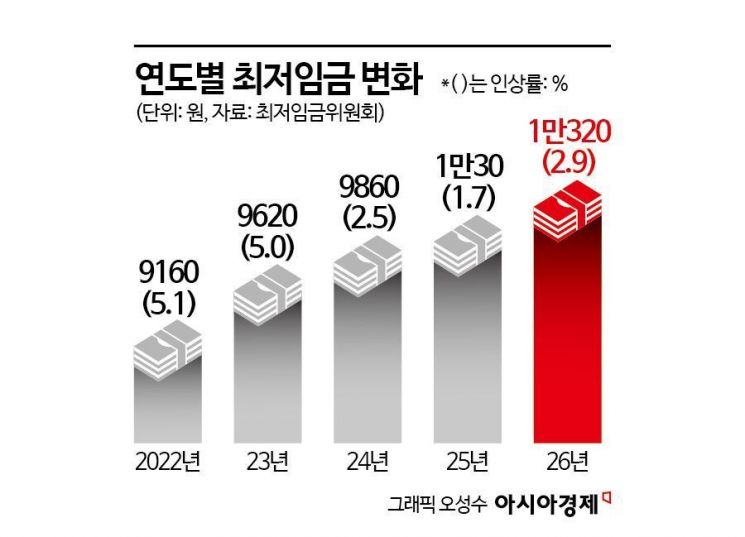
In the first year of the Lee Jaemyung administration, the minimum wage was set through a labor-management-public agreement for the first time in 17 years. Next year's minimum wage will be 10,320 won per hour, a 2.9% increase from this year. Compared to the minimum wage increase rates in the first year of previous administrations, this is a low figure, which is seen as reflecting the difficult economic conditions.
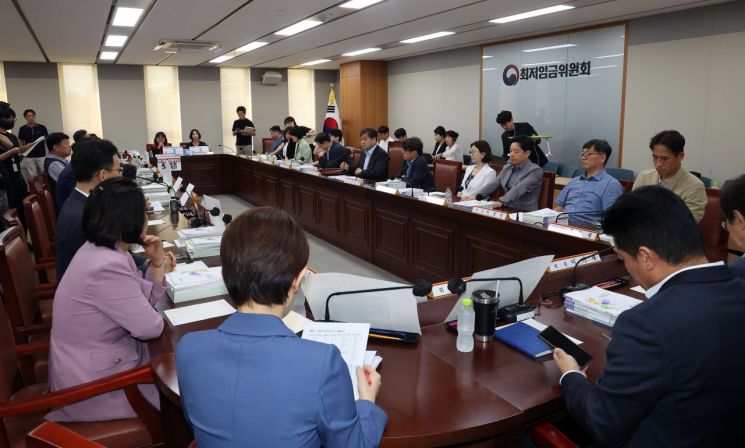 The 12th plenary meeting of the Minimum Wage Commission held on the 10th at the Government Sejong Complex. Photo by Yonhap News
The Minimum Wage Commission held its 12th plenary meeting at the Government Sejong Complex on the 10th and decided to raise next year's minimum wage by 2.9% from this year's 10,030 won to 10,320 won. This translates to a monthly wage of 2,156,880 won, based on a 209-hour work month, which includes a 40-hour work week and weekly paid leave.
Lee Injae, chairperson of the Minimum Wage Commission, stated, "This agreement will be remembered as an achievement that demonstrates our society's capacity to resolve differences and conflicts through social dialogue." Kwon Soonwon, public interest commissioner and professor at Sookmyung Women's University, commented, "The determination to persist until the end and persuade both labor and management to reach an agreement ultimately resulted in today's outcome."
The minimum wage increase rate in the first year of the Lee Jaemyung administration is the second lowest among all previous administrations. During the Kim Daejung administration, the first-year increase rate was only 2.7% due to the International Monetary Fund (IMF) foreign exchange crisis, which was the lowest. The Yoon Sukyeol administration saw a 5.0% increase, the Lee Myungbak administration 6.1%, the Park Geunhye administration 7.2%, and the Kim Youngsam administration 8%. Under the Moon Jaein administration, the government showed strong determination to increase the minimum wage, resulting in the highest rate of 16.4%.
This year's minimum wage decision marks the first labor-management-public agreement in 17 years, since the 2009 minimum wage agreement in 2008. Since the introduction of the minimum wage system in 1988, this is the eighth time the minimum wage has been set through a labor-management-public agreement. This year, the gap between labor and management was also significant, so the legal deadline for deliberation (June 29) was missed, but an agreement was reached in an unusual move, drawing attention.
Labor and management initially had a difference of 1,470 won between their proposals, but gradually narrowed the gap through several rounds of negotiations, including the first revision (1,440 won), the second (1,390 won), the third (1,270 won), and the fourth (1,150 won). In the meeting held on this day, the ninth revised proposal (220 won) was followed by the tenth revised proposal (200 won), and an agreement was finally reached after last-minute coordination.
However, during the meeting, the Korean Confederation of Trade Unions (KCTU) refused to participate in the deliberation and walked out, so only the Federation of Korean Trade Unions (FKTU) participated in the final agreement process. As a result, a total of 23 members, including five worker representatives (excluding the four KCTU-affiliated members), nine public interest commissioners, and nine employer representatives, produced the final result. This has led to criticism that the agreement was only partial.
The Minimum Wage Commission explained, "At the 10th plenary meeting held on the 8th, the chairperson requested labor and management to submit revised proposals within the public interest commissioners' deliberation facilitation range." The commission added, "The meeting continued with labor and management submitting the ninth and tenth revised proposals and making efforts to reach an agreement, even after the KCTU-recommended worker representatives, who did not agree to submit revised proposals, walked out."
 Members of the Democratic Labor Union, who are worker representatives on the Minimum Wage Commission, are refusing to deliberate and walking out during the 12th plenary session of the Minimum Wage Commission held at the Government Sejong Complex on the 10th. Photo by Yonhap News
Previously, as the gap between labor and management remained wide, the public interest commissioners suggested a deliberation facilitation range between 10,210 won (lower limit) and 10,440 won (upper limit). The lower limit reflected this year's projected consumer price inflation rate (1.8%), while the upper limit reflected this year's projected national economic productivity growth rate (2.2%) and the difference between the cumulative consumer price inflation and minimum wage increase rates from 2022 to 2024 (1.9%).
The KCTU demanded the withdrawal of the facilitation range, arguing that the proposed increase was too low, but when this was not accepted, they chose to walk out. The KCTU criticized in a statement, "The facilitation range is a deceptive proposal that disregards workers' livelihoods and only reflects the employers' position." They also demanded, "All public interest commissioners should immediately resign."
The FKTU participated in the final agreement but assessed the result as falling short of expectations. The FKTU stated, "The level is woefully inadequate to cover the living expenses of low-wage workers," and added, "The shortfall remains a challenge for the Lee Jaemyung administration." The FKTU continued, "Special measures must be prepared to address the shortfall in living expenses for low-wage workers."
Representing the employer members of the Minimum Wage Commission, the Korea Employers Federation explained, "This decision was reached as both labor and management recognized the need to make certain concessions and coordinate their positions, rather than repeating existing conflicts, in order to overcome the current complex crisis." The federation added, "The agreement was reached after much deliberation."
The Minimum Wage Commission explained that, given the poor economic indicators this year, it was not possible to raise the upper limit of the facilitation range as high as labor groups requested. Professor Kwon stated, "Although the agreement was reached with only five worker representatives remaining, the concerns and arguments of the four who walked out were also considered in the agreement." He added, "This can be seen as a meaningful result, as it is the first labor-management-public agreement in 17 years."
Going forward, the Minimum Wage Commission will submit the minimum wage proposal adopted on this day to the Ministry of Employment and Labor in accordance with the Minimum Wage Act. The Ministry of Employment and Labor will then finalize and announce next year's minimum wage by August 5. The new minimum wage will take effect on January 1 of next year. According to the Survey on the Actual Status of Workers by Employment Type, 782,000 workers (impact rate: 4.5%) will be affected by next year's minimum wage proposal. Based on the Supplementary Survey of the Economically Active Population, the number is estimated at 2,904,000 workers (impact rate: 13.1%).
© The Asia Business Daily(www.asiae.co.kr). All rights reserved.
![Clutching a Stolen Dior Bag, Saying "I Hate Being Poor but Real"... The Grotesque Con of a "Human Knockoff" [Slate]](https://cwcontent.asiae.co.kr/asiaresize/183/2026021902243444107_1771435474.jpg)

















