Next Year's Minimum Wage Set at 10,320 Won
2.9% Increase... Lowest Among Last Five Administrations
Business Burden Remains Heavy
Issue of Differentiated Application by Industry Still Unresolved
With the minimum wage for 2026 set at 10,320 won per hour, a 2.9% increase from this year, the atmosphere among small and medium-sized businesses and self-employed business owners is one of cautious relief. Although the decision fell short of the business sector's demand for a freeze, it is the lowest first-year increase among the past five administrations. However, as overall costs continue to rise, labor costs remain a heavy burden, and the long-standing demand for "differentiated application by industry" was once again not adopted this year, there is little optimism about the future.
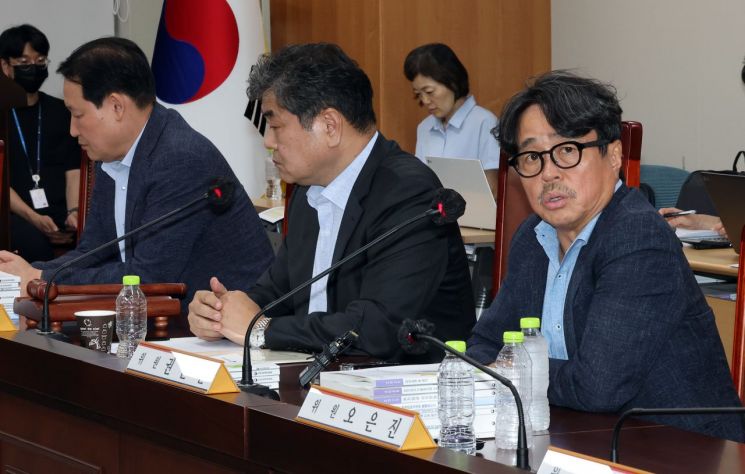 Kwon Sunwon, a public interest member of the Minimum Wage Commission and professor at Sookmyung Women's University, is answering reporters' questions after the 12th plenary session held at the Government Complex Sejong on the 10th, where next year's minimum wage was decided to be 10,320 won per hour. Photo by Yonhap News
On July 11, the Korea Federation of Small and Medium Business stated regarding next year’s minimum wage, "The business sector has consistently maintained that a freeze in the minimum wage is necessary, considering the management difficulties of micro, small, and medium-sized businesses, as well as self-employed business owners. However, in light of the growing hardships across the entire livelihood economy, we have agreed to the current minimum wage decision," adding, "We hope this agreement will serve as a starting point for our society to move beyond conflict toward unity and harmony."
A representative of the Korea Federation of Micro Enterprises said, "Although the increase rate is lower than feared, it is hard to deny that, given the current economic and market conditions, it will further increase the burden on small business owners," adding, "The government must continue to develop additional support measures to ease this burden."
Typically, the first-year minimum wage increase under a new administration is seen as an indicator of the future direction of labor policy. Looking at the first-year increase rates of the past five administrations: the Roh Moo-hyun administration was 10.3%, the Lee Myung-bak administration was 6.1%, and the Park Geun-hye administration was 7.2%. The Moon Jae-in administration had the highest at 16.4%, while the Yoon Suk-yeol administration had the lowest at 5.0%. Given the pro-labor stance of the Lee Jaemyung administration, there was a widespread expectation both inside and outside the industry that the first-year increase would be set at a relatively high level, if not as high as under the Moon Jae-in administration.
An industry representative explained, "Because the economy is struggling, even a 0.1% increase is a burden for small business owners. Still, since the increase is not as high as initially feared, there is an internal assessment that the authorities have taken the difficulties of the business sector into account and made an effort to moderate the pace of increase."
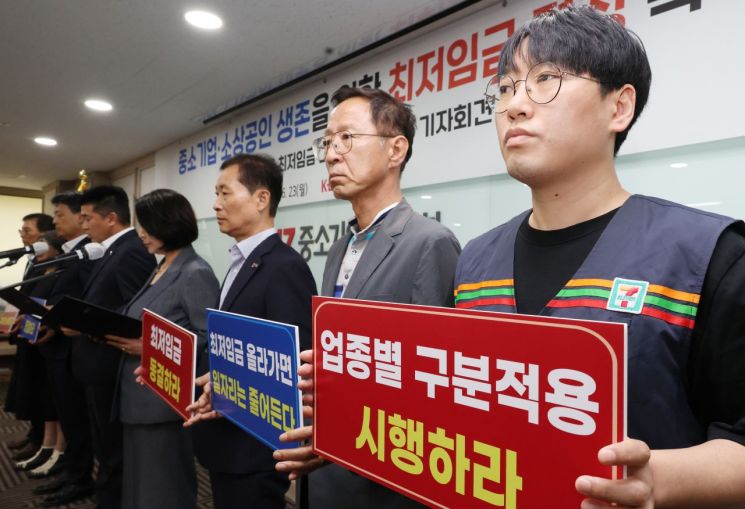 On the 23rd of last month, at the Korea Federation of Small and Medium Business in Yeouido, Seoul, convenience store owners and other small and medium-sized business owners read an appeal urging the determination of the minimum wage for survival at the "Press Conference on the Minimum Wage Application for 2026" held for the SME sector. Photo by Yonhap News
Nevertheless, the overall mood in the industry remains heavy and somber. This is because gas and electricity rates, as well as various raw material prices, continue to rise, and the pressure from rapidly increasing labor costs under previous administrations still persists, making even a 2% range increase significant. Due to the prolonged slump in domestic demand, small and medium-sized businesses and self-employed business owners are, in fact, being pushed to their limits. According to a survey by Korea Credit Data, the average sales of self-employed businesses in the first quarter of this year fell by 12.9% compared to the previous quarter, and the number of business closures exceeded one million for the first time last year.
The issue of differentiated application of the minimum wage by industry and business size, which the industry has consistently advocated, remains unresolved. This year, the small and medium-sized business sector demanded a differentiated minimum wage for industries with relatively less capacity to pay, but this was rejected at the 6th plenary session on June 19. Earlier this year, a survey by the Korea Federation of Micro Enterprises showed that 80.1% responded that differentiation by industry is necessary, and 92.1% said differentiation by business size is needed when reforming the minimum wage system, highlighting strong calls for such measures.
An industry representative said, "The president has consistently emphasized policies to protect workers, and the first nominee for Minister of Employment and Labor was also a former chairman of the Korean Confederation of Trade Unions, so there is skepticism about how much the business sector's position will be reflected."
© The Asia Business Daily(www.asiae.co.kr). All rights reserved.
![Clutching a Stolen Dior Bag, Saying "I Hate Being Poor but Real"... The Grotesque Con of a "Human Knockoff" [Slate]](https://cwcontent.asiae.co.kr/asiaresize/183/2026021902243444107_1771435474.jpg)
















