Korean Confederation of Trade Unions Walks Out in Protest, Refusing to Participate in Deliberations
For the first time in 17 years, labor, management, and public interest representatives reached an agreement, setting next year's minimum wage at 10,320 won per hour. When converted to a monthly wage, this amounts to 2,156,880 won.
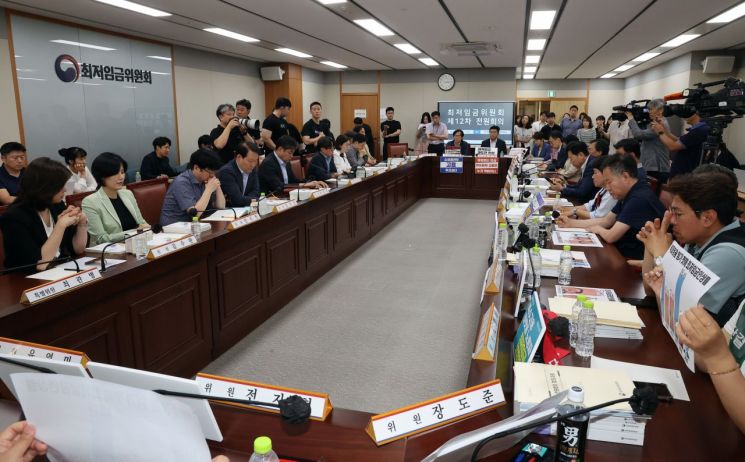 The 12th plenary meeting of the Minimum Wage Commission held on the 10th at the Government Sejong Complex. Photo by Yonhap News
The Minimum Wage Commission held its 12th plenary meeting on the 10th at the Government Sejong Complex and decided to set next year's minimum wage at 10,320 won, a 2.9% increase from this year's 10,030 won. When converted to a monthly wage, this amounts to 2,156,880 won. This calculation is based on 209 hours per month, which includes weekly holiday pay for those working 8 hours a day, 5 days a week.
This minimum wage decision marks the first labor-management-public agreement since 2008, after 17 years. The gap between the initial proposals from labor and management was 1,470 won, but they narrowed the difference through the first revised proposal (1,440 won) and the second revised proposal (1,390 won). During the meeting held on this day, they continued to negotiate, presenting the ninth revised proposal (220 won difference) and the tenth revised proposal (200 won difference), finally reaching an agreement after last-minute adjustments.
However, during the meeting, the Korean Confederation of Trade Unions refused to participate in the deliberation and walked out, so the final agreement was reached only with the Federation of Korean Trade Unions. Excluding the four representatives from the Korean Confederation of Trade Unions, the agreement was concluded by the remaining five labor representatives, nine public interest representatives, and nine management representatives. The Korean Confederation of Trade Unions had previously demanded the withdrawal of the deliberation acceleration range proposed by the public interest members, arguing that the suggested rate of increase was too low. When their demand was not accepted, they chose to leave the meeting.
© The Asia Business Daily(www.asiae.co.kr). All rights reserved.
![Clutching a Stolen Dior Bag, Saying "I Hate Being Poor but Real"... The Grotesque Con of a "Human Knockoff" [Slate]](https://cwcontent.asiae.co.kr/asiaresize/183/2026021902243444107_1771435474.jpg)















