Plants continue to grow even under prolonged heat waves. A Korean research team has provided an answer to the question, "How?" Their findings are expected to contribute to the development of climate-adaptive crop varieties and advanced gene regulation technologies in the future.
The Korea Research Institute of Bioscience and Biotechnology (KRIBB) announced on July 10 that the research team led by Dr. Hyesun Cho at the Plant Systems Engineering Research Center has uncovered, at the molecular level, the secret behind how plants can survive heat stress.
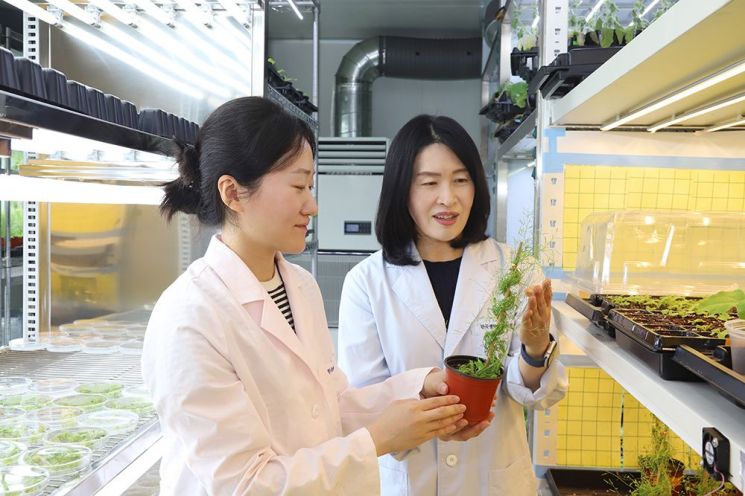 (Photo from right) Dr. Hyesun Cho (corresponding author), Dr. Seunghui Cho (first author). Provided by Korea Research Institute of Bioscience and Biotechnology
The DNA of all living organisms stores genetic information, which is copied to create a substance called RNA. RNA contains both essential segments for protein synthesis (exons) and unnecessary segments (introns), requiring a precise editing process to remove the unnecessary parts. This process is called "RNA splicing."
The molecular complex responsible for RNA splicing is known as the "spliceosome." The spliceosome acts as a tailor, precisely refining RNA and assisting in the production of functional proteins in plants.
In their search for the reason why plants can withstand heat waves, the research team identified a key regulatory protein, "PP2A B′η (Bprimeeta)," which is a core component of the spliceosome, the RNA tailor.
They also discovered, for the first time in the world, that when plants are exposed to high temperatures, Bprimeeta acts as a switch to activate the spliceosome. This facilitates the RNA editing process, enabling plants to produce the proteins they need in a timely manner under heat stress conditions.
The research team conducted experiments in which they artificially removed Bprimeeta or, conversely, increased its production. As a result, they found that plants lacking Bprimeeta failed to germinate and died under high temperatures, while plants with this protein grew healthily and showed higher survival rates even in hot environments.
They also revealed the molecular mechanism by which the absence of Bprimeeta leads to improper RNA editing in numerous genes, making it difficult for plants to produce essential proteins for survival. This, in turn, makes plants more vulnerable to heat stress.
Dr. Hyesun Cho, the lead researcher, stated, "With climate change, the importance of developing heat-resistant crops will continue to grow. We expect that the newly discovered function of the Bprimeeta protein will contribute to the development of climate-adaptive crop varieties and advanced gene regulation technologies in the future."
This research was supported by the Mid-career Researcher Program of the Ministry of Science and ICT, the Convergence Research Program of the National Research Council of Science and Technology, KRIBB's core projects, and the Next-generation Crop Breeding Technology Development Project of the Rural Development Administration. The research findings were published online in the internationally renowned plant science journal 'The Plant Cell' on May 13.
© The Asia Business Daily(www.asiae.co.kr). All rights reserved.
![Clutching a Stolen Dior Bag, Saying "I Hate Being Poor but Real"... The Grotesque Con of a "Human Knockoff" [Slate]](https://cwcontent.asiae.co.kr/asiaresize/183/2026021902243444107_1771435474.jpg)
















