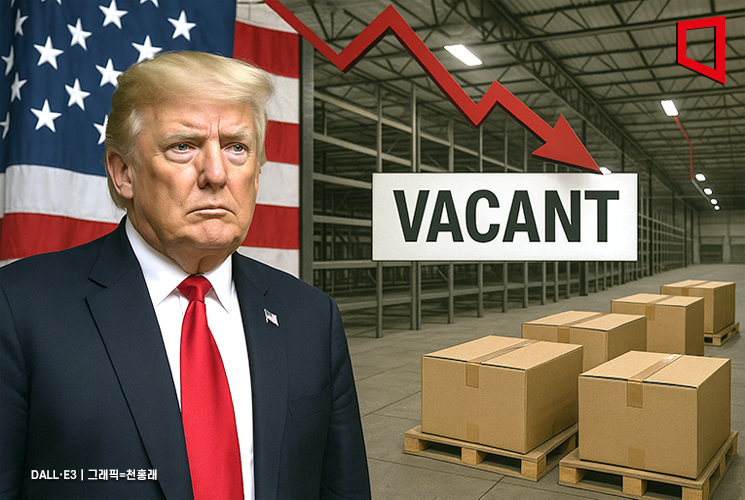
Uncertainty stemming from U.S. President Donald Trump's tariff policies has led to the highest warehouse vacancy rate in the United States in 11 years.
On July 9 (local time), the Wall Street Journal (WSJ) reported, citing a report from commercial real estate services firm Cushman & Wakefield, that the average warehouse vacancy rate across the United States in the second quarter reached 7.1%.
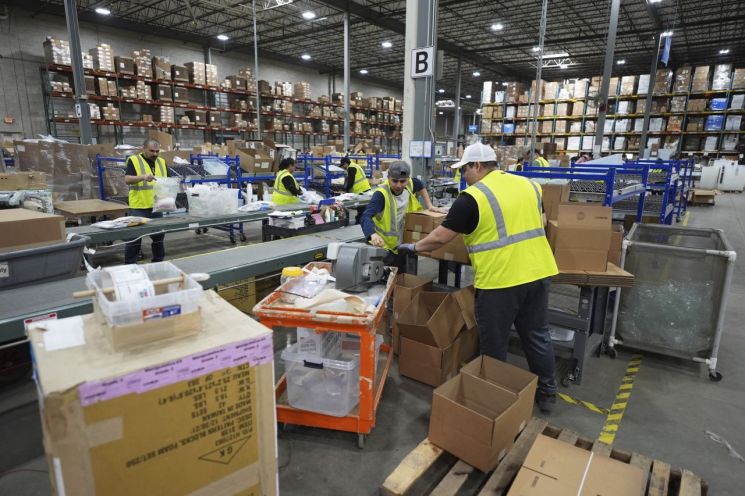
This figure is up from 6.9% in the previous quarter and 6.1% in the same period last year. It is the first time the vacancy rate has exceeded 7% since 2014. According to the WSJ, this is because repeated tariff announcements by the Trump administration prompted companies to halt new leasing decisions and instead fill existing warehouses with inventory.
Jason Tolliver, head of logistics and industrial real estate at Cushman, stated, "The market has shown unstable movements over the past three months." Companies responded by stockpiling inventory in anticipation of President Trump's tariffs, then reducing overseas orders and putting leasing decisions on hold once tariffs were announced. However, Tolliver added, "As the Trump administration has suspended or withdrawn some new tariffs, more companies have been touring warehouses over the past month."
The warehouse leasing industry has struggled with rising vacancy rates over the past three years, following an overheated period of warehouse construction and leasing during the COVID-19 pandemic, when vacancy rates fell below 3%. This is due to many warehouse tenants trying to reduce their space after the pandemic. According to real estate services firm Savills, in the second quarter, warehouse space listed for sublease in the United States reached a record 225 million square feet (about 20.9 million square meters), a 25% increase compared to the same period last year. Mark Russo, head of industrial research at Savills, explained that companies stored excess goods by utilizing their existing space rather than leasing new facilities.
With weakening demand, developers are reducing new warehouse construction. According to Cushman, new warehouse supply in the second quarter amounted to about 72 million square feet, a 45% decrease compared to the same period last year. In addition, the total warehouse inventory across the United States in the first half of this year increased by 19% compared to 2019, but new leasing during the same period decreased by 5%.
Despite the rising vacancy rate, rents continue to climb. According to Cushman, the overall net rent in the second quarter was $10.12 per square foot, approximately a 3% increase compared to the same period last year. The WSJ explained that this is due to the unique nature of the industrial real estate market, where decisions are based on long-term prospects rather than short-term market conditions.
© The Asia Business Daily(www.asiae.co.kr). All rights reserved.
![Clutching a Stolen Dior Bag, Saying "I Hate Being Poor but Real"... The Grotesque Con of a "Human Knockoff" [Slate]](https://cwcontent.asiae.co.kr/asiaresize/183/2026021902243444107_1771435474.jpg)
















