Identification of Electronic Properties in Chain Structures
Paving the Way for Quantum Research
Ajou University announced on the 11th that a joint research team led by Professor Seongheon Kim from the Department of Physics at Ajou University, Dr. Junghoon Hyun from KAIST, and Professor Yongkwan Kim from KAIST has successfully observed the phenomenon of spin-charge separation across the conductor-insulator transition in one-dimensional chain-structured materials.
 From the left, Seongheon Kim, Professor at Ajou University (corresponding author), Junghoon Hyun, PhD (first author), Yongkwan Kim, Professor at KAIST (corresponding author). Ajou University
The results of this study were published under the title "Band-selective spin-charge separation across the charge density wave transition in quasi-1D NbSe3" in a recent issue of
An electron is a fundamental particle with a negative charge that constitutes the atoms of matter. Electrons exhibit two representative properties: charge and spin. Charge is a fundamental property that enables the experience of electrical force and is the element that allows electricity to flow. Spin is a quantum mechanical property, akin to the electron spinning on its own axis, and it determines magnetic properties such as those found in magnets.
In one-dimensional metallic materials where electron-electron interactions are strong, it has been predicted that the movement of electrons can be explained by the Luttinger liquid model, unlike the conventional Fermi liquid model typically followed by electrons in materials. The Luttinger liquid model predicts the spin-charge separation phenomenon, in which the two representative properties of electrons?charge and spin?behave independently.
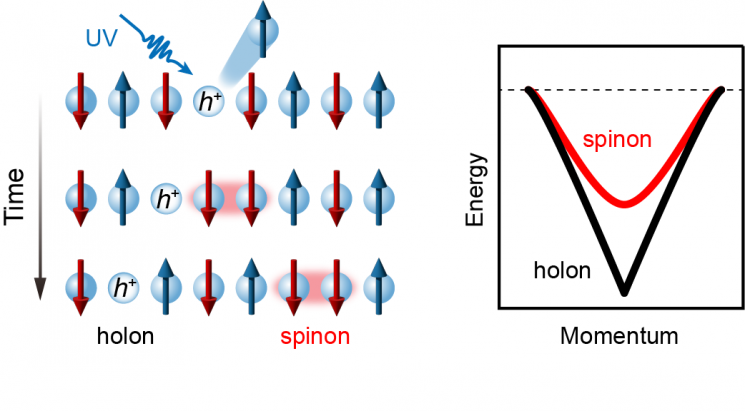 Schematic of spin-charge separation occurring during the emission of photoelectrons from one-dimensional metallic materials (left) and schematic of energy-momentum distribution of spin movement (Spinon) and positive charge movement (Holon) propagating at different speeds (right). Ajou University
This phenomenon not only provides clues for elucidating the non-Fermi liquid state that appears before the onset of superconductivity, but it is also attracting attention for its potential application as a quantum information material that can carry distinct spin and charge information.
Superconductivity refers to the phenomenon in which electrical resistance drops to zero, occurring under specific conditions such as extremely low temperatures below -240°C. Utilizing superconductors allows for the use of energy without power loss, making superconductivity and superconductors the focus of recent attention in both academia and industry.
Quantum information materials are materials used in quantum computers, communications, and sensors. Next-generation quantum technologies, which are based on the principles of quantum mechanics, can process larger amounts of information more rapidly and are expected to significantly enhance efficiency and productivity across various industries.
Experimental results of the energy-momentum distribution of photogenerated electrons in niobium (Nb)-selenium (Se) compound (NbSe3) according to temperature. The dotted lines represent the spectra of spin movement (red) and positive charge movement (black), respectively. As the temperature rises, the charge density wave gap closes, but the spin-charge separation phenomenon is observed to be maintained.
It is this "spin-charge separation phenomenon" that can provide new insights into various advanced fields. However, while theoretical predictions have offered solutions for electron behavior, direct observation of this phenomenon in actual materials has been extremely rare. Although spin-charge separation is predicted to arise from strong electron-electron interactions, these same "strong interactions" hinder the observation of spin information, making it difficult to obtain experimental evidence. In particular, it is challenging to realize an ideal one-dimensional electron system and to directly control the degree of electron-electron interaction, so experimental evidence for this phenomenon has so far been very limited.
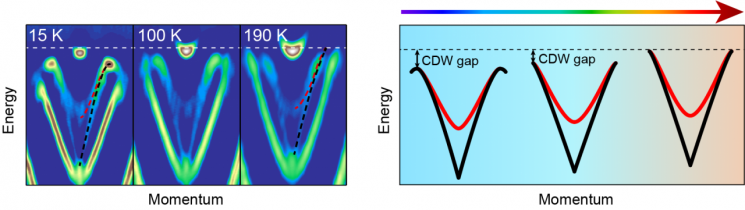 Experimental results of the energy-momentum distribution of photogenerated electrons in niobium (Nb)-selenium (Se) compound (NbSe3) according to temperature. The dotted lines represent the spectra of spin movement (red) and hole movement (black), respectively. As the temperature rises, the charge density wave gap closes, but the spin-charge separation phenomenon is observed to be maintained. Ajou University
To overcome these challenges, the Ajou University joint research team searched for candidate materials in which appropriate electron-electron interactions could exist. The team synthesized NbSe3 samples, a niobium (Nb)-selenium (Se) compound composed of three types of one-dimensional atomic chains, and succeeded in directly observing that spin and charge information propagate at different speeds through band structure analysis using angle-resolved photoemission spectroscopy. Angle-resolved photoemission spectroscopy is an experimental method that analyzes the kinetic energy and momentum of photoelectrons emitted when bright light is shone on a material, allowing for the observation of quantum phenomena occurring within the material.
The research team analyzed photoelectrons emitted when intense ultraviolet light, focused to a micrometer (μm, 1μm=0.001mm) scale, was irradiated at a synchrotron accelerator. Through this, they captured the distinct separation and movement of the positive charge movement (Holon) formed at the site where the photoelectron was emitted, and the spin movement (Spinon) resulting from the spin flips of each electron within the compound.
Furthermore, the team succeeded in observing the separation and independent movement of spin and electrons even during the process of the conductor-insulator transition induced by the charge density wave, another quantum phenomenon frequently observed in one-dimensional materials. Both spin-charge separation and charge density waves are characteristic quantum phenomena of one-dimensional electron systems that can appear before the onset of superconductivity, and further research into their interrelation is expected to provide important clues for elucidating the principles behind the emergence of superconductivity.
Professor Seongheon Kim (Department of Physics, Ajou University) stated, "This achievement is a direct observation of the collective behavior in which information on charge and spin is independently transmitted in the unique environment of one-dimensional materials. In the future, by further controlling the crystal structure or the strength of interactions, we may be able to find clues to the principles underlying the emergence of superconductivity."
Professor Kim added, "In addition to solving fundamental problems in physics, the development of new quantum information materials utilizing the independent degrees of freedom of charge and spin could further expand the scope of applications."
This research was supported by the Excellent Young Researcher Program of the National Research Foundation of Korea, the University Basic Research Laboratory (G-LAMP) Program, and the University Key Research Institute Program.
© The Asia Business Daily(www.asiae.co.kr). All rights reserved.
![Clutching a Stolen Dior Bag, Saying "I Hate Being Poor but Real"... The Grotesque Con of a "Human Knockoff" [Slate]](https://cwcontent.asiae.co.kr/asiaresize/183/2026021902243444107_1771435474.jpg)

















