Presidential Office: "Lee to Preside Over Full NSC Meeting"
Meeting Agenda: Security Briefing for the Second Half of the Year
Key Issues: South Korea-U.S. Security Topics Including Defense Cost-Sharing
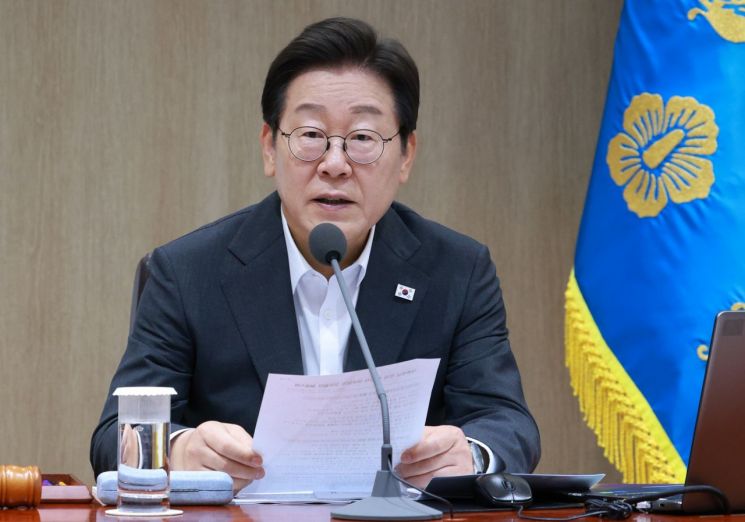
President Lee Jae Myung will preside over his first National Security Council (NSC) meeting since taking office on July 10. The entire meeting will be held behind closed doors, with a review of national security issues and response measures for the second half of the year on the agenda. In particular, it is expected that South Korea-U.S. security issues, such as the defense cost-sharing matter linked to the U.S. reciprocal tariffs issue, will be discussed.
The presidential office announced, "President Lee will preside over a full NSC meeting to receive reports on security-related affairs for the second half of the year," adding, "The meeting will be entirely closed to the public, with no opening remarks disclosed."
Although the specific topics to be discussed at the NSC have not been made public, it is possible that security issues connected to the South Korea-U.S. tariff negotiations will be reported, as National Security Advisor Wi Sung Rak returned from the United States on July 9. Advisor Wi visited the U.S. on July 6 and met with Secretary of State and National Security Advisor Marco Rubio, as well as Under Secretary of State Alexson Hooker. The primary objective was to resolve the issue of U.S. reciprocal tariffs scheduled for August 1, but Advisor Wi counter-proposed to bundle all security issues into the negotiations.
It is known that the U.S. side also agreed on the need for a comprehensive trade-security package consultation with South Korea. At a briefing at the Yongsan presidential office the previous day, Advisor Wi explained, "The issues we have raised with the U.S. so far cover trade, investment, procurement, and overall security," adding, "We proposed to advance the discussions by considering such a package comprehensively." He also conveyed, "Advisor Rubio expressed his agreement."
This suggests an intention to put all relevant issues on the table for negotiations with the U.S., aiming for a kind of 'give-and-take' approach. President Donald Trump is currently prioritizing the reciprocal tariffs issue, but if the negotiation agenda is limited to trade, South Korea would have few cards to play. In contrast, if South Korea presents its investments in the U.S., its record of purchasing American goods, and the value of the alliance in the Asia-Pacific region, the chances of resolving the tariff issue increase.
In particular, the presidential office is leaving open the possibility of increasing South Korea's share of defense costs. At a White House cabinet meeting on July 8 (local time), President Trump pointed out, "South Korea pays too little to the U.S. for the stationing of U.S. forces," and emphasized, "South Korea should bear its own defense costs." In this regard, Advisor Wi stated, "It is true that we are negotiating to increase overall defense and military spending in line with international trends," and stressed, "Our government already makes significant contributions, and there is room for those contributions to increase."
However, as the timing of a South Korea-U.S. summit has not been narrowed down this time either, it remains uncertain whether the issue will be resolved within this month. During his four-day, two-night visit to the U.S. starting July 6, Advisor Wi was unable to coordinate a specific date for a summit between the two leaders.
© The Asia Business Daily(www.asiae.co.kr). All rights reserved.
![Clutching a Stolen Dior Bag, Saying "I Hate Being Poor but Real"... The Grotesque Con of a "Human Knockoff" [Slate]](https://cwcontent.asiae.co.kr/asiaresize/183/2026021902243444107_1771435474.jpg)















