Pointing Out the Inability to Utilize U.S. Forces in Korea During a China Conflict Due to South Korean Opposition
Dan Caldwell, who previously served as the chief adviser to U.S. Secretary of Defense Pete Hegseth, has argued that the majority of U.S. ground combat forces currently stationed in South Korea?currently about 28,500 personnel?should be withdrawn, leaving only around 10,000 troops.
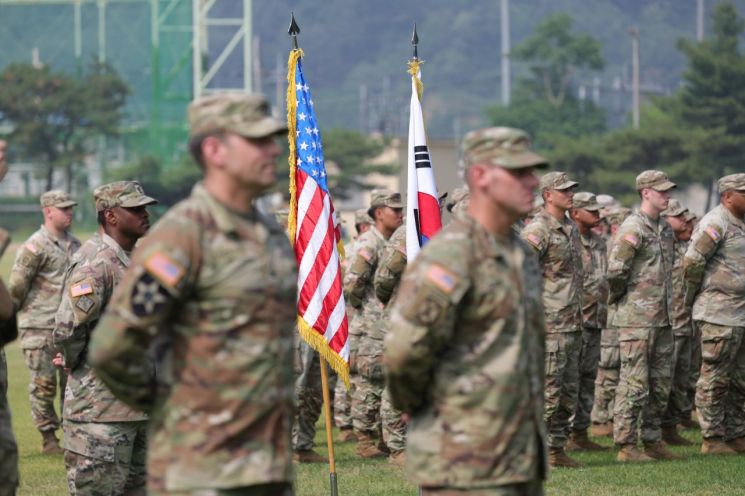
In a report released on July 9 (local time) with Jennifer Kavanagh, a senior fellow at the think tank Defense Priorities, Caldwell suggested that the U.S. military posture in East Asia should be restructured to contain China and protect U.S. national interests.
The authors stated, "We recommend reducing all ground combat units in South Korea that are not related to base defense, as well as some Army communications, intelligence, headquarters units, and certain support and sustainment units associated with these forces." They explained, "This would mean withdrawing most of the 2nd Infantry Division, including rotationally deployed Brigade Combat Teams (BCTs) and Army Combat Aviation Brigades, from the Korean Peninsula." They further added, "Additionally, the United States should relocate two combat aviation squadrons currently based in South Korea back to the U.S., thereby reducing the air power stationed in Korea." They noted that "about one-third of the aviation maintenance and other support units and personnel, along with the fighter jets, could also be returned to the U.S."
The authors explained that this would reduce the U.S. military presence in South Korea by more than 50%, leaving about 10,000 personnel and two combat aviation squadrons along with support units. They also recommended that, ultimately, the U.S. should further reduce its forces, withdrawing the remaining aviation squadrons and most ground forces.
One reason the authors cited for this realignment is that South Korea has not provided the U.S. with unrestricted access to bases in Korea in the event of conflicts elsewhere in the region outside the Korean Peninsula. They argued that, in the event of a regional war, U.S. forces based in Korea might not be available for use. This points to the likelihood that South Korea would oppose the involvement of U.S. Forces Korea in conflicts such as a potential clash with China in the Taiwan Strait.
The authors also argued that "free-riding by U.S. allies and partners remains a problem," stating, "Although South Korea spends more on defense than many other U.S. allies, it still relies on the U.S. for some key combat support capabilities." They asserted that the U.S. should require its regional allies?Japan, the Philippines, Taiwan, and South Korea?to take primary responsibility for their own security, with the U.S. providing support or playing a limited role. "The U.S. must adjust its military footprint," they emphasized.
The authors assessed that South Korea holds a significant conventional military advantage over North Korea and can effectively defend itself without U.S. support, either immediately or in the short term. They also argued that the current U.S. posture is too offensive-oriented and is positioned close to the Chinese border, which is more likely to provoke tensions rather than deter Chinese attacks. In the event of conflict, they warned, the survival prospects for U.S. personnel and assets would be low.
The authors stated that the U.S. military posture in Asia should aim for balance, not regional hegemony, and that maintaining U.S. dominance in Asia is becoming increasingly unrealistic given China's military buildup. However, they argued that it is possible for the U.S. to maintain a balance of power to block Chinese hegemony, and that at a minimum, Japan and the Philippines should retain their sovereignty and remain outside China's sphere of influence.
Regarding Taiwan, the authors noted that, as a small island, it cannot significantly alter the overall balance of power, so the U.S. does not need to directly defend Taiwan. For Japan, they recommended relocating 9,000 of the 26,000 U.S. troops stationed in Okinawa to Guam and the U.S., in line with an agreement already reached between the U.S. and Japanese governments in 2012. They did not recommend posture changes elsewhere in Japan, leaving about 45,000 troops stationed there.
The authors also argued for reductions of U.S. forces not only in Asia but also in Europe and the Middle East. In Europe, they said that Russia's conventional forces do not pose a threat to the U.S., and that European countries are free-riding on security. They recommended reducing the 90,000 U.S. ground troops currently in Europe to about 30,000, and halving both air and naval forces. If implemented, this would affect Germany, Italy, Spain, Poland, Romania, and the United Kingdom.
In the Middle East, the authors argued that the current deployment of 40,000 U.S. troops is excessive relative to U.S. interests in the region, and that maintaining such a presence exposes U.S. forces to insurgent attacks and risks unnecessary entanglement in conflicts. They recommended reducing the force to about 25,000 personnel.
Caldwell served as chief adviser to Secretary Hegseth but was dismissed from his position in April after becoming involved in the "Signal Gate" scandal, in which Secretary Hegseth and other senior diplomatic and security officials discussed Houthi airstrike plans in a civilian messenger chatroom. The U.S. Department of Defense is currently reviewing the global U.S. military posture and formulating the National Defense Strategy (NDS). Given Caldwell's previous close relationship with Secretary Hegseth, there is growing attention on whether the recommendations in this report will be reflected in actual policy.
© The Asia Business Daily(www.asiae.co.kr). All rights reserved.
![Clutching a Stolen Dior Bag, Saying "I Hate Being Poor but Real"... The Grotesque Con of a "Human Knockoff" [Slate]](https://cwcontent.asiae.co.kr/asiaresize/183/2026021902243444107_1771435474.jpg)















