Universities Compete to Attract International Talent Amid U.S. Restrictions on Foreign Students
Yonsei and Korea University Launch Transfer and Exchange Programs for International Students
As the U.S. government tightens visa screening, putting international students at risk of having to suspend their studies, major universities in South Korea are making all-out efforts to attract talented students.
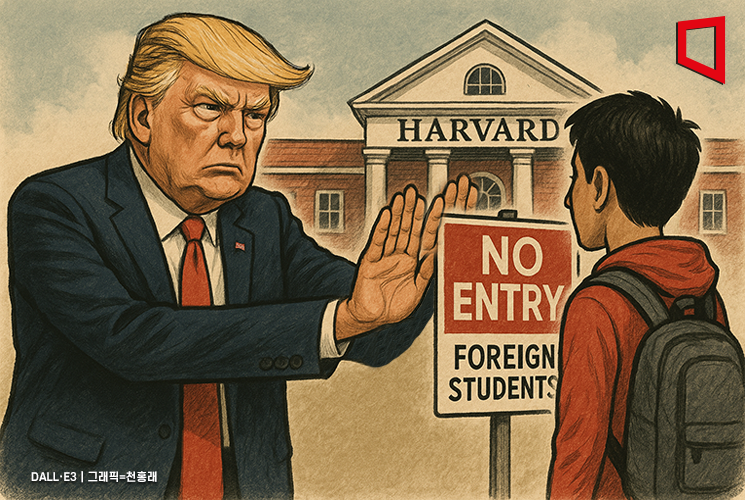
According to Yonsei University on July 11, the university will introduce a rolling admission system for undergraduate transfer students starting in the first semester of the 2026 academic year, targeting international students currently enrolled at U.S. universities. While transfer admissions are typically held in December, this new system is designed to allow U.S. university students whose studies have been suddenly interrupted to continue their education in Korea at any time.
Yonsei University will also introduce a customized exchange program for international students. The university is in discussions with U.S. universities to allow international students to take classes at Yonsei temporarily through exchange programs and to ensure that credits earned can be recognized when they return to their U.S. institutions.
For international graduate students, scholarships will be offered regardless of nationality. Last month, Yonsei University established the "Yonsei Foreign Student Companion Scholarship" to secure talented graduate students, providing scholarships to all international students enrolled in regular semesters at its graduate school.
Korea University is taking an even broader approach to attracting talent. The university plans to support transfer admissions not only for undergraduate students at U.S. universities but also for graduate students, with specific recruitment schedules currently under internal discussion. In addition, Korea University will support international students in continuing their studies in Korea through exchange programs and summer and winter sessions, and will ensure that credits earned can be recognized when students return to their U.S. universities.
The university is also seeking to recruit specialized research personnel. Korea University plans to hire outstanding international faculty from U.S. universities through special invitation and will provide them with settlement support programs, including housing. For postdoctoral researchers, the university will invite them as research-focused professors, enabling them to conduct research in collaboration with Korea University faculty.
The Korea Advanced Institute of Science and Technology (KAIST), Ulsan National Institute of Science and Technology (UNIST), Daegu Gyeongbuk Institute of Science and Technology (DGIST), and Gwangju Institute of Science and Technology (GIST) are working with the Ministry of Science and ICT to form the "INNOCORE Research Group," aiming to recruit 400 overseas postdoctoral researchers. To secure talent in AI convergence technologies?such as artificial intelligence (AI), bio, energy, and aerospace?the selected postdoctoral researchers will be guaranteed annual compensation of at least 90 million won and will receive additional support through corporate matching programs.
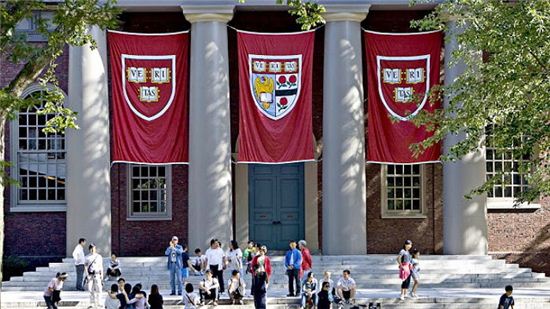 Harvard University
Photo by Getty Images Bank
The competition to attract international student talent is also underway overseas. The Hong Kong University of Science and Technology and the University of Hong Kong recently accepted 15 and 16 transfer students, respectively, including students from Harvard University. The Hong Kong University of Science and Technology has decided to offer benefits such as streamlined admissions procedures and credit recognition, while the University of Hong Kong is offering scholarships and other incentives.
Japan is preparing measures to recruit outstanding researchers leaving the United States. To this end, the country is discussing an emergency policy package worth at least 100 million yen (940 million won) and plans to establish support measures for accommodating and assisting international students from U.S. universities such as Harvard University.
The reason universities in various countries are making such efforts to secure international students and other talented individuals is largely due to the U.S. government’s restrictions on the entry of international students. As international students currently attending or planning to attend U.S. universities face the risk of having to suspend their studies, universities around the world are fiercely competing to recruit them.
In May, the U.S. government revoked Harvard University's Student and Exchange Visitor Program (SEVP) certification, effectively blocking international students. The reason cited was Harvard’s refusal to change its educational policies, including efforts to eradicate antisemitism. U.S. universities must obtain SEVP certification from the government in order to issue the "Certificate of Eligibility for Nonimmigrant Student Status (I-20)" required for student visa issuance. If the U.S. government cancels SEVP certification, international students can no longer remain in the country. As a result, newly admitted international students at Harvard are unable to enter the U.S., while current international students are subject to individual review.
Currently, the U.S. District Court in Massachusetts has accepted Harvard’s request for a preliminary injunction to suspend the effectiveness of the SEVP certification cancellation, allowing existing international students and foreign researchers at Harvard to maintain their current status. However, since the conflict between the U.S. government and Harvard has not yet been resolved, the outflow of talent from the United States is expected to continue.
© The Asia Business Daily(www.asiae.co.kr). All rights reserved.
![Clutching a Stolen Dior Bag, Saying "I Hate Being Poor but Real"... The Grotesque Con of a "Human Knockoff" [Slate]](https://cwcontent.asiae.co.kr/asiaresize/183/2026021902243444107_1771435474.jpg)















