Lecture Series at the National Museum of Korea on the 16th
Highlighting the Beauty in Japanese Art
Introduction to the Simple Tea Ceremony, "Wabi-cha"
Exploring the Sentiment of Sorrow and Melancholy, "Aware"
The National Museum of Korea announced on July 9 that it will hold a special lecture series in conjunction with the exhibition "Japanese Art: Four Perspectives" at the museum's small auditorium on July 16 at 1:30 p.m. This exhibition, co-hosted with the Tokyo National Museum to commemorate the 60th anniversary of the normalization of diplomatic relations between Korea and Japan, highlights the diverse beauty found in Japanese art through four perspectives: ornamentation, restraint, emotion, and playfulness.
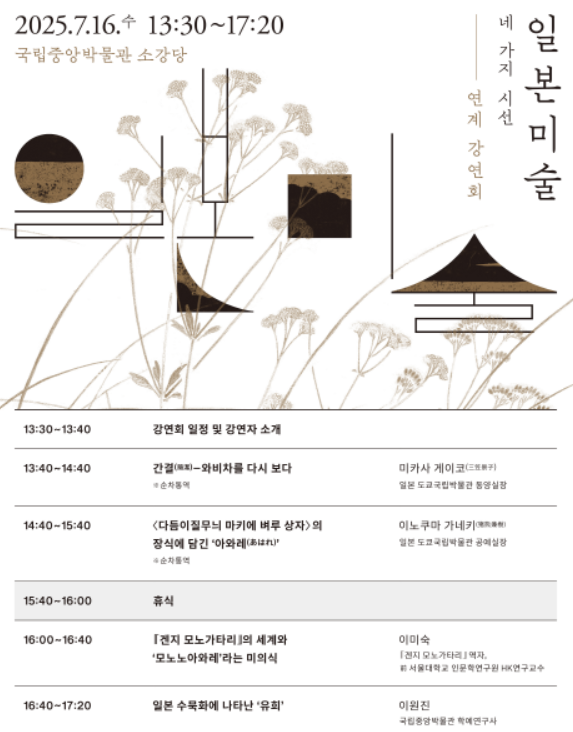
The lecture series will cover four topics in total. The first lecture, delivered by Mikasa Keiko, Head of the Asian Gallery at the Tokyo National Museum and a ceramics historian, is titled "Simplicity: Revisiting Wabi-cha." She will explain the Japanese tea ceremony and the concept of "wabi-cha," examining the relationship between the rough, rustic tea utensils featured in the exhibition and the minimalist Japanese tea ceremony known as "wabi-cha."
The second lecture will be given by Inokuma Kaneki, Head of the Crafts Gallery at the Tokyo National Museum and an expert in Japanese court culture and lacquerware, under the theme "The Awareness in the Decoration of a Makie Ironing-Pattern Inkstone Box." Focusing on the "Makie Ironing-Pattern Inkstone Box" (a Tokyo National Museum collection and an Important Cultural Property of Japan) featured in the third section of the exhibition, the lecture will shed light on the sentiment of "aware" as it appears in various forms in Japanese art. "Aware" is a term derived from an exclamation expressing awe, referring to the emotion of being moved by beauty while also feeling a sense of longing and melancholy when contemplating nature.
The third lecture will be presented by Lee Misook, former HK Research Professor at the Institute of Humanities, Seoul National University, who is a researcher and translator of "The Tale of Genji." Titled "The World of The Tale of Genji and the Aesthetic of Mono no Aware," the lecture will explore the concept of "aware" as found not only in artworks but also in classical Japanese literature such as "The Tale of Genji."
The fourth lecture will focus on "Playfulness in Japanese Ink Paintings." Lee Wonjin, curator at the National Museum of Korea and a researcher of ink painting from the Japanese Muromachi period (1392?1573), will examine the playfulness in Japanese ink paintings, centering on works by Ito Jakuchu (1716?1800) and Nagasawa Rosetsu (1754?1799) featured in the exhibition's fourth section, "The Playfulness of Life."
The lecture series is open to everyone without reservation. It will also be broadcast live on the National Museum of Korea's YouTube channel.
© The Asia Business Daily(www.asiae.co.kr). All rights reserved.
![Clutching a Stolen Dior Bag, Saying "I Hate Being Poor but Real"... The Grotesque Con of a "Human Knockoff" [Slate]](https://cwcontent.asiae.co.kr/asiaresize/183/2026021902243444107_1771435474.jpg)















