Lee Donghwan Announces 'G-Nomics Five-Year Plan' to Mark Three Years as Mayor of Goyang
Jump, AI, Mobility, Culture, and Eco... Launching the Era of the Five G-Nomics Strategies
Transforming Goyang into a 'Jump-Up Belt' for 1,000 Startups and Pre-Unicorn Companies
Lee Donghwan, mayor of Goyang Special City, unveiled the 'G-Nomics Five-Year Plan' to mark the third anniversary of the 8th local government term, presenting a blueprint to transform Goyang into an industry-driven city. Centered on five key strategies?Jump, AI, Mobility, Culture, and Eco?the plan aims to reorganize all of Goyang into an industrial belt and turn it into a future-oriented advanced city.
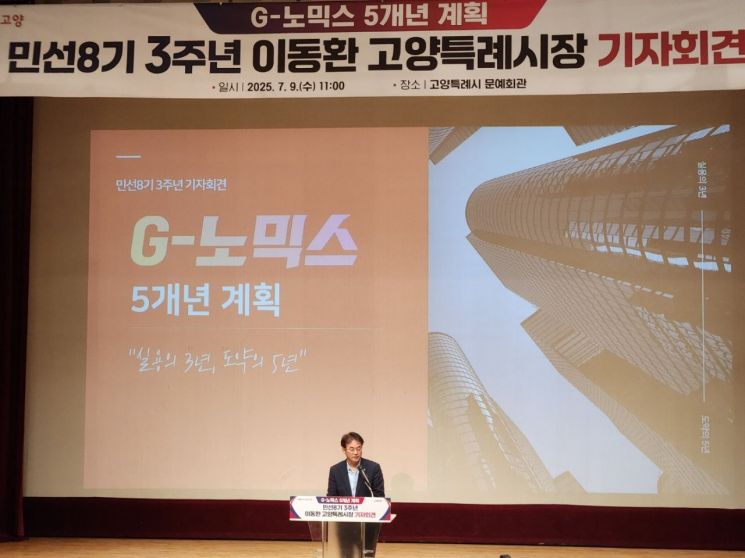 Lee Donghwan, mayor of Goyang Special City, is announcing the 'G-Nomics Five-Year Plan' on the 9th to mark the third anniversary of the 8th local government term. Photo by Lee Jonggu
At a press conference on the 9th, Mayor Lee stated, "It is now time for industry, not housing, to lead the city," and explained, "To drive urban growth, we have focused on restraining residential development and restructuring the framework of industry, ecology, and transportation."
He diagnosed that over the past decade, the approval of around 2,100 apartment complexes and 77 officetels had led to severe urban congestion and stagnation. In contrast, since the start of the 8th local government term, the number of residential permits has been drastically reduced to just 35 apartment complexes and one officetel.
Efforts to restructure the city's framework in terms of industry, transportation, and ecology have accelerated.
Construction began on KINTEX Exhibition Center 3 and Ilsan Techno Valley, railway networks such as GTX, the Seohae Line, and the Gyeongui Line have been expanded, and ecological restoration projects for Changneungcheon and Gongneungcheon are now in full swing. New strategic zones have also been designated, including the Education Development Special Zone, Venture Business Promotion District, and Mini Hydrogen City.
The city's fiscal policy has also shifted. Instead of distributing populist budgets to everyone, resources are now strategically focused where they are most needed. Through public contests, the city has secured 470 billion won in national and provincial funding.
The administrative approach has also become more practical. Over the past three years, Mayor Lee has personally visited each district more than 130 times to meet with citizens directly, resolving or processing 78% of the 435 civil complaints received on-site. The 'Direct Complaint Day' initiative and on-site visits have been significantly expanded. Citizen satisfaction with municipal administration rose from 61.8% in the first year of the 8th local government term to 77.4% this year.
Mayor Lee emphasized that now is the "critical build-up period" that will determine Goyang's future.
The 'G-Nomics' initiative being pursued by Goyang City consists of Jumpnomics, AInomics, Mobilinomics, Festanomics, and Economics. Mayor Lee plans to reorganize Goyang into a Blue Zone (advanced industry), Red Zone (residential), and Green Zone (ecology and future industry), and to use this as a foundation for building a full-fledged industrial ecosystem in the city.
First, the 'Jumpnomics' strategy will be fully launched, enabling the city and businesses to leap forward together. The entire city will be developed as a 'Jump-Up Belt' to foster 1,000 startups and pre-unicorn companies. The strategy is to encourage companies to keep their headquarters in Seoul but relocate their R&D centers and new business divisions?referred to as 'future headquarters'?to Goyang.
The Venture Business Promotion District, which will serve as the foundation for this, was designated last year as the first in northern Gyeonggi Province. In just six months, the number of resident companies increased by 8%, and more than 1,000 new jobs were created, demonstrating tangible results.
Through 'Jumpnomics,' Goyang aims to establish a 'Jump-Up Belt' throughout the city and nurture 1,000 startups and pre-unicorn companies. The city is pursuing a flexible approach to attracting companies by having their headquarters remain in Seoul while drawing their R&D and new business divisions to Goyang.
The Free Economic Zone, targeting the Songpo, Gajwa, Janghang, and Daehwa areas, will complete consultations and reviews with the Ministry of Industry within this year, with the goal of designation in the first half of next year. Although the area has been reduced from the initial plan of 9.4 million pyeong, Mayor Lee stated, "We will prioritize speed over size and proceed in stages."
The Daegok Station area is set to be designated as a district in 2026 and to begin occupancy in 2031, becoming a Silicon Valley-style hub for convergence of advanced industries such as AI, content, and big tech. The plan to create a 'Northwest Mega Cluster' connecting Goyang, Gimpo, and Paju is also underway.
In addition, under the AInomics strategy, the city will establish an 'AI Plus Hub' that integrates specialized industries such as robotics, healthcare, and logistics with AI. The Seongsa Innovation District will house an AI campus and a robotics center, and a digital twin-based smart city will be completed across the downtown area within the year.
Under the 'Mobilinomics' strategy, where mobility itself becomes industry, Goyang aims to become a leading city for testing next-generation transportation technologies such as autonomous driving, drones, and UAM. Mayor Lee emphasized, "Seoul lacks space, and provincial areas lack infrastructure. Goyang has both, making it the ideal testbed for transportation innovation."
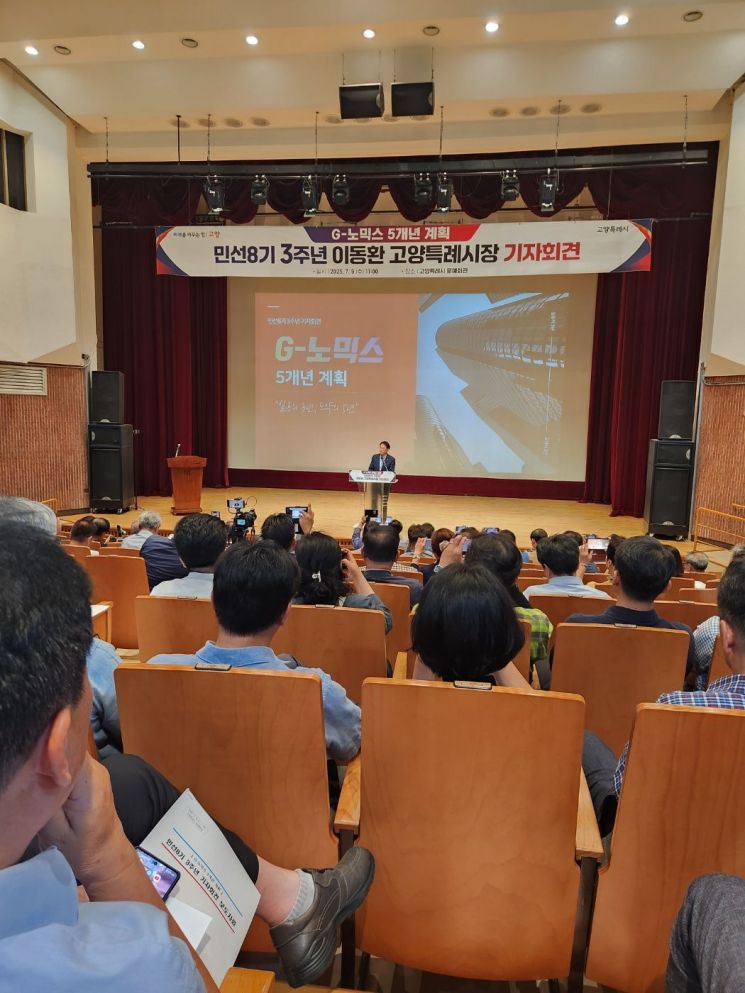 Lee Donghwan, mayor of Goyang Special City, is announcing the 'G-Nomics Five-Year Plan' on the 9th to mark the third anniversary of the 8th local government term. Photo by Lee Jonggu
By 2027, Goyang will establish the first smart logistics demonstration city in the Seoul metropolitan area, where robots will handle everything from shipping to delivery. Next year, an aerial route between KINTEX and Gimpo Airport will open, and core UAM infrastructure such as vertiports, maintenance facilities, and drone clusters will be developed. The city is also accelerating the realization of a "three-zero traffic city"?with no congestion, no waiting, and no waste?through autonomous buses, smart intersections, and AI-based traffic management systems.
Festanomics is a strategy to industrialize Goyang's cultural infrastructure, including performances, exhibitions, broadcasting, and sports. The city converted Goyang Sports Complex into a large-scale performance venue, attracting 690,000 visitors over the past year.
Furthermore, with the sequential completion of the Broadcasting and Video Valley in 2026, the IP Convergence Content Cluster in 2027, KINTEX Exhibition Center 3 and the anchor hotel in 2028, and the arena in 2029, Goyang will emerge as a "showroom city where experiences are bought and sold" and a "Korean-style studio city."
The 'Economics' strategy is also being fully implemented. The 'Blue Network' connecting Changneungcheon, Gongneungcheon, the Han River estuary, and Janghang Wetlands is Goyang's unique ecological asset. The city plans to link these into a 'Blue Triangle' and restore urban and natural environments through the 'Green Space 100 Project' and a '5-Minute View System,' which allows residents to experience Goyang's scenery within five minutes. In addition, Goyang will establish the first hydrogen production base in northern Gyeonggi Province and a distributed energy special district (JDS District) to expand the foundation of an eco-friendly future city.
Mayor Lee pointed out, "It is a recurring pattern for stages to be rented in Goyang while consumption occurs in Seoul. To promote stay-type tourism, hotel supply is essential, but the key S2 site sale is currently blocked by the city council's opposition." He added, "For the future of Goyang, we will steadily lay the groundwork to supply 10,000 hotel rooms in the long term."
© The Asia Business Daily(www.asiae.co.kr). All rights reserved.
![Clutching a Stolen Dior Bag, Saying "I Hate Being Poor but Real"... The Grotesque Con of a "Human Knockoff" [Slate]](https://cwcontent.asiae.co.kr/asiaresize/183/2026021902243444107_1771435474.jpg)
















