Rural Development Administration Secures 944,670 Peach Genetic Data Points
Full-Scale Digital Breeding Initiative to Accelerate Development of New Peach Varieties
The Rural Development Administration is set to launch a full-scale initiative to develop new peach varieties based on big data of peach genetic information.
On July 9, the Rural Development Administration announced that it will actively introduce digital breeding technology into peach development in order to enhance the efficiency of domestic peach breeding and to bring a greater variety of cultivars to the market.
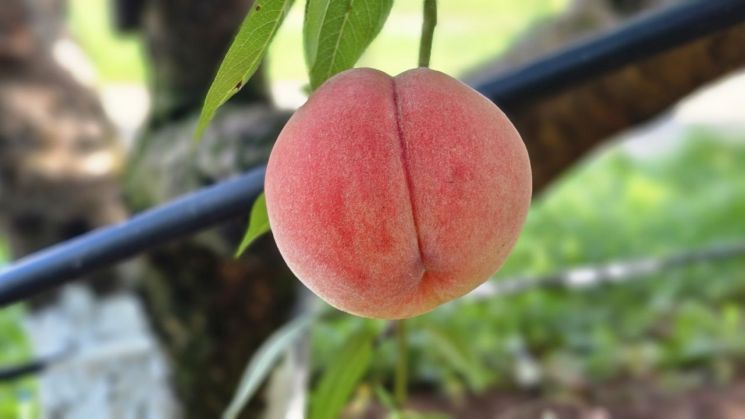
Unlike traditional breeding, which involves direct cultivation, observation, and selection by humans, digital breeding is a data-driven breeding method that integrates biotechnology with big data technology.
To implement digital breeding, researchers decoded the genomes of 445 peach genetic resources preserved in-house from 2021 to 2023 and secured 944,670 genetic data points. By combining this genetic information with fruit trait evaluation data, they selected a core group of 150 peach accessions that represent the 445 genetic resources. The Rural Development Administration explained that this core group serves as a valuable source for generating high-quality big data, holding significant academic and practical value.
In addition, during the genome decoding process, the researchers developed a total of two molecular markers: one for distinguishing fruit shape and another for identifying the presence or absence of fuzz. Molecular markers are indicators that allow for rapid and accurate identification of genetic characteristics in plants. When applied to breeding, these markers enable the analysis of genotype information from the leaves of young trees, allowing early determination of whether the fruit will be round or flat, and whether it will have fuzz or not. For example, in the past, 1,000 trees had to be planted and only after 3 to 4 years, when the trees bore fruit, could flat-shaped individuals be selected. With the newly developed molecular markers, only 500 trees need to be planted, as those likely to produce flat peaches can be selected at an early stage. This reduces both the ancillary costs and the labor time required for breeding by half.
The Rural Development Administration has completed the patent application for the fruit shape molecular marker and is preparing to file for the fuzz-related molecular marker. Looking ahead, the agency also plans to develop molecular markers related to fruit acidity, which is a key concern for consumers, and to fruit ripening time, in preparation for abnormal climate conditions.
Kim Myungsoo, Director of the National Institute of Horticultural and Herbal Science at the Rural Development Administration, stated, "Digital breeding technology will serve as an important turning point in effectively transforming the peach variety development system in Korea. We expect that as the use of molecular markers associated with various traits in the peach core group expands, not only will the market be invigorated with an increase in unique varieties, but both producers and consumers will enjoy a much wider range of choices."
© The Asia Business Daily(www.asiae.co.kr). All rights reserved.
![Clutching a Stolen Dior Bag, Saying "I Hate Being Poor but Real"... The Grotesque Con of a "Human Knockoff" [Slate]](https://cwcontent.asiae.co.kr/asiaresize/183/2026021902243444107_1771435474.jpg)















