Linked Rapid Integrated Plans for Five Sites
Infrastructure for Three Generations
Plans for Child and Senior Care Facilities
Strengthening East-West Regional Connectivity
The Doksan and Siheung-dong area, which once served as the residential base for the former Guro Industrial Complex, will be transformed into a three-generation residential complex where children and parents can live together.
On July 9, Seoul City announced that it is formulating and implementing a rapid integrated plan, starting with the Siheung-dong 810 area along Doksan-ro and connecting a total of five sites, including the eastern side of Siheung-daero and the Doksan-ro area. The purpose is to resolve development imbalances within the region by upgrading infrastructure such as roads and expanding urban vitality from the west to the east, thereby strengthening connections between the eastern and western parts of the area.
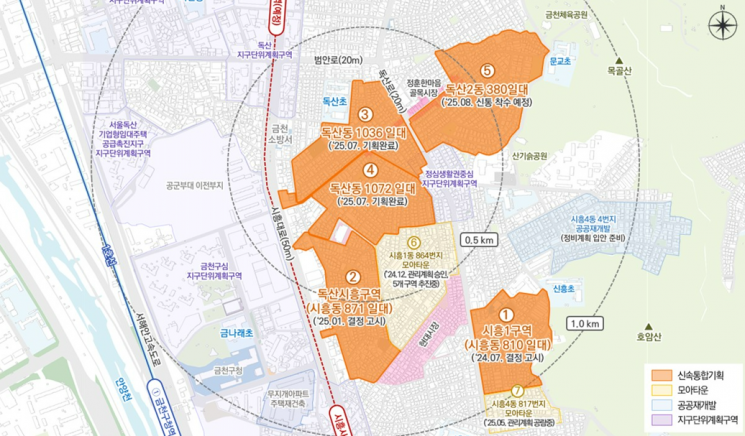
The Doksan and Siheung-dong area on the eastern side of Siheung-daero consists of aging low-rise residential neighborhoods that have experienced prolonged development stagnation. Residents have long complained about poor living conditions due to a lack of infrastructure such as roads, parks, and parking lots. Additionally, as the urban structure has formed around the north-south axes of Siheung-daero and Doksan-ro, there has been a disconnect between east and west, with development concentrated on the western side.
In response, this month the city finalized rapid integrated plans for two areas?Doksan-dong 1036 and 1072?and announced an integrated development plan covering approximately 320,000 square meters (four sites, around 7,300 households) in the vicinity. Once the rapid integrated planning for Doksan-dong 380 begins in earnest in the second half of this year, a structural transformation is expected across the entire urban area spanning about 440,000 square meters from the eastern side of Siheung-daero to the Doksan-ro area.
First, in the Doksan-dong 1036 and 1072 areas, the city will actively expand infrastructure by simultaneously advancing rapid integrated plans for the two adjacent sites. A new east-west road connecting Siheung-daero and Doksan-ro will be established to supplement the existing north-south traffic system and dramatically improve local mobility. In addition, surrounding roads with widths of 4 to 6 meters will be widened, and pedestrian and vehicle lanes will be separated to greatly enhance local transportation convenience.
Living infrastructure to accommodate three generations?parents and children?will also be created. To address the challenges of a low birthrate and an aging society, the city has planned child welfare facilities and senior care centers, envisioning a "three-generation residential complex" where parents and children can enjoy life together. The existing park adjacent to Doksan Elementary School will be expanded into a school park, and new parks will be distributed to address areas lacking green space. Child and senior welfare facilities will be strategically located for convenience and accessibility, with social welfare facilities planned for the southern part of the site at Siheung-dong 871 and in connection with the Doksan 2-dong Community Center.
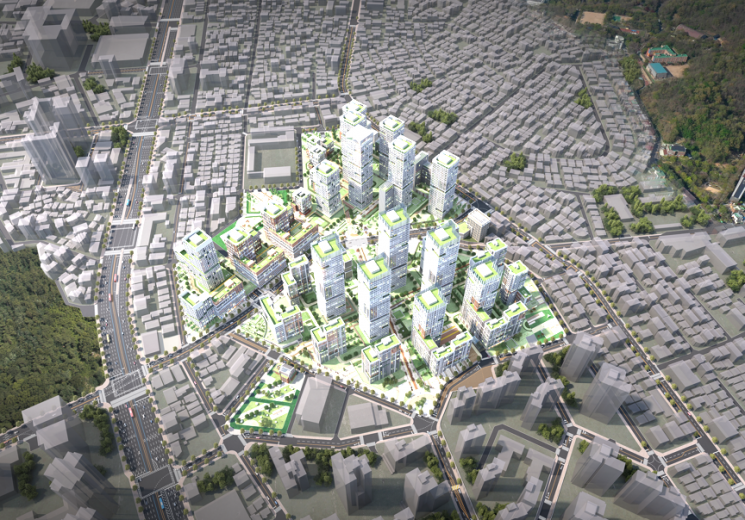
To ensure that existing pedestrian routes, such as school routes and commuting paths, remain uninterrupted, public walkways, sidewalks, and wide crosswalks will be appropriately installed. Elevators and ramps will be added to areas with slopes or level differences, ensuring safe movement for those with mobility challenges.
To enhance the urban landscape, an open view corridor will be secured from Siheung-daero through Doksan-ro to Mokgol Mountain, and a skyline that harmonizes with schools, residential areas, and adjacent development sites will be planned. The city also aims to secure a view corridor overlooking Mokgol Mountain by linking the new east-west road from Siheung-daero to Doksan-ro with public walkways. The central part of the complex will feature high-rise buildings of up to approximately 40 stories, while mid- to low-rise buildings will be located near schools and along main streets, creating a customized skyline for each area.
For smooth urban renewal, the city will upgrade the land use zoning of the target sites by up to two levels (from Class 2, 7-story residential to Class 3 residential) and apply a flexible height plan of up to 40 stories. In addition, the city will use the project feasibility adjustment coefficient from the 2030 Seoul City Urban and Residential Environment Improvement Master Plan to ensure project viability. For the Doksan-dong 1036 and Doksan-ro 1072 areas, the city aims to designate the zones within this year through the "Redevelopment Processing Deadline System," which requires a resident review process within two months after the completion of the rapid integrated plan.
Cho Namjun, head of the Seoul City Urban Space Headquarters, stated, "From the initial planning stages, the Doksan and Siheung-dong area has focused on expanding infrastructure at the living zone level and establishing a region-specific integrated renewal plan. We will actively support subsequent procedures so that residents, who have endured inconvenience due to long-term development neglect, can directly experience the remarkable urban transformation brought about by the rapid integrated plan."
© The Asia Business Daily(www.asiae.co.kr). All rights reserved.
![Clutching a Stolen Dior Bag, Saying "I Hate Being Poor but Real"... The Grotesque Con of a "Human Knockoff" [Slate]](https://cwcontent.asiae.co.kr/asiaresize/183/2026021902243444107_1771435474.jpg)

















