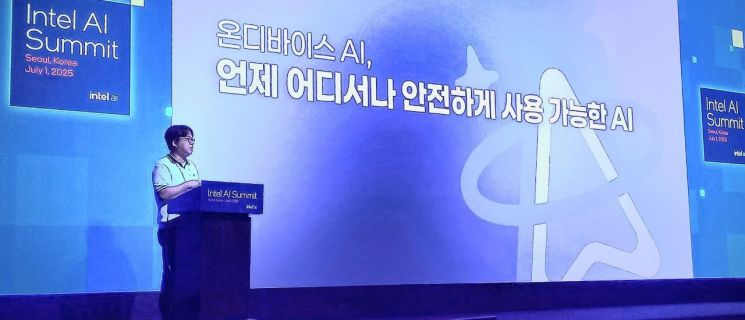
 Vice President Lee Haeseok of Polaris Office presenting at the 2025 Intel AI Summit Seoul. Polaris Office
Polaris Office has unveiled its next-generation strategy to secure leadership in the global artificial intelligence (AI) document market.
At the "Intel AI Summit 2025" held on July 1, Lee Haeseok, Vice President (COO and CAIO) of Polaris Office, took the stage under the theme "AX Innovation with Document-Based AI: Breaking the Boundaries of Job Roles." He presented the company's on-device AI strategy and outlined a concrete roadmap for entering the global OEM market.
Founded in 1997, Polaris Office is a leading domestic cloud-based service (SaaS) company that has grown in the global document software sector for 28 years. The company's "Polaris Office" solution boasts 140 million users worldwide, with 73% of them being overseas users, demonstrating its technological competitiveness in the global market.
Earlier this year, Polaris Office was recognized for its technological excellence by winning the AI Innovation Award at "CES 2025," the world's largest IT exhibition. At the recent event, the company announced the launch of "AI Nova (NOVA)," which features enhanced generative AI capabilities, and an on-device AI solution for Windows that operates without an internet connection, drawing significant attention from attendees.
Vice President Lee Haeseok emphasized, "AI has now become more than a simple auxiliary tool; it is entering an era where it serves as a core member of the team," adding, "AI will play a central role across various tasks, transcending the boundaries of traditional job roles."
The "AI Nova (NOVA)" introduced by the company is an AI agent that provides a variety of features, including real-time meeting transcription, document Q&A, presentations via AI avatars, image generation and editing, and document translation. The integration of multiple AI models has dramatically improved both the efficiency and creativity of document-related tasks.
Another key strategy announced at the event was "on-device AI." Polaris Office revealed its plans to actively enter the OEM (original equipment manufacturer) PC market through on-device AI technology. In collaboration with Intel's AI Assistant Builder (AAB) platform, the company is developing a document AI platform that operates independently of internet connectivity and continues to function even when the network is disconnected.
To achieve this, Polaris Office is working with Intel's AI Assistant Builder (AAB) platform to develop a document AI agent based on a lightweight language model (SLM) optimized for Intel CPU environments.
This technology is attracting significant interest, particularly from public institutions and enterprise markets where data security and internal network operations are essential. On-device AI can implement key features of traditional cloud AI?such as document search, summarization, and chart generation?even in personal PC environments, making it highly promising for rapid adoption in terms of data sovereignty and cost predictability.
Vice President Lee stated, "We plan to launch the on-device AI product within this year," and added, "AI technology is no longer a choice but a critical factor for corporate survival."
He continued, "Building on the software expertise that originated with our predecessor, Hunminjeongeum SW, Polaris Office will lead the global AI document market with the pride of a homegrown company."
Meanwhile, Polaris Office plans to accelerate its push into the enterprise market through collaborations with SLM development companies. In fact, the company has signed memorandums of understanding (MOUs) with kt cloud, Saltlux, Naver Cloud, LG AI Research, and Upstage to pursue technological cooperation and market expansion.
© The Asia Business Daily(www.asiae.co.kr). All rights reserved.
![Clutching a Stolen Dior Bag, Saying "I Hate Being Poor but Real"... The Grotesque Con of a "Human Knockoff" [Slate]](https://cwcontent.asiae.co.kr/asiaresize/183/2026021902243444107_1771435474.jpg)















