Hyundai Motor Group struggled in the U.S. electric vehicle (EV) market during the first half of this year. Analysts attribute the drop in market share rankings to weakened price competitiveness and a shift in consumer preference toward latecomer brands.
According to the Korea Automobile & Mobility Association (KAMA) and other sources on July 9, Hyundai and Kia’s combined market share in the U.S. EV market from January to June was 7.6%, ranking third after Tesla (42.5%) and General Motors (13.3%). This represents a 3.4 percentage point decrease from 11% in the first half of last year, resulting in a one-rank drop in market share standings. This is the first time in three years that Hyundai and Kia have fallen from their No. 2 position, which they first achieved in 2022. Previously, Hyundai and Kia jumped from fourth place (4.1%) in 2021 to second place (10.4%) in 2022 and had maintained the No. 2 spot in the first half of each year since then.

This ranking drop is due to a slowdown in Hyundai and Kia’s EV sales growth in the U.S. this year. In the first half of 2025, Hyundai and Kia sold 44,555 EVs in the U.S., a 28% decrease from the same period last year. Hyundai sold 30,988 units, down 4.6%, while Kia saw a sharp 53.8% decline to 13,567 units. During the same period, total U.S. EV sales increased by 5.2%, from 560,198 to 589,066 units, making Hyundai and Kia’s negative growth stand out even more.
This decrease in U.S. EV sales marks the first such decline since Hyundai Motor Group began its electrification strategy in 2021. Hyundai and Kia’s U.S. EV sales in the first half of each year had shown steady growth: 8,262 units in 2021, 34,517 in 2022, 38,457 in 2023, and 61,883 last year. The strong momentum continued through the second half of 2024, with a record annual total of 123,861 units sold.
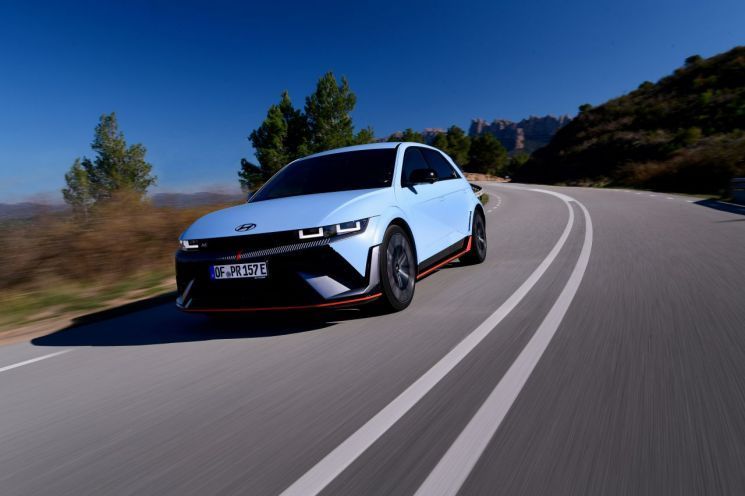
The lackluster performance of Hyundai and Kia in the U.S. EV market is partly attributed to incentive policies. An industry insider explained, "Until now, Hyundai and Kia have pursued a mass sales strategy through leasing and rental car channels, but with the expansion of local production, they are now focusing on direct consumer sales. In this process, sales incentives have declined, which may have reduced price competitiveness from the consumer’s perspective."
Another analysis points to changing consumer preferences due to the emergence of latecomer brands. Hyundai Motor Group has released the Hyundai Ioniq and Kia EV series based on its dedicated E-GMP EV platform, but latecomers such as GM have improved their product offerings by learning from the leading brands. In fact, GM recorded a 103.8% year-on-year increase in sales in the first half of this year, selling 78,167 units, led by the value-oriented Chevrolet Equinox.
However, some analysts note that Hyundai and Kia are offsetting the decline in EV sales with strong hybrid electric vehicle (HEV) sales, maintaining their medium- to long-term competitiveness in eco-friendly vehicles. In the first half of this year, Hyundai and Kia’s HEV sales rose by 45.3% to 136,180 units. Total eco-friendly vehicle sales, including HEVs, reached an all-time high of 180,715 units.
© The Asia Business Daily(www.asiae.co.kr). All rights reserved.
![Clutching a Stolen Dior Bag, Saying "I Hate Being Poor but Real"... The Grotesque Con of a "Human Knockoff" [Slate]](https://cwcontent.asiae.co.kr/asiaresize/183/2026021902243444107_1771435474.jpg)

















