Rumors of Major Earthquakes in Japan and Fierce Price Wars Drive Down Fares
LCCs Must Monitor Financial Risks Such as Capital Increases
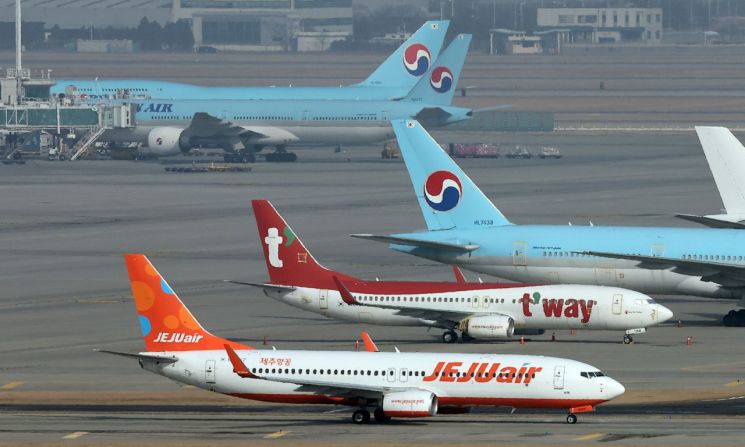
On July 9, Korea Investment & Securities released a report titled "LCCs Have More to Worry About This Summer," analyzing that domestic low-cost carriers (LCCs) are facing financial risks this summer despite the peak travel season, due to declining fares. The firm maintained a "neutral" outlook on the airline sector.
In June, which is traditionally an off-peak season falling between the May golden holiday and the July-August summer vacation period, international passenger traffic increased by only 5% year-on-year. Domestic passenger traffic continued to decline for the tenth consecutive month. The market share of international routes held by domestic LCCs fell by only 1 percentage point compared to the previous year. However, the widening gap in fares between LCCs and Korean Air has become a significant issue. While Korean Air's passenger business profit for the second quarter is estimated to have improved compared to the previous quarter, LCCs are expected to post large deficits.
Since May, the travel consumer sentiment index has rebounded, and the burden of fuel surcharges has dropped to its lowest level in four years. However, prices for airline tickets to Japan have recently fallen much more than expected. For LCCs, ticket prices for Japan routes in July have dropped to around 200,000 won. As LCCs significantly lowered fares in the process of overcoming the aftermath of the Jeju Air accident, these low prices have become entrenched and have not recovered even during the peak season. Moreover, with domestic consumption slowing and demand for overseas travel weakening, concerns over major earthquakes in Japan are making travel demand even more sensitive.
Choi Gowoon, an analyst at Korea Investment & Securities, stated, "Unlike in the past, the benefits of falling oil prices, exchange rates, and the summer peak season are no longer intuitive," adding, "LCCs are facing a fundamental weakening of their demand base, so in the second half of the year, they should pay more attention to financial risks, such as capital increases, rather than expecting a turnaround." She also noted, "The dominance of Korean Air and its subsidiary LCC Jin Air is becoming even more solidified. Although a decline in profits is inevitable this year due to rising costs, considering the worsening profitability and expansion challenges faced by competitors, the market dominance of Korean Air and Jin Air needs to be reassessed."
© The Asia Business Daily(www.asiae.co.kr). All rights reserved.
![Clutching a Stolen Dior Bag, Saying "I Hate Being Poor but Real"... The Grotesque Con of a "Human Knockoff" [Slate]](https://cwcontent.asiae.co.kr/asiaresize/183/2026021902243444107_1771435474.jpg)















