Revised Commercial Act Passed by National Assembly
Securing Just 4% Stake Allows Attempt to Appoint Audit Committee Members
Minority Shareholders Can Now Exert Influence
Potential for Abuse in Technology Theft
Concerns Over a Repeat of the 2005 SsangYong Motor Incident
Calls for Introduction of Management Rights Defense Measures
A leading domestic company, Company A, known for its advanced technology in semiconductor cleaning processes, was recently acquired by Chinese capital. Facing financial difficulties, Company A sold a significant portion of its shares to a Singaporean entity owned by a Chinese parent company. As this entity became the largest shareholder, it now has a direct influence on management rights. Such cases have reportedly become increasingly frequent. Industry insiders are expressing growing concern that, through these acquisitions, Chinese interests may attempt to secure core technologies by establishing research institutes or dispatching personnel after gaining control of management rights. Amidst the reality that concerns over technology leakage via foreign capital have already materialized, there is increasing apprehension both within and outside the business community that the recently passed Commercial Act could further facilitate such outflows.
The Problematic 3% Rule Makes It Easier for 'Strategic Forces' to Enter
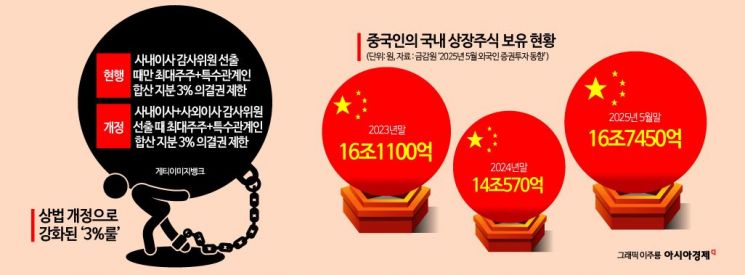
According to the business community on July 9, the revised Commercial Act includes a provision that makes it easier for foreign shareholders, such as those from China, to gain access?commonly known as the "3% rule." This rule limits the combined voting rights of the largest shareholder and their related parties to 3% when appointing auditors or audit committee members (including both internal and external directors) at a shareholders' meeting. Previously, this restriction applied only to "one member of the audit committee," allowing the largest shareholder to exert influence over the remaining audit committee members. However, with the recent revision expanding the scope to "all audit committee members," the largest shareholder is now effectively unable to influence the appointment of audit committee members, regardless of the amount of shares held. If an outsider holds more than 4% of shares and seeks to appoint their own representative as an audit committee member, it becomes difficult for the company to prevent this. Since the largest shareholder can exercise only 3% of voting rights for all audit committee members, multiple external individuals can potentially join the audit committee. The intention behind this system is to enhance the independence of auditors and curb the arbitrary power of the largest shareholder. However, there are concerns that it could also be exploited by foreign capital seeking to steal technology.
From the Chinese perspective, even without being the largest shareholder, simply securing more than 4% of shares opens the door to placing "strategic forces" on the audit committee. Of course, exercising 100% of voting rights is not guaranteed, and there may be competition with other shareholders holding larger stakes. However, if a Chinese representative were to be appointed as an auditor, there are concerns that this could lead to technology leakage. Since audit committee members have access to internal information, analysts point out that external forces now have greater access to technology than before. As a result, the pathways for China to enter the internal operations of domestic companies have clearly widened compared to the past.
Son Seungwoo, an intellectual property and technology advisor at Yulchon LLC, stated, "The biggest concern in the business community regarding the 3% rule is the defense of management rights," adding, "Within that concern is the fear of technology leakage in extreme situations where management rights cannot be protected." Chinese companies are making every effort to secure technology worldwide, so their entry into the domestic market is being viewed with even greater sensitivity. According to the Financial Supervisory Service, as of the end of May, Chinese investors (including corporations) held 16.745 trillion won in domestic listed stocks, an increase of 19.1% from the previous year. There are also many cases of indirect investment through multinational consortiums, private equity funds, and subsidiaries in Singapore and Southeast Asia, so the actual scale is presumed to be even larger.
Oh Ilseon, head of the Korea CXO Institute, commented, "There have been patterns in the past?and still ongoing?where China becomes the largest shareholder by acquiring a majority stake and then extracts core technology design documents and blueprints," adding, "We cannot rule out the possibility that such behavior will intensify after the revision of the Commercial Act."
Concerns Over a Repeat of the SsangYong Motor and MagnaChip Incidents
Among experts, there are concerns that the recent revision of the Commercial Act could trigger a repeat of the 2005 "SsangYong Motor technology leakage incident." In January 2005, SsangYong Motor was acquired by Shanghai Automotive Industry Corporation (SAIC) of China, which became its largest shareholder. However, in January 2009, SAIC withdrew from management, returning SsangYong to independence. During this process, it was discovered that the source code for SsangYong's latest technology, the hybrid vehicle central control unit (HCU), had been leaked to SAIC.
The 2021 case involving MagnaChip Semiconductor is also frequently mentioned. MagnaChip, a system semiconductor company, agreed to sell all its shares to the Chinese private equity fund Wise Road Capital for 1.58 trillion won and began the related acquisition process. However, the deal fell through when the Committee on Foreign Investment in the United States (CFIUS) did not approve it. Since MagnaChip is listed on the New York Stock Exchange (NYSE), it was subject to CFIUS review.
"Urgent Need for Management Rights Defense Measures"
There are some legal mechanisms in place to block Chinese interests seeking to infiltrate domestic companies with the impure intention of technology leakage. Korean commercial law requires companies to clearly specify qualification restrictions for audit committee members in their articles of incorporation, and the government operates a "foreign investment review system." However, many experts believe that China's sophisticated tactics have already rendered these measures ineffective in practice. China is exploiting loopholes in Korean law, using private equity funds and affiliates in other countries?whose investor information is difficult to verify?to purchase stakes in domestic companies, making it hard to identify the true controlling party.
Companies want to be guaranteed at least the minimum means to defend their management rights. Alternatives such as dual-class shares, poison pills, and golden shares?which have been shelved in previous discussions?are now being reconsidered. Dual-class shares are a system that grants founders or management more voting rights per share than ordinary shareholders to protect management rights. A poison pill is a provision that grants existing shareholders the right to purchase additional shares at a price significantly below market value in the event of a hostile M&A or attempt to infringe on management rights. A golden share is a special type of share that allows its holder to exercise veto power over important matters decided at the shareholders' meeting, regardless of the amount or number of shares held. The business community emphasizes that, unlike in advanced foreign countries where these three measures are appropriately implemented, Korea does not have such systems. However, some in the financial sector oppose their introduction, citing potential side effects. Some friction is expected during the discussion process.
© The Asia Business Daily(www.asiae.co.kr). All rights reserved.


















