Impact of Early Heat Wave After Dry Rainy Season
Watermelon Wholesale Prices Up 55% Year-on-Year
Lettuce Prices Nearly Double from Previous Month
Large Supermarkets Stabilize Prices with Alternative Supply and Existing Stock
Prolonged Heat May Lead to Continued Price Surge
#On July 5, at NH Nonghyup Hanaro Mart in Yesan, South Chungcheong Province. Upon entering the store, there was a price tag showing that a single watermelon, large enough for an adult to carry in both arms, was being sold for 32,000 won. Considering that an 8kg watermelon, which is commonly found in the market, is usually sold in the 20,000 won range, this is about 50% more expensive. Although the product was larger and heavier than average, passing shoppers whispered, "Are watermelons really this expensive?"
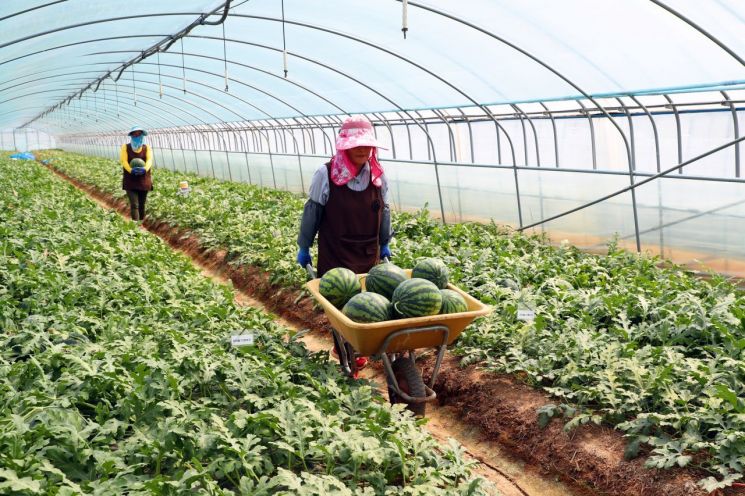
With an early heat wave arriving, the price of watermelon, the representative summer fruit, is soaring.
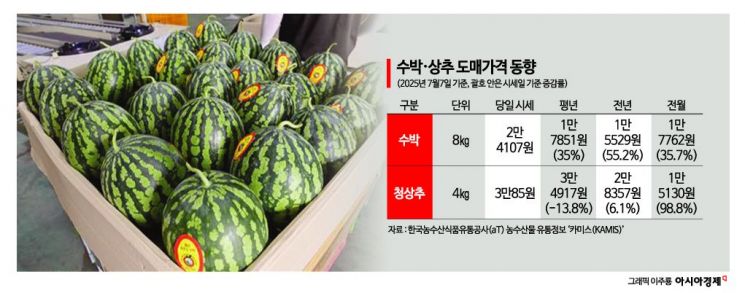
According to 'KAMIS,' the agricultural and fishery product distribution information service operated by the Korea Agro-Fisheries & Food Trade Corporation (aT), as of July 7, the wholesale price of an 8kg watermelon was 24,107 won, up 55.2% from the same period last year and 35% higher than the average year. A representative from Nonghyup Distribution, which operates Hanaro Mart, said, "We are maintaining average prices with the stock secured before the heat wave, but supply is insufficient compared to demand." The representative added, "Wholesale prices at the production sites have already surged, and soon the price increases will be reflected nationwide."
Not only Hanaro Mart but also other major supermarkets such as Emart, Homeplus, and Lotte Mart are on alert due to the rise in watermelon prices. A representative from a major supermarket said, "The rainy season ended early and the heat continues, so the quality of watermelons scheduled to be shipped this month is poor, resulting in a low proportion of standard-grade products." The representative also said, "Recently, demand for watermelons has been high due to the heat, so prices continue to rise."
Usually, watermelon prices rise after the rainy season ends in July, but this year, the industry explains that the timing has come earlier due to a dry rainy season and an early heat wave. Considering the recent trend of heat waves lasting until after August, there is a possibility that the watermelon supply shortage could continue for more than two months. Large supermarkets have expanded their sourcing by contracting with farms in cool highland areas to prepare for the heat wave, but there are limits to how much they can lower the rapidly rising prices. An industry official said, "With less rainfall than usual and continued heat, the size of watermelons shipped from the production areas will inevitably become smaller. It will also be difficult for prices to drop in the short term due to supply shortages."
Lettuce, which faces supply shortages every summer, is also seeing a price surge. As of July 7, the wholesale price for 4kg of green leaf lettuce was 30,085 won, nearly double (98.8%) the previous month's price. Compared to the same period last year, this is a 6.1% increase. Although the current price is still 13.8% lower than the average year, it is expected to rise sharply soon as the costs associated with harvesting have increased due to the heat wave.
A lettuce farm representative explained, "The optimal temperature for lettuce growth is 15 to 20 degrees Celsius, but when the weather gets hotter, the weight and volume of the leaves decrease, and due to the impact of pests and diseases, the yield rate (the proportion of quality products), which used to be around 90%, drops to 50%." The representative added, "To meet the 4kg wholesale standard, we have to pack more lettuce than usual, which increases labor costs, and management costs for pest and disease prevention also rise."
Large supermarkets are trying to stabilize prices by securing additional supply from farms not only in South Chungcheong and North Jeolla, which have high lettuce production, but also in Gangwon Province and northeastern North Gyeongsang Province, where summer temperatures are relatively low. They are also releasing stored leafy vegetables, which were kept during periods of high supply, to prepare for the heat wave. For example, starting July 10, Lotte Mart will sell spinach from the southern coast and Gyeongnam region, stored using CA (Controlled Atmosphere) technology, for 2,990 won per bundle. Lettuce (150g) and perilla leaves (about 30 leaves) produced by smart farms will be sold for 2,490 won and 1,990 won, respectively.
Despite these measures, price increases due to unstable supply are expected to continue for some time. An industry official said, "Leafy vegetables tend to wilt or burn easily in the heat, so the lettuce harvest per greenhouse, which used to be around 150 boxes, has recently dropped to 20-30 boxes." The official added, "If the heat wave and drought continue, the upward trend in prices could be prolonged."
© The Asia Business Daily(www.asiae.co.kr). All rights reserved.
![Clutching a Stolen Dior Bag, Saying "I Hate Being Poor but Real"... The Grotesque Con of a "Human Knockoff" [Slate]](https://cwcontent.asiae.co.kr/asiaresize/183/2026021902243444107_1771435474.jpg)

















