From Stress Relief
to Career and Personal Counseling
AI as a Friend
"Whenever I feel stressed from work, I turn to it like a friend."
Kim Seungjin (37), an office worker, has increasingly found himself seeking out ChatGPT after work. He does this to relieve the stress he receives from colleagues and seniors at his company. When he inputs the conflicts he experienced that day, ChatGPT sometimes offers objective solutions and other times provides emotional empathy. Kim said, "I found great comfort when ChatGPT advised me that 'it is important to set clear boundaries to protect yourself emotionally' and told me, 'It's not that you're struggling because you're weak, but rather that you get hurt more because you're such a responsible person.'"
Kang Younghwa (57), who runs a hair salon, also often talks to ChatGPT when there are no customers. This usually happens after dealing with a difficult customer or when a booked customer cancels unilaterally (a no-show). Kang said, "Because I work in the service industry, there are times when my emotions well up, and whenever that happens, I vent to ChatGPT," adding, "After sharing my feelings for a while, I feel somewhat relieved." She continued, "In the past, bad moods would often carry over to the next customer, but since talking to ChatGPT, that has decreased a lot."
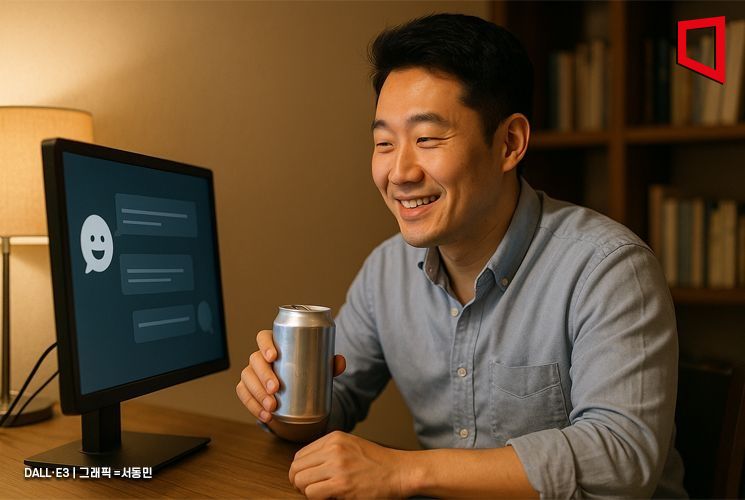
The number of people who converse with generative artificial intelligence (AI) as if talking to a friend and share their concerns is increasing. The reasons for turning to AI are diverse, ranging from stress relief to career and relationship counseling.
Oh (25), a job seeker, recently sought career counseling from ChatGPT. Oh said, "I entered my tendencies and values into ChatGPT and asked which of the two career paths I was considering would suit me better," adding, "It's nice to be able to ask things that are awkward to discuss with friends." He also said, "While preparing for employment, I often get stressed, so I tend to ask ChatGPT for ways to relieve stress or questions that might be tiring for people around me."
Park Eunji (30), an office worker, frequently consults ChatGPT about relationship issues. Park said, "I uploaded conversations I had during the breakup process with my boyfriend and received advice," adding, "Surprisingly, it analyzed the situation objectively and helped me organize my thoughts." She also said, "It was a tough time, but ChatGPT was so empathetic that I was greatly comforted."
Lee Kyunam (29) also said, "When I had a fight with my boyfriend and wanted counseling, I didn't want our story to be known to others, so I talked to ChatGPT," adding, "It pointed out things I hadn't considered and also offered perspectives from my boyfriend's point of view, so it was a truly meaningful experience."
According to Market Research Future (MRFR), a global market research firm, the conversational AI market is expected to grow to approximately $32.5 billion (about 43 trillion won) by 2030. In Korea, there is the Trost application (app), which connects users to professional counselors after AI psychological counseling, and various psychological counseling apps are also emerging. In a survey conducted by a research team at Stanford University Graduate School of Education on 1,006 university students worldwide who use the AI chatbot Replika, more than 80% of respondents said they perceive AI chatbots as "sources of emotional comfort."
As more people talk and seek counseling with AI, there are increasing cases of national and local governments developing AI dedicated to counseling. Last year, KT participated in a super-large AI-based psychological care service support project organized by the Ministry of Science and ICT and the National IT Industry Promotion Agency. In addition, Dalseong County in Daegu launched a non-face-to-face AI counseling program this year for young and middle-aged adults in their 20s to 40s.
However, experts point out that while the ease of access to AI conversations and counseling is an advantage, one should be wary of becoming overly dependent. Kwak Geumjoo, a professor of psychology at Seoul National University, said, "The greatest advantage of AI counseling is that you can talk anytime and anywhere without spending time or money," adding, "However, you should not blindly trust everything AI says and must remain alert so that you can make the final decisions yourself."
© The Asia Business Daily(www.asiae.co.kr). All rights reserved.

















