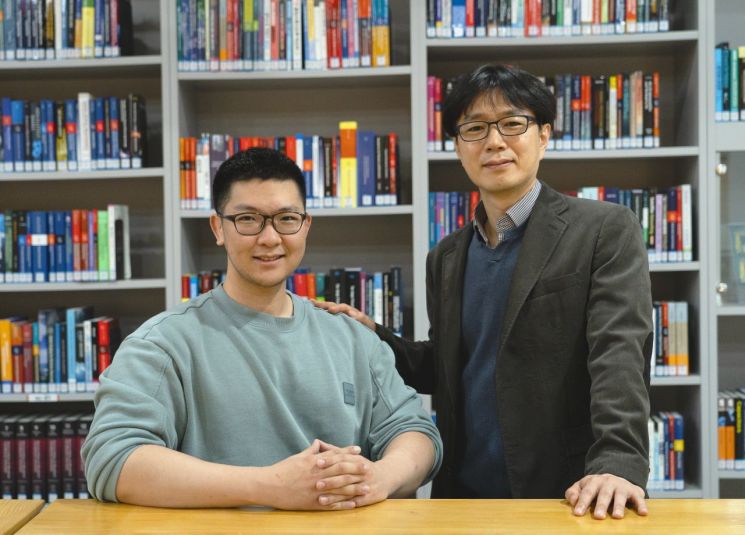
 (From right) Professor Jongseok Lee, Department of Physics and Optical Science, GIST, Dr. Inhyuk Choi.
The Gwangju Institute of Science and Technology (GIST) announced on July 8 that a research team led by Professor Jongseok Lee from the Department of Physics and Optical Science, in collaboration with the University of Minnesota, has become the first in the world to observe ultrafast 'anisotropy of light-electron interaction' in ruthenium oxide (RuO2) thin films at the picosecond (10^-12 seconds) scale. The team also demonstrated that the intensity of this interaction can be precisely controlled by adjusting the thickness at the atomic layer level.
This research experimentally demonstrated for the first time that anisotropy of light-electron interaction, comparable to that found in van der Waals materials, can be realized and controlled even in metal oxides. As a result, it is being recognized as laying the technological foundation necessary for the development of next-generation large-area optoelectronic devices.
Optoelectronic devices, which utilize the interaction between light and electrons in solids, are devices that generate electrical signals from light or emit light using electricity. They are essential components in various technologies involving the transmission of electrical signals, such as ultrafast optical communications and optical imaging.
In particular, 'optical anisotropy', which allows for the control of electronic signals depending on the polarization direction of light, is drawing attention as a key element for next-generation optical communication, imaging, and spintronics technologies.
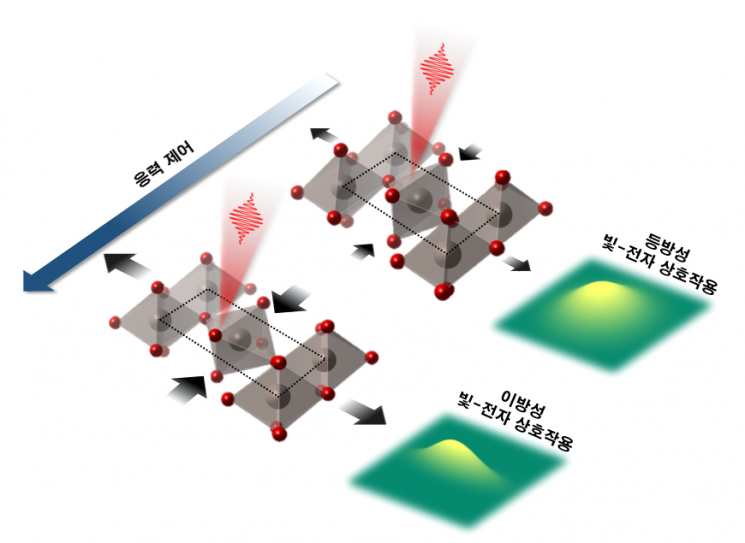
To develop such devices, the material must be as thin as the nanometer scale (10^-9 m) and capable of large-area production. Until now, anisotropy of light-electron interaction has mainly been observed in two-dimensional van der Waals materials, but industrial applications have been limited due to challenges in large-area manufacturing and environmental instability. In contrast, metal oxides have the advantage of enabling precise large-area growth at the atomic layer level while also offering high environmental stability.
If optical anisotropy can be achieved in oxides, they hold great potential as next-generation optoelectronic devices. The research team used molecular beam epitaxy (MBE) technology to grow ruthenium oxide thin films at the atomic layer level on titanium oxide (TiO2) substrates, and confirmed through various optical measurements that these films exhibit light-electron interaction anisotropy comparable to that of van der Waals materials.
After analyzing the static anisotropy of the material using techniques such as X-ray absorption spectroscopy and ellipsometry, the team observed, using femtosecond laser-based pump-probe techniques, that the behavior of optically excited electrons varies significantly at the picosecond (10^-12 seconds) timescale depending on the polarization direction. This provides important evidence that ruthenium oxide thin films can be used in ultrafast optoelectronic devices. Furthermore, by precisely controlling the thickness of the thin films at the atomic level to relieve the stress from the substrate, the team confirmed that the intensity of light-electron interaction anisotropy can also be tuned. This achievement is being evaluated as offering a new direction for the design of oxide-based optoelectronic devices.
Professor Jongseok Lee stated, "We have experimentally confirmed that the electronic structure of ruthenium oxide, which has recently attracted attention in the field of spintronics, can be controlled using stress." He added, "These research results will serve as an important starting point not only for optoelectronic devices but also for the development of next-generation spin devices."
This research was conducted as an international collaboration between GIST and the University of Minnesota. At GIST, Dr. Inhyuk Choi carried out ultrafast optical experiments under the direction of Professor Jongseok Lee. At the University of Minnesota, Professor Bharat Jalan's research team from the Department of Chemical Engineering and Materials Science was responsible for the growth of ruthenium oxide thin films, while Professor Tony Low's research team from the Department of Electrical and Computer Engineering handled the theoretical analysis of the electronic structure.
© The Asia Business Daily(www.asiae.co.kr). All rights reserved.
![Clutching a Stolen Dior Bag, Saying "I Hate Being Poor but Real"... The Grotesque Con of a "Human Knockoff" [Slate]](https://cwcontent.asiae.co.kr/asiaresize/183/2026021902243444107_1771435474.jpg)

















