Estimated Impact of Prey Influx Due to Climate Change
"Bluefin Tuna Quota" Exhausted in Some Regions
All Catches Must Be Discarded
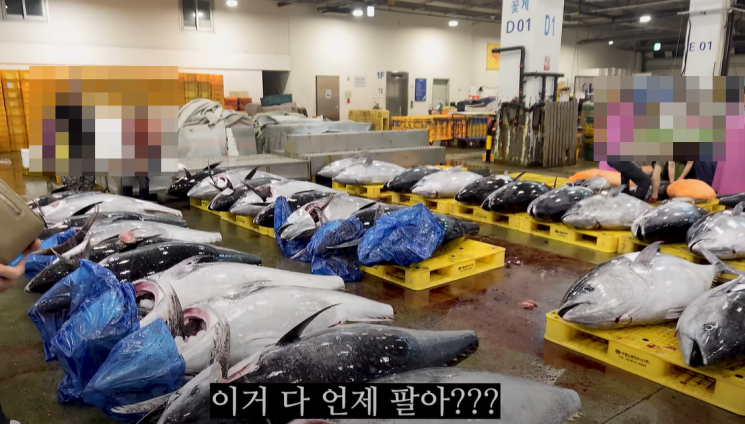
This year, bluefin tunas weighing over 100 kg are being caught in large numbers along the East Coast and in some parts of the southern coast, including Busan. However, neither fishermen nor consumers are able to take much joy from this. Bluefin tuna must be bled and have their gills removed immediately after being caught, and then stored on ice to maintain freshness and market value. However, because these are not traditional tuna fishing vessels, the proper conditions for these processes are not available, making it difficult to achieve good auction prices.
According to Yeongdeok County on July 8, on July 6, 70 bluefin tunas measuring 1 to 1.5 meters in length and weighing between 30 and 150 kg were caught in the fixed net fishery off the coast of Samsa-ri, Ganggu-myeon, Yeongdeok. These bluefin tunas were sold at the fisheries cooperative for 14,000 won per kilogram.
Although bluefin tuna have been caught off the coast of Yeongdeok before, they usually weighed around 10 kg. While large individuals have occasionally been caught, it is rare for so many large bluefin tunas to be caught at once.
Recently, bluefin tunas weighing over 200 kg have also been caught from the East Coast to the Busan area. In particular, subtropical fish species such as yellowtail, Spanish mackerel, and mackerel, which serve as their prey, are being caught in greater numbers than usual, leading to hectic scenes at fish markets.
However, despite the abundance of tuna, fishermen and consumers are not really benefiting. First, because this is an unusual catch, the fishing vessels are not accustomed to handling tuna, and the necessary conditions are not in place, making it difficult to bleed and ice the fish immediately after capture. Since bluefin tuna have high body temperatures, if they are not bled, the heat causes the flesh to cook over time, resulting in a loss of freshness. In such cases, even if the fish go to auction, they are traded at around 3,000 won per kilogram.
Additionally, the Western and Central Pacific Fisheries Commission (WCPFC), which sets the total allowable catch quotas for each country, has already filled the bluefin tuna quota for Korea in some regions, making further sales impossible. This year, the quota for North Gyeongsang Province is 110 tons, down from 1,219 tons last year, and the 35-ton quota allocated to Yeongdeok has already been filled. As a result, all the bluefin tuna caught on this day will either be discarded or used as feed.
An official from Yeongdeok County stated, "Due to climate change, large bluefin tunas are now appearing in Yeongdeok as well," adding, "It seems likely that this will happen more frequently in the future."
© The Asia Business Daily(www.asiae.co.kr). All rights reserved.
![Clutching a Stolen Dior Bag, Saying "I Hate Being Poor but Real"... The Grotesque Con of a "Human Knockoff" [Slate]](https://cwcontent.asiae.co.kr/asiaresize/183/2026021902243444107_1771435474.jpg)















