U.S. Sends Tariff Letter... Japan's Tariff Rate Raised by 1 Percentage Point
Prime Minister Ishiba Expresses "Regret" at Press Conference
Ruling Party: "Notifying with Just One Letter Is Disrespectful to an Ally"
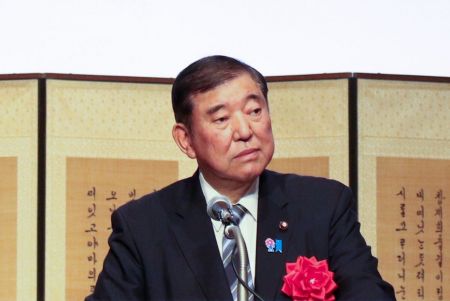 Japanese Prime Minister Shigeru Ishiba is delivering a congratulatory speech at the reception commemorating the 60th anniversary of the normalization of diplomatic relations between Korea and Japan, hosted by the Korean Embassy in Japan, held at the New Otani Hotel Tokyo on the 19th of last month. Photo by Yonhap News
Japanese Prime Minister Shigeru Ishiba expressed "deep regret" on July 8 regarding the United States' announcement of a 25% reciprocal tariff on Japanese goods, stating that negotiations would continue in pursuit of an agreement beneficial to both countries. This stance reflects his unwillingness to back down in trade talks with the U.S., especially as domestic sentiment has been unsettled by rising prices ahead of the upcoming House of Councillors election.
According to Kyodo News and other Japanese media, Prime Minister Ishiba told reporters at the Prime Minister's Office that day, "The Japanese government will avoid any hasty compromises," and added, "We are negotiating with all our strength, making demands where necessary and defending what must be protected."
He further stated, "We will negotiate toward a mutually beneficial agreement for both countries while safeguarding our national interests, aiming for the new deadline of August 1," and added, "We will also make every effort to mitigate the impact on domestic industries and employment."
This is consistent with Prime Minister Ishiba's recent comments made during the House of Councillors election period. On July 6, appearing on NHK's party leaders' debate program, he emphasized, "Even with allies, we must say what needs to be said," and reiterated his position that "there will be no easy compromises." With the House of Councillors election scheduled for July 20 and public sentiment deteriorating due to a sharp rise in rice prices and other goods, it appears unlikely that Prime Minister Ishiba will make significant concessions to the U.S. in the near future.
The ruling party's message is even more hardline. Itsunori Onodera, Policy Research Council Chairman of the Liberal Democratic Party, said at a party meeting that day, "This is not something we can accept," and criticized, "Notifying us with just a single letter is extremely discourteous to an ally, and I feel strong anger." He added, "There is still time," and expressed hope that "the government will make sure to advance the negotiations."
Prime Minister Ishiba also convened a comprehensive response headquarters meeting on the U.S. tariff measures at the Prime Minister's Office that day. During the meeting, he explained that "the content could change depending on Japan's response," and clarified that the new negotiation deadline is August 1. Regarding the increase of the reciprocal tariff on Japanese goods from the original 24% to 25%, he said, "It is truly regrettable."
Earlier, on July 7, U.S. President Donald Trump sent a "tariff letter" to 14 countries including Korea and Japan, specifying reciprocal tariffs of 25-40% by country and notifying that these would take effect from August 1. The reciprocal tariff rate for Japan disclosed that day was 25%, 1 percentage point higher than the initial 24%, while Korea's rate remained unchanged at 25%. President Trump has continued to apply pressure on Japan ahead of the negotiation deadline, making remarks such as "Japan is being disrespectful" and warning that "reciprocal tariffs could be set at 30% or 35%."
The Japanese yen weakened due to uncertainty surrounding the tariffs. The dollar-yen exchange rate rose to 146.44 yen that day, recovering to the level seen on June 24. Compared to the 142-yen range on July 1, the yen's value has dropped significantly. The background to this weakness is attributed to diminished expectations for monetary tightening by the Bank of Japan (BOJ). Reuters pointed out that this was due to weakened expectations that the BOJ would deliver a hawkish message in its quarterly report to be released on July 31.
Takeshi Ishida, a strategist at Kansai Mirai Bank, commented, "If the new deadline is set for August 1, the BOJ will find it difficult to say much in its July report," and analyzed, "Market expectations for a short-term interest rate hike will likely recede."
© The Asia Business Daily(www.asiae.co.kr). All rights reserved.

















