The South Korean government attempted to formally place the issue of Japan's failure to implement follow-up measures regarding the Gunkanjima (Hashima) coal mine on the agenda at the UNESCO World Heritage Committee, but the effort was unsuccessful. Despite unprecedented voting that took place amid Japan's opposition, South Korea lost the vote. However, while the matter will not be pursued further at the level of international organizations, the government stated it will continue to raise the issue bilaterally with Japan. As the Lee Jaemyung administration has emphasized 'pragmatic diplomacy' and sought to foster amicable relations between South Korea and Japan, there are concerns that historical issues may become a flashpoint in the future.
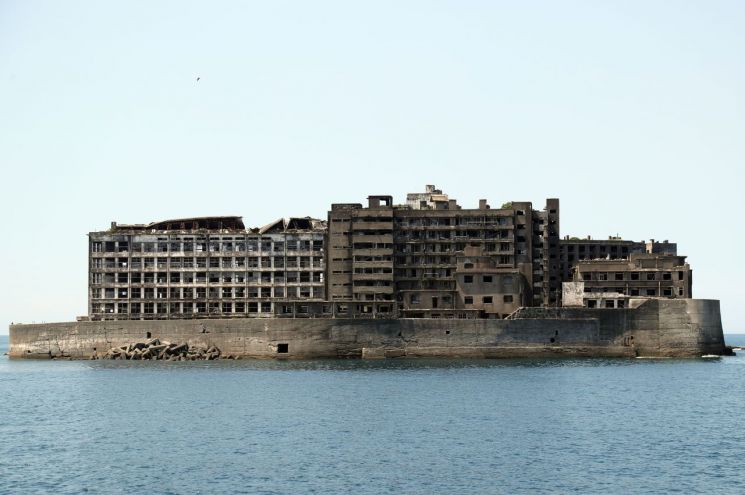 A view of Gunkanjima from a cruise ship off the coast of Hashima, Nagasaki Prefecture, Japan. Photo by Yonhap News
On July 8, an official from the Presidential Office expressed regret over the failure to have the follow-up measures regarding the Gunkanjima coal mine, which had been a provisional agenda item, officially adopted as an agenda item at the 47th plenary session of the UNESCO World Heritage Committee held in Paris, France, the previous day (local time). The official stated, "Our government maintains the position that Japan must faithfully implement both the promises it made regarding modern industrial facilities and the decisions of the World Heritage Committee that include these promises."
The Gunkanjima coal mine, or Meiji Industrial Heritage Sites, was inscribed as a World Heritage Site in 2015. At the time, the Park Geunhye administration initially opposed the inscription of the Gunkanjima coal mine, but agreed to it based on the Japanese government's promise to acknowledge the forced labor of Koreans.
However, over the subsequent ten years, Japan did not keep its promise. Instead, Japan has ignored historical facts by insisting that there was no coercion involved in the conscription and sexual slavery of Koreans. The World Heritage Committee repeatedly pointed out Japan's insufficient follow-up measures and urged improvements, but to no avail. As a result, the South Korean government proposed that the issue be placed on the committee's official agenda for discussion. At the plenary session, Hah Wiyeong, head of the Ministry of Foreign Affairs' UNESCO Cooperation Task Force, pointed out, "The materials at the Industrial Heritage Information Center in Tokyo do not sufficiently reflect the history of forced labor of Koreans," and called for the committee to directly review the implementation of its decisions.
The World Heritage Committee conducted a secret ballot among its 21 member countries in response to South Korea's proposal, resulting in 7 votes in favor, 3 against, 3 invalid, and 8 abstentions, effectively siding with Japan. This marks the first time that South Korea and Japan have faced off in a vote at an international organization over historical issues.
Since its inauguration, the Lee Jaemyung administration has expressed its intention to improve South Korea-Japan relations, starting with a friendly phone call between the two leaders. However, this recent development has reaffirmed Japan's rigid stance on historical issues, raising concerns that such issues will remain an obstacle in future bilateral relations.
An official from the Ministry of Foreign Affairs stated, "During this session of the World Heritage Committee, we intend to formally reiterate our position on the implementation of decisions regarding Japan's modern industrial facilities at an appropriate opportunity." The official added, "We will continue to demand, both bilaterally and multilaterally, that Japan faithfully implement the relevant decisions of the World Heritage Committee and its own promises." The official also said, "While we will continue to make our position clear on historical issues, we also seek to pursue future-oriented cooperation with Japan based on mutual trust."
© The Asia Business Daily(www.asiae.co.kr). All rights reserved.

















