Lowers "leptin" levels regardless of weight loss
Daewoong Pharmaceutical announced on July 8 that it presented research results demonstrating the metabolic improvement effects of its diabetes treatment, Enblo, at the 2025 American Diabetes Association (ADA) Annual Scientific Sessions held in Chicago, USA.
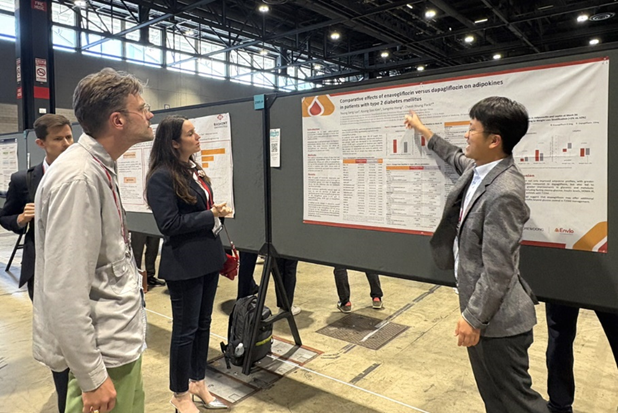 Professor Ryu Youngsang of the Department of Endocrinology and Metabolism at Chosun University (far right) is explaining the research results to the attendees. Daewoong Pharmaceutical
This study was a secondary analysis in poster format presented by the research team led by Professor Park Cheolyoung of Kangbuk Samsung Hospital. Using data from a previously conducted phase 3 clinical trial of Enblo, the study compared its effects to those of dapagliflozin, a drug in the same class.
The potential for Enblo to improve metabolic function had already been observed in previous studies. At last year’s Obesity Society meeting in the United States, research involving patients with type 2 diabetes showed that Enblo could have a positive impact not only on lowering blood glucose but also on improving insulin resistance. Building on these findings, the current study further confirmed that Enblo reduced leptin levels regardless of changes in body weight, compared to dapagliflozin.
The study was conducted over 24 weeks with a total of 426 patients with type 2 diabetes, focusing on changes in adiponectin and leptin?both types of adipokines secreted by fat cells. These two indicators are closely linked to not only body weight changes but also insulin resistance, blood glucose control, and overall metabolic health, making them key markers for evaluating the metabolic health of diabetes patients. Typically, patients with metabolic diseases such as obesity tend to have lower adiponectin and higher leptin levels compared to healthy individuals.
The results showed that Enblo improved all major metabolic indicators, with leptin levels?which are involved in appetite regulation and energy metabolism?significantly improved regardless of weight loss. In particular, the reduction in leptin was greater with Enblo than with dapagliflozin, and the difference was statistically significant (p=0.043). This is the first clinical result among SGLT-2 inhibitors to demonstrate improvement in leptin levels independent of body weight changes.
Notably, Enblo also reduced leptin levels in the patient group with minimal weight change (less than 3% reduction in body weight). Generally, leptin levels decrease in association with weight loss, but among patients with almost no weight change, the Enblo group showed an average decrease of 0.90 ?g/L, whereas the dapagliflozin group actually showed an increase of 1.71 ?g/L. This suggests that Enblo may improve fat cell function itself, beyond simply reducing body weight.
Leptin is a hormone that suppresses appetite and increases energy expenditure, and is secreted in greater amounts as body fat increases. However, when excessive fat accumulates, the body can develop “leptin resistance,” where the brain no longer responds to high leptin levels, making appetite control and energy metabolism more difficult. In this study, Enblo was shown to lower leptin levels even in those who did not lose much weight, highlighting the possibility that it may contribute to the normalization of fat cell function by improving leptin resistance.
In addition, Enblo showed superior results compared to dapagliflozin in several other indicators, including fasting blood glucose, insulin resistance index (HOMA-IR), fasting insulin levels, and urinary glucose-to-creatinine ratio (UGCR).
Professor Ryu Youngsang of the Department of Endocrinology and Metabolism at Chosun University, who presented the poster, stated, “This study suggests that Enblo may directly affect fat cell function beyond simple weight loss, and presents meaningful results indicating the potential for expanded treatment across a range of metabolic diseases.” He added, “However, the physiological pathways by which leptin reduction occurs are not yet clear, so further research into the mechanism of action is needed.”
Park Hyungcheol, Head of ETC Marketing at Daewoong Pharmaceutical, said, “This study shows that Enblo may have a differentiated metabolic mechanism compared to existing SGLT-2 inhibitors, and it is significant that the excellence of Enblo, a domestically developed new drug, has been recognized at the world’s largest diabetes conference. We expect that it could become a new treatment option for diabetes patients with fat cell dysfunction or metabolic imbalance in the future.”
© The Asia Business Daily(www.asiae.co.kr). All rights reserved.
![Clutching a Stolen Dior Bag, Saying "I Hate Being Poor but Real"... The Grotesque Con of a "Human Knockoff" [Slate]](https://cwcontent.asiae.co.kr/asiaresize/183/2026021902243444107_1771435474.jpg)
















