Six Out of Fourteen Countries Receiving Letters Are in Southeast Asia
Analysis: Strategy to Pressure China's Alternative Supply Chains
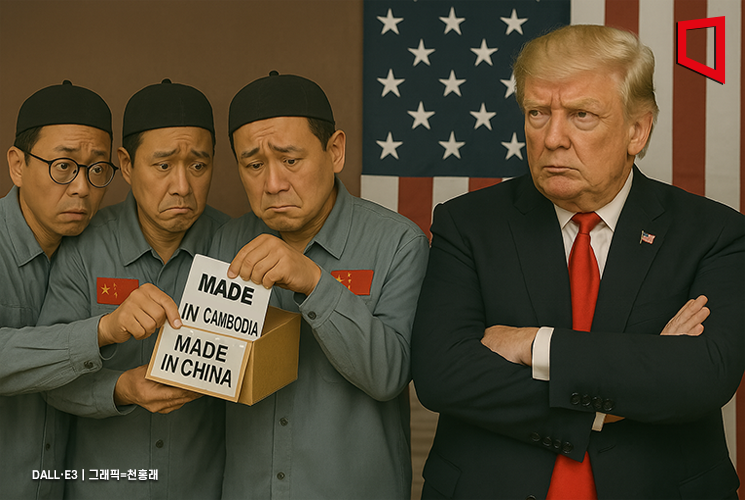
Among the 14 countries that received tariff letters from the Donald Trump administration, all but Japan and South Korea have a relatively small share of trade with the United States, and most are concentrated in Southeast Asia. This suggests a strategy aimed at preemptively pressuring countries that could potentially serve as alternative supply chain routes for China, rather than targeting those with large trade deficits.
On July 7 (local time), President Trump named 14 countries as targets for tariffs via his social media platform, Truth Social. The countries listed were Japan, South Korea, Malaysia, South Africa, Kazakhstan, Laos, Myanmar, Bosnia and Herzegovina, Serbia, Cambodia, Bangladesh, Indonesia, Tunisia, and Thailand. The United Kingdom, China, Vietnam, and the European Union (EU)?which have trade agreements or are in negotiations with the United States?were excluded from this measure.
Of the 14 countries singled out, Japan and South Korea are the only major trading partners; for the remaining countries, trade with the United States accounts for less than 1% of their total trade. Analysts interpret this as an attempt to pressure countries with weaker bargaining power first, in order to establish a tariff model.
The New York Times (NYT) reported, "Among these, only Japan and South Korea account for more than 4% of total U.S. imports," adding, "Thailand (1.9%) and Malaysia (1.6%) have lower shares, while all the others?including Bangladesh and Indonesia?are below 1%."
This contradicts the original reciprocal tariff criteria set by President Trump. He previously explained that he would impose fair tariffs on countries running large deficits in trade with the United States.
There is analysis that the United States is taking this action to expand its geopolitical influence and to compete with China over supply chains. Among the 14 countries that received letters, six?excluding Japan and South Korea?are members of the Association of Southeast Asian Nations (ASEAN). Thailand, Malaysia, Indonesia, and Cambodia have been identified as key transit points for Chinese goods being rerouted to the U.S. to avoid high tariffs. There have been persistent allegations that Chinese companies use these countries as "alternative supply chain hubs," exporting goods to the U.S. after simple assembly or relabeling to disguise them as "non-Chinese" products.
According to the U.S. Census Bureau, as of May, China's exports to the United States had plummeted by 43% compared to the previous year. During the same period, China's total exports increased by 4.8%, with exports to ASEAN rising by 15% and to the EU by 12%. This is interpreted as a sign that China is strengthening its strategy of rerouting exports through Southeast Asia, as the United States had feared.
The Financial Times (FT) recently reported, "Chinese companies are steadily increasing shipments routed through Southeast Asia to circumvent the tariff barriers established by the Trump administration as part of the trade war," noting that Southeast Asian countries are emerging as "transit points for tariff evasion."
On this day, President Trump raised the level of pressure by warning, "If these countries impose retaliatory tariffs or attempt to reroute exports through third countries, we will further increase tariff rates."
© The Asia Business Daily(www.asiae.co.kr). All rights reserved.
![Clutching a Stolen Dior Bag, Saying "I Hate Being Poor but Real"... The Grotesque Con of a "Human Knockoff" [Slate]](https://cwcontent.asiae.co.kr/asiaresize/183/2026021902243444107_1771435474.jpg)
















