Trump Announces "25% Tariff on South Korean Products Starting August 1"
Government Responds: "Effectively a Conditional Suspension... Accelerating Negotiations"
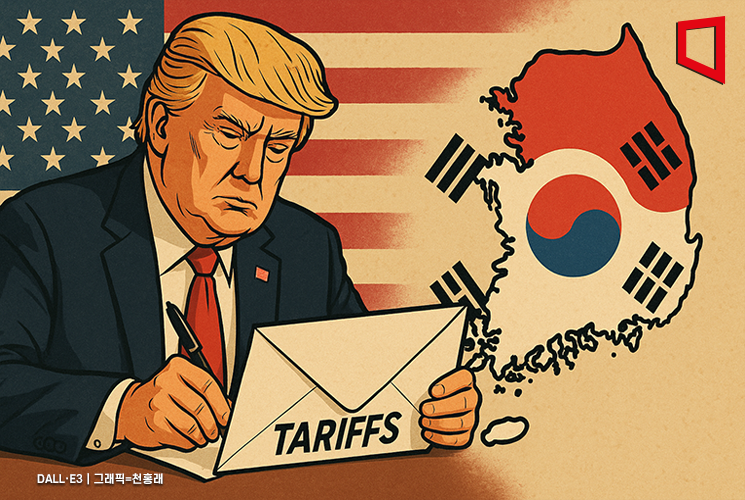
U.S. President Donald Trump has officially announced his plan to impose a 25% tariff on all South Korean products. However, since he has set the implementation date as August 1, some interpret this not simply as an irrevocable declaration, but as a 'deadline pressure' move that leaves room for negotiation. The South Korean government views this letter as, in effect, an extension of the mutual tariff suspension, and plans to focus on achieving tangible results during the remaining period.
The Ministry of Trade, Industry and Energy stated on the 8th, "We consider President Trump's letter to be, in effect, an extension of the mutual tariff suspension," and added, "During the remaining period, we will work to resolve uncertainties caused by the tariffs and accelerate negotiations to achieve mutually beneficial results."
Earlier, at 1:20 a.m. (Korean time) on this day, President Trump disclosed the official letter he sent to the South Korean government via his social networking platform, Truth Social. The letter included the plan to impose a uniform 25% tariff on all South Korean products starting August 1, as well as provisions such as: ▲ the application of high tariffs in cases of tariff evasion through transshipment, and ▲ countermeasures in response to retaliatory tariffs.
The letter also mentioned conditions for tariff exemption, such as expanding production within the United States, deregulation, and market opening. Since the application of tariffs could vary depending on South Korea's response, it appears that the Trump administration intends to use this 'pressure card' to induce more substantial concessions.
The Ministry also stated, "Since the launch of the administration, we have engaged in negotiations with the national interest as our top priority. However, it is true that there was insufficient time to reach agreement on all issues," and interpreted, "This measure serves as a clear warning of tariff implementation, while also leaving room for negotiation depending on South Korea's additional responses."
South Korea and the United States have recently focused their discussions on mutual tariff suspension for key items such as automobiles, steel, and batteries through the so-called 'July Package Negotiations.' In particular, the South Korean government dispatched Yeo Han-koo, Chief Negotiator for Trade, and Wi Sung-lac, Director of the National Security Office, to Washington, D.C. as chief representatives in the trade and security fields, respectively, for last-minute coordination. Chief Negotiator Yeo explained the grounds for tariff suspension and adjustment based on increased investment in the U.S. and institutional improvements, while Director Wi is reported to have emphasized the potential for security linkages through strategic industry cooperation. President Trump's letter was made public before these negotiations concluded, and is seen as a means of pressuring the South Korean side to make clearer and more concrete choices.
The South Korean government intends to utilize this opportunity not only for short-term response but also as part of a mid- to long-term industrial strategy. Accordingly, it is expected to refine its response strategy by focusing on measures that address the core interests of the United States during the remaining period.
Regarding the U.S. emphasis on 'reducing the trade deficit,' expanding imports of agricultural and livestock products and further opening the digital market are being discussed as possible negotiation cards. In addition, in response to President Trump's direct mention in his letter of 'expanding production within the U.S.,' it is considered likely that South Korean companies will be encouraged to specify plans for expanding and investing in local factories. Domestically, presenting institutional improvement measures such as enhancing the investment environment and easing unnecessary regulations is seen as a way to signal strengthened manufacturing cooperation between the two countries.
The Ministry of Trade, Industry and Energy stated, "We will use this as an opportunity to lay the foundation for the growth of key industries through a manufacturing renaissance partnership with the United States," and added, "We will pursue not only the reduction of the trade deficit but also domestic institutional improvements and regulatory rationalization in parallel."
The government also plans to accelerate on-site responses to minimize damage to each sector. On this day, the Ministry held an emergency meeting presided over by the First Vice Minister, and plans to assess the impact of the tariffs on sectors with high export ratios to the U.S., such as automobiles, electric vehicles, steel, and semiconductors. In addition, company-specific response measures and the possibility of supply chain adjustments will be discussed. The Ministry stated, "We will work to minimize corporate damage in response to rapid changes in the trade environment, and will also provide support to enhance the overall resilience of the industry."
© The Asia Business Daily(www.asiae.co.kr). All rights reserved.
![Clutching a Stolen Dior Bag, Saying "I Hate Being Poor but Real"... The Grotesque Con of a "Human Knockoff" [Slate]](https://cwcontent.asiae.co.kr/asiaresize/183/2026021902243444107_1771435474.jpg)















