Number of Power Strip Fires Rises by 27% in Five Years
Caution Urged Against "Octopus-Style" Use of Air Conditioners and Other Devices in Summer
Public concern is rising as power strips have been identified as a common cause in two tragic incidents in Busan, where young sisters died in separate apartment fires within nine days.
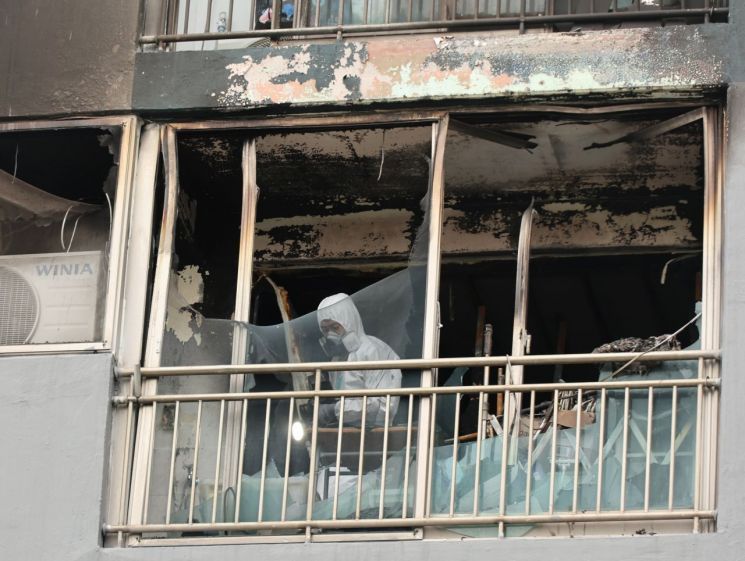 On the 24th, fire authorities, police, and related agencies conducted a joint investigation at the site of an apartment fire in Jin District, Busan. Photo by Yonhap News
According to the Busan Fire Department and police on July 7, the fire that claimed the lives of two sisters, aged 8 and 6, in an apartment in Gijang County, Busan on July 2 is believed to have started due to an electrical issue in a two-outlet power strip connected to a standing living room air conditioner. Signs of exposed and shorted wiring were found on the power strip, which was reportedly used for both the air conditioner and the outdoor unit. However, the manufacturer, product name, and whether the rated capacity was observed could not be confirmed, as the power strip was destroyed in the fire.
On June 24, a fire believed to have started from a living room power strip in an apartment in Gaegeum-dong, Jin District, Busan, resulted in the deaths of two sisters, aged 10 and 7. A joint investigation by related agencies at the time found that multiple electronic devices, including a computer, were connected to the power strip.
Although there are no legal regulations, it is recommended that high-power electronic devices such as air conditioners be plugged in separately, not together with other devices on a power strip, due to the risk of fire. High-capacity power strips are also sold separately on the market. However, these recommendations are often not followed in everyday life.
Experts warn that using power strips in a so-called "octopus" manner?connecting multiple devices simultaneously without considering power consumption or replacement cycles?greatly increases the risk of fire due to overheating. If excessive current flows and exceeds the maximum allowable power, the wires can overheat and cause a fire.
In fact, fires caused by outlets, including power strips, have been on the rise over the past five years. According to the Busan Fire Department, of the 23,547 fires that occurred in multi-family housing in Busan over the past five years (from 2020 to last year), 6,971 cases, or 29.6%, were caused by electrical factors. Among these, fires caused by outlets increased from 396 cases in 2020 to 435 cases in 2022 and 504 cases last year?a rise of about 27% over five years.
In response, the Busan Fire Department will conduct a fire experiment on July 10 in the afternoon, focusing on "Verification of Power Strip Fire Risk Factors and Safety Measures." The department plans to examine the likelihood of fire due to octopus-style use of outlets, the risk of overcurrent when using outlets that do not meet rated capacity, and the possibility of fire from improper use, such as twisted or loosely connected plugs.
Meanwhile, the National Fire Agency issued a nationwide "alert" level fire risk warning at 10 a.m. on July 4. This measure was taken after the number of fires surged by 38% following the first heatwave advisory of the year on June 29. The main causes of summer fires are cited as excessive use of cooling devices during heatwaves and overloads in aging electrical equipment.
© The Asia Business Daily(www.asiae.co.kr). All rights reserved.
![Clutching a Stolen Dior Bag, Saying "I Hate Being Poor but Real"... The Grotesque Con of a "Human Knockoff" [Slate]](https://cwcontent.asiae.co.kr/asiaresize/183/2026021902243444107_1771435474.jpg)















