Hong Gukpyo: "100% Installation Rate for Priority Targets Is an Illusion"
The installation rate of manhole fall prevention facilities promoted by Seoul City remains at just 14%. While the city stated that it has installed fall prevention facilities on 7 out of every 10 high-risk manholes, this figure only reflects the prioritized targets. When considering all manholes, experts point out that the overall risk level remains high.
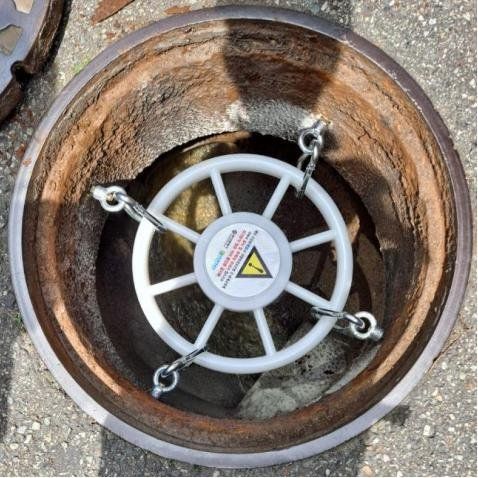
According to data received by Seoul Metropolitan Council member Hong Gukpyo of the People Power Party from Seoul City on July 7, the city selected approximately 53,000 manholes (18.4%) out of a total of about 288,000 as priority targets for the installation of fall prevention facilities. Seoul City achieved 100% of its annual installation plans for priority targets in both 2022 and 2023, and as of the end of last month, had completed installations on 39,000 manholes, achieving 73.6% of its overall priority target plan.
However, when considering all 288,000 manholes rather than just the priority targets, the installation rate is only 13.7%.
The installation of manhole fall prevention facilities became mandatory following an accident in August 2022, when a man and woman in their 40s and 50s drowned after falling into a manhole on a road flooded by heavy rain near Gangnam Station in Seoul. In December of that year, the Ministry of Environment revised sewer design standards to mandate the installation of fall prevention facilities for new and renovated manholes. However, these measures were not retroactively applied to the numerous existing manholes. As a result, safety measures such as maintenance and repair of manholes remain at the discretion of each local government, depending on their budget and commitment.
The situation is similar even in Seoul, which has a relatively high level of fiscal independence. A closer look at each district reveals that the proportion of manholes designated as priority targets is itself low.
For example, in Gangnam District, where the 2022 manhole accident occurred, there are 16,399 manholes?the highest number among all districts. However, only 3,305 manholes, or 20.2%, have been designated as priority targets. This means that even if the installation goal is achieved 100%, more than 13,000 manholes will still lack safety devices. The current installation rate for priority targets in Gangnam District is also only 68.8%.
In Jongno District, where a manhole accident occurred in 2023, only 30.2% of all manholes have been designated as priority targets, and the installation rate is just 55.7%. In particular, Jungnang District has both a low priority target designation rate of 20.1% and the lowest installation rate among Seoul's 25 districts at 47.8%. Council member Hong pointed out, "It is time for Seoul City to move to a second-stage plan that increases the installation rate for all manholes, beyond just the priority targets. The city should immediately establish a new safety roadmap and conduct special inspections of the 19 districts with below-average installation rates to ensure the real safety of citizens."
© The Asia Business Daily(www.asiae.co.kr). All rights reserved.
![Clutching a Stolen Dior Bag, Saying "I Hate Being Poor but Real"... The Grotesque Con of a "Human Knockoff" [Slate]](https://cwcontent.asiae.co.kr/asiaresize/183/2026021902243444107_1771435474.jpg)















