Despite Trump's Opposition, Nippon Steel Acquires US Steel
Interview with Chairman and CEO Hashimoto Eiji
"We Will Take Market Share from the No. 2 Steelmaker, Cleveland-Cliffs"
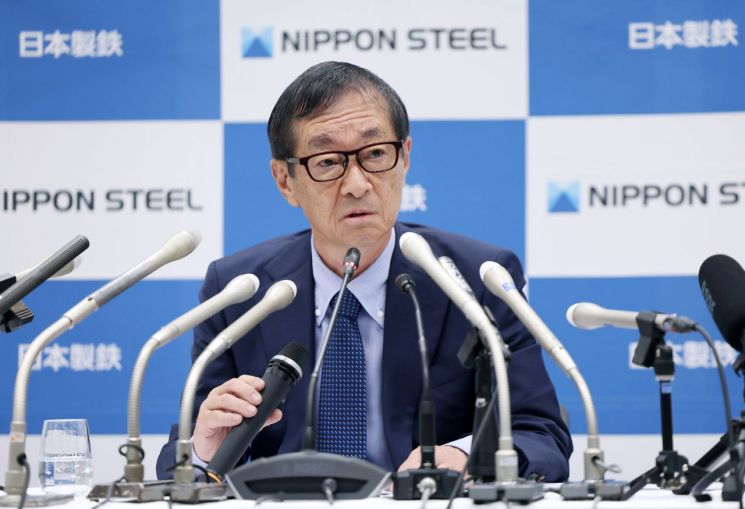 Hashimoto Eiji, chairman of Nippon Steel, is speaking at a press conference held in Tokyo, Japan, after completing the acquisition of US Steel on the 19th of last month (local time). Photo by EPA Yonhap News
Hashimoto Eiji, chairman and CEO of Nippon Steel, who completed the acquisition of US Steel last month for 2 trillion yen (approximately 18.87 trillion won), has announced plans to invest an additional 1.5 to 1.6 trillion yen (14 to 15 trillion won). Nippon Steel will dispatch 40 Japanese engineers to US Steel, which currently operates at only 70% capacity, to upgrade its outdated technology and pursue dominance in the US steel industry.
In an interview with the Nihon Keizai Shimbun (Nikkei) on July 7, Hashimoto said, "Many people are surprised when they hear that we spent 2 trillion yen on the US Steel acquisition and plan an additional investment of 1.5 to 1.6 trillion yen," signaling a large-scale investment.
He explained, "However, the steel industry inherently requires that level of expenditure. Since I became president in 2019, our investment in Japan alone has reached 1.6 trillion yen by fiscal year 2024. As long as there is demand, we can generate sufficient profit." He added, "My main concern is securing manpower. There are only 13 million manufacturing workers in the US, and that number is decreasing each year."
Hashimoto stated, "In the past, we did not supply steel to the US market, including Japanese automakers, but going forward, we will target all customers." He also identified Cleveland-Cliffs as the competitor to be most wary of. Cleveland-Cliffs is the second-largest steelmaker in the US.
He pointed to low production relative to equipment capacity as the main issue facing US Steel. In fact, the current operating rate is only 70%, meaning the company is not generating enough efficiency to recover its fixed costs.
Regarding this, Hashimoto diagnosed, "The biggest cause is high variable costs, which stem from a lack of manufacturing technology. Their yield is lower than ours, their equipment is outdated, and their logistics system is not well organized." To address these issues, the company plans to dispatch 40 Japanese engineers and a significant number of technical support staff.
On US steel demand, he noted, "In the US, demand for power infrastructure related to artificial intelligence (AI) semiconductors is increasing, but the US cannot produce the ultra-high-grade electrical steel sheets required for advanced transformers. High-performance electrical steel sheets are also needed for hybrid and electric vehicle motors, but there is a shortage of these as well."
Hashimoto emphasized, "The steel industry is facing a very difficult situation due to China's low-price offensive, and some companies will go bankrupt in the future. Opportunities will come to strong companies, so we plan to immediately consider potential acquisitions."
While he did not mention specific company names, he clarified that the targets are small and medium-sized steelmakers. Currently, the US market is dominated by four major steel companies, including US Steel.
Hashimoto stated, "We are not interested in China, Vietnam, or Indonesia. As long as China's low-priced exports continue, it will be difficult to make profits in the Asian construction steel market." He added, "Our M&A targets are regions where demand growth is certain and there is a need for high-quality steel technology."
Under Hashimoto's leadership, Nippon Steel conducted acquisition negotiations for a year and a half due to continued opposition from US President Donald Trump. Ultimately, with the support of the US labor union and favorable public opinion in local communities, Nippon Steel succeeded in acquiring US Steel.
© The Asia Business Daily(www.asiae.co.kr). All rights reserved.
![Clutching a Stolen Dior Bag, Saying "I Hate Being Poor but Real"... The Grotesque Con of a "Human Knockoff" [Slate]](https://cwcontent.asiae.co.kr/asiaresize/183/2026021902243444107_1771435474.jpg)
















