Tourism Account Deficit Down 9% Year-on-Year in May
Need to Attract High-Spending Foreign Tourists
Longer Stays Essential

As the number of foreign tourists visiting South Korea this year is on track to reach an all-time high, the country's tourism account deficit, which surpassed $10 billion last year for the first time in six years, has decreased by nearly 10% in the first half of this year. Although the trend of increasing deficits since the COVID-19 pandemic has reversed, the deficit remains significant. Experts point out that in order to fundamentally address the issue, it is necessary to attract foreign tourists with high spending power and to extend their length of stay, for example by revitalizing regional airports.
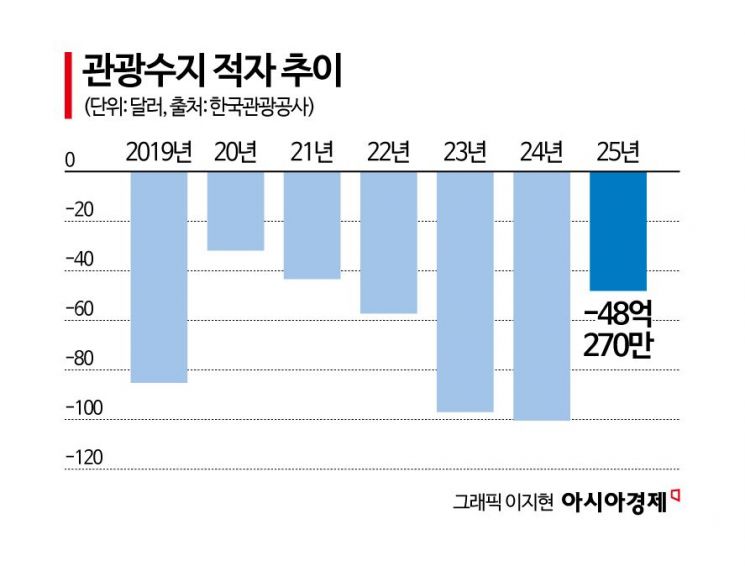
According to the Korea Tourism Organization on July 8, the tourism account deficit as of May this year stood at $4.3758 billion (approximately 5.98 trillion won), an 8.9% decrease compared to the same period last year ($4.8027 billion). Tourism revenue from inbound foreign tourists reached $7.3097 billion (about 9.98 trillion won) by May, an 18.8% increase from the same period a year ago ($6.1525 billion). In contrast, outbound travel spending by Korean tourists was $11.6855 billion (about 15.96 trillion won), a 6.7% increase from the previous year ($10.9552 billion). As the growth rate of tourism revenue outpaced the increase in outbound spending, the deficit narrowed compared to last year.
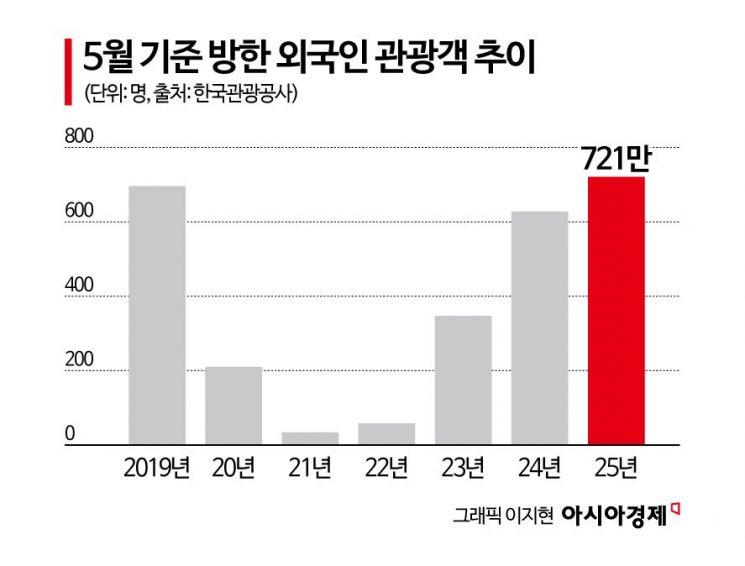
The increase in tourism revenue is due to a rise in the number of foreign tourists. As of May this year, 7,206,747 foreign visitors came to Korea, a 14.7% increase compared to the same period last year (6,284,133). With tourists arriving at a much faster pace than last year, it is expected that the record for inbound foreign tourists will be broken this year. Last year, the number of inbound tourists was 16.37 million, which is 93.5% of the all-time high of 17.5 million in 2019. Considering the current trend, it is likely that this year will surpass 2019 and even reach 18 million visitors.
Although the increase in tourists has reduced the deficit by nearly 10 percentage points, the large tourism account deficit remains a chronic problem for Korea's tourism industry. Korea's tourism account deficit reached an all-time high of $14.6959 billion (about 20.07 trillion won) in 2017, when China imposed a travel ban on Korea in response to the deployment of THAAD, and slightly decreased to $13.2078 billion the following year. The deficit shrank to around $3 billion in 2020 as the tourism industry contracted during the COVID-19 pandemic. However, the deficit has grown every year since then, surpassing $10 billion last year for the first time in six years since 2018.
This persistent deficit is due to stagnant tourism revenue. This year, per capita tourism revenue was $1,014.3, only a 3.6% increase from the same period last year ($979.1). The fact that far more Koreans travel abroad than foreign tourists visit Korea demonstrates that the Korean tourism industry cannot achieve improved profitability through quantitative recovery alone.

Ultimately, to resolve the tourism account deficit, it will be necessary to attract foreign tourists with high spending power and to extend their length of stay. To achieve this, not only the development of high value-added tourism products but also the expansion of air service supply to revitalize regional airports is needed. For example, in Japan, although there is sufficient inbound demand, there are no regular routes operated by Japanese airlines at regional airports, so all flights depend on Korean carriers. This imbalance between supply and demand is one of the factors preventing improvement in the deficit.
Hong Seokwon, chief researcher at Yanolja Research, said, "Policy incentives such as priority slot allocation, operational subsidies, and tax benefits are important to encourage foreign airlines to operate at regional airports," adding, "It would be desirable to first apply these strategies to proven markets such as Japan and Taiwan." He also explained, "In the short term, these strategies can help revitalize regional economies, and in the mid- to long-term, they can lay the foundation for improving the tourism account balance."
© The Asia Business Daily(www.asiae.co.kr). All rights reserved.
![Clutching a Stolen Dior Bag, Saying "I Hate Being Poor but Real"... The Grotesque Con of a "Human Knockoff" [Slate]](https://cwcontent.asiae.co.kr/asiaresize/183/2026021902243444107_1771435474.jpg)

















