A company that illegally obtained steel export quotas by falsely declaring the country of export has been caught by customs authorities.
On July 7, the Seoul Regional Customs Office of the Korea Customs Service announced that it had detected two steel export companies suspected of violating the Foreign Trade Act and the Customs Act, and referred them to the prosecution.
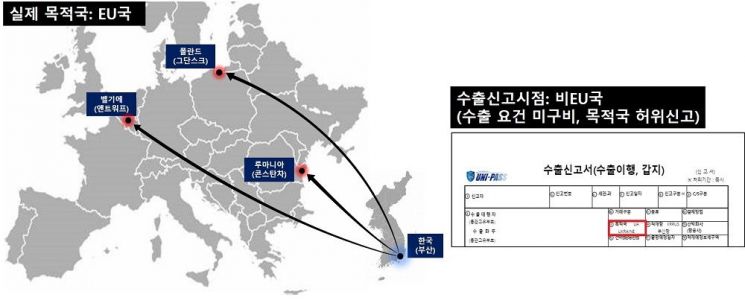 Overview of Illegal Export Crime of Color Coated Steel Sheets. Provided by Seoul Regional Customs Office, Korea Customs Service
According to the Seoul Regional Customs Office, these companies are accused of exporting color coated steel sheets to the European Union (EU) while falsely declaring the country of export as a non-EU country, thereby obtaining steel quotas illegally. The total amount of color coated steel sheets exported through these illicit methods reached 126,354 tons, with a market value of 230 billion won.
Color coated steel sheets are products manufactured by applying a special paint to the surface of steel sheets at the factory. They are highly resistant to rust and are mainly used for refrigerator exteriors, air conditioner covers, and steel panels on building facades. In Korea, they are considered a representative steel export product.
However, exports of color coated steel sheets to the EU are subject to restrictions. Since 2018, the EU has implemented import restriction measures (steel safeguard) to protect its domestic steel industry. The system sets import volumes by country and by quarter, applying zero tariffs only to the designated quota, while imposing a 25% tariff on any excess. Steel quotas are subject to this quota system.
The two companies that were caught attempted to export color coated steel sheets to the EU by circumventing the steel quota system, but were ultimately detected by customs authorities.
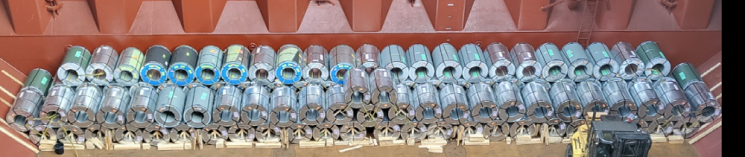 Photo of color steel sheet product. Provided by Seoul Regional Customs Office, Korea Customs Service.
The Seoul Regional Customs Office began its investigation after noting that the volume of steel exported from Korea to the EU, as recorded by EU customs, was excessively higher than the amount cleared through Korean customs for export to the EU. The investigation was also prompted by reports from several legitimate exporters who were unable to benefit from tariff exemptions.
The investigation revealed that, between June 2020 and February 2023, the two companies illegally exported color coated steel sheets to EU countries such as Romania, Poland, and Belgium on 147 occasions.
Although color coated steel sheets are a restricted export item and require approval from the Korea Iron & Steel Association for export to the EU, these companies knowingly evaded the quota restrictions by falsely declaring the country of export as non-EU countries such as Ukraine, Russia, and Moldova. In doing so, they misappropriated quotas that should have been allocated to legitimate exporters, according to the Seoul Regional Customs Office.
During the investigation, the Seoul Regional Customs Office conducted searches of the companies' offices and secured key evidence, including export contracts and invoices with EU countries. They also linked and analyzed export-import data from EU customs and export approval records from the Korea Iron & Steel Association to fully uncover the extent of the crime.
In particular, it was confirmed that the companies had systematically organized their illegal activities by preparing an "export operations manual" instructing staff to ensure that EU countries were not listed on trade documents submitted to customs.
An official from the Seoul Regional Customs Office stated, "This case is a serious trade crime that deprived other steel companies of export opportunities. The customs office will continue to thoroughly monitor and crack down on illegal exports to lead the creation of a fair trade environment."
Meanwhile, the false declarations by these illegal exporters result in the early exhaustion of quotas, forcing legitimate exporters to either pay a 25% safeguard tariff or wait for the next quarter's quota. This increases logistics costs for companies and poses a risk of undermining the overall credibility of the Korean steel industry.
© The Asia Business Daily(www.asiae.co.kr). All rights reserved.
![Clutching a Stolen Dior Bag, Saying "I Hate Being Poor but Real"... The Grotesque Con of a "Human Knockoff" [Slate]](https://cwcontent.asiae.co.kr/asiaresize/183/2026021902243444107_1771435474.jpg)
















