Report Diagnoses Crisis and Growth Strategies
for the Domestic Construction Industry
Amidst challenges such as the downturn in the real estate market, there is a growing consensus that the domestic construction industry, currently facing a crisis, must diversify its business models and expand the adoption of digital transformation and smart construction technologies in order to become a future growth industry.
On July 7, Samil PwC announced the publication of its report, "Construction of Tomorrow: Strategies for Sustainable Growth in the Construction Industry." The report diagnoses the crisis and structural issues facing the domestic construction sector and was prepared to present strategic directions and actionable plans for achieving a sustainable industry.
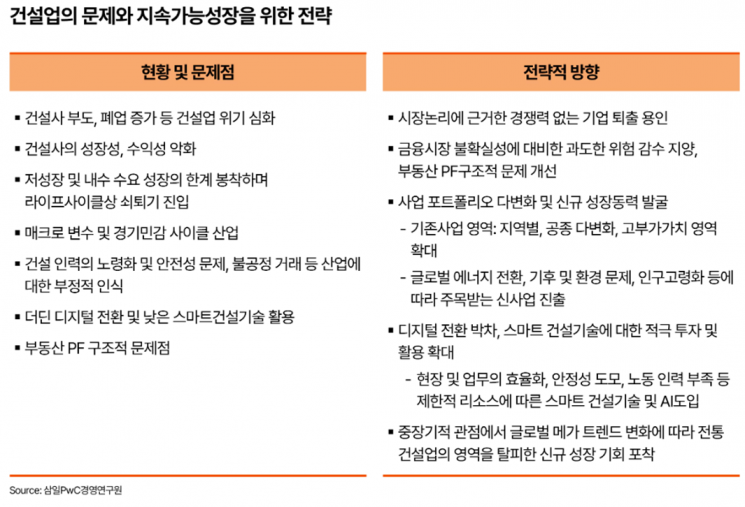
Since 2022, the continued downturn in both domestic and global economies, as well as the real estate market slump caused by real estate project financing (PF), have led to an increase in bankruptcies and closures among construction companies. As a result, key management indicators such as growth potential, profitability, and financial soundness have deteriorated, prolonging the crisis in the construction industry.
In particular, several structural problems are highlighted: the limited size of the domestic market restricting growth potential; domestic construction companies lagging in global competitiveness; declining productivity and efficiency due to an aging workforce and slow digital transformation; and the domestic real estate PF structure characterized by low capital and high leverage.
The report emphasizes "restructuring" as a solution. It argues that, rather than relying on artificial support or resuscitation, the market should be allowed to operate on its own logic, enabling non-competitive companies to exit naturally. The report also stresses the need to diversify existing business portfolios and discover new growth engines through new businesses. Additionally, it calls for expanding digital transformation to boost productivity and efficiency, increasing the use of smart construction technologies, and seizing growth opportunities arising from global mega trends.
Specific action plans for sustainable growth include: expanding mergers and acquisitions (M&A) to diversify portfolios; fostering ventures and utilizing technology through increased investment in research and development (R&D) and open innovation; building cooperative relationships between large corporations and small and medium-sized enterprises to diversify business and utilize smart construction technologies; and providing policy support for overseas expansion, M&A, and R&D investment.
Han Jaesang, leader (partner) of the Construction (E&C) Division at Samil PwC, stated, "Domestic construction companies, like their overseas counterparts, need to actively expand their business models through M&A and make efforts to enhance profitability. Just as the shipbuilding industry transformed into a high value-added growth sector through technological advancement, I hope the construction industry will also establish itself as a more growth-oriented future industry through investments in diverse future technologies and the discovery of new businesses and markets."
The full report is available on the Samil PwC website.
© The Asia Business Daily(www.asiae.co.kr). All rights reserved.
![Clutching a Stolen Dior Bag, Saying "I Hate Being Poor but Real"... The Grotesque Con of a "Human Knockoff" [Slate]](https://cwcontent.asiae.co.kr/asiaresize/183/2026021902243444107_1771435474.jpg)















