Scheduled to Meet Key U.S. Officials
Pressing Issues Include Defense Cost Sharing and Military Spending
Diplomatic circles are closely watching whether National Security Advisor Wi Sunglak, who is visiting the United States, will be able to resolve the challenges of negotiating reciprocal tariffs between South Korea and the U.S., as well as coordinating the schedule for a South Korea-U.S. summit. Wi is scheduled to meet with key high-level officials, including U.S. Secretary of State and White House National Security Advisor Marco Rubio, and attention is focused on whether common ground can be found.
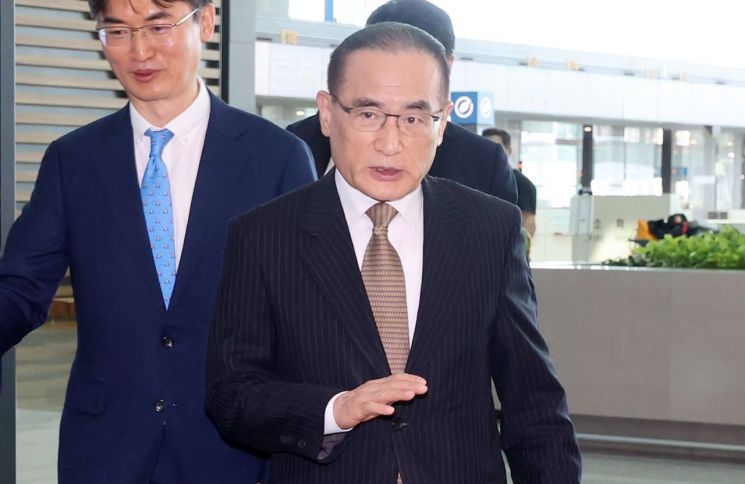
On July 6 (local time), at Dulles International Airport near Washington, D.C., Wi met with correspondents and was asked whether his consultations with his counterpart, Secretary Rubio, were expected to help with trade negotiations. He responded, "That is what I am hoping for," and added, "Since we deal with the overall relationship, not just trade, any discussion with my counterpart should address the relationship as a whole."
This visit to the U.S. was decided as the deadline for the reciprocal tariff suspension, currently under negotiation between the South Korean and U.S. governments, is imminent on July 8. It is also the first top-level visit since the South Korea-U.S. summit was postponed due to the worsening situation in the Middle East.
The government does not view this visit as a simple working-level contact, but rather as the first high-level bilateral meeting covering the full spectrum of political, security, and trade issues since President Lee Jaemyung took office, and is making a concerted effort. Yeo Hankoo, Director-General for Trade Negotiations at the Ministry of Trade, Industry and Energy, has already met with Jamieson Greer, U.S. Trade Representative (USTR). Regarding the reciprocal tariff negotiations, the realistic goal is to secure sufficient time for negotiations under favorable terms, as the expiration of tariff suspension measures for key South Korean export industries such as steel, semiconductors, and automobiles could result in significant damage. The Trump administration has prepared to unilaterally notify countries that fail to conclude trade negotiations by July 9 that new tariff rates will take effect on the first day of the following month.
In addition, there are numerous security issues, including the sharing of defense costs for U.S. Forces Korea, increases in defense spending, and the division of roles within the Indo-Pacific strategy, making it critical to arrange a South Korea-U.S. summit at an early date. If this visit results in progress on the three key issues?extension of the tariff suspension, coordination of the summit schedule, and strengthening of security cooperation?it is expected to mark the first diplomatic achievement for the Lee Jaemyung administration.
Meanwhile, on July 7, the Presidential Office announced plans to recruit youth affairs officers. A total of two people, one man and one woman, will be hired. The newly established youth affairs officers will work in the Office for National Unity and will be responsible for developing youth policies, improving systems, operating participation platforms, and other tasks aimed at substantially improving the lives of young people.
© The Asia Business Daily(www.asiae.co.kr). All rights reserved.
![Clutching a Stolen Dior Bag, Saying "I Hate Being Poor but Real"... The Grotesque Con of a "Human Knockoff" [Slate]](https://cwcontent.asiae.co.kr/asiaresize/183/2026021902243444107_1771435474.jpg)















