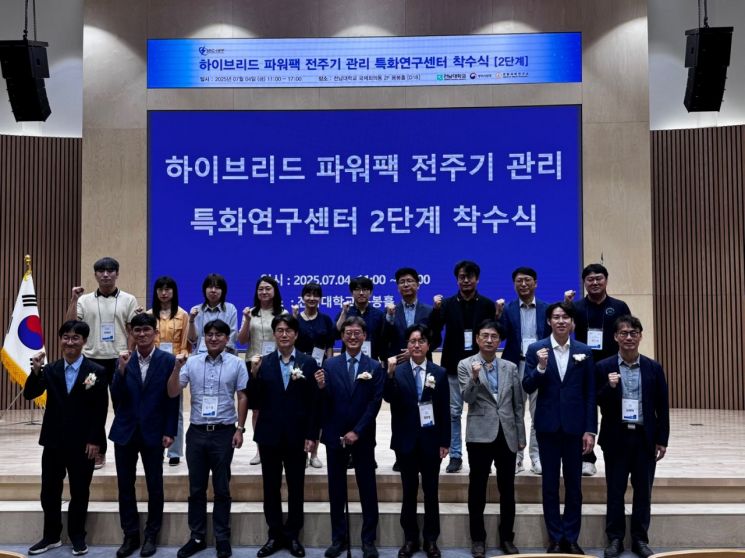
 Chonnam National University held the "Hybrid Powerpack Full-Cycle Management Specialized Research Center Phase 2 Kickoff Meeting" at Yongbong Hall on the 4th. Photo by Chonnam National University
Chonnam National University announced on July 7 that it has officially begun advancing electric propulsion system technology to supply power for next-generation unmanned weapon systems.
The university recently held the "Hybrid Powerpack Full-Cycle Management Specialized Research Center Phase 2 Kickoff Meeting" at Yongbong Hall. At the event, the start of the Phase 2 research was announced, with the goal of developing pilot process technology, conducting demonstrations, and securing integrated full-cycle management technology.
Over 100 people attended the kickoff meeting, including Ko Seongseok, Vice President for Research at Chonnam National University, Choi Yoosong, Director at the Agency for Defense Development, officials from the Defense Acquisition Program Administration, professors and experts from participating research institutions, as well as representatives from industry and public organizations.
The Hybrid Powerpack Specialized Research Center is a large-scale national research project launched after Chonnam National University was selected in 2022 for the Agency for Defense Development’s basic research specialized center program. The project will invest approximately 20.1 billion KRW over a total of 10 years (108 months), with six universities and two research institutes nationwide participating under the leadership of Chonnam National University to develop full-cycle technology for energy solutions for future unmanned systems.
The Phase 2 research will focus on pilot-scale process demonstrations of high-efficiency fuel cells (URFC) and high-power secondary battery technologies that can be installed in electrically propelled unmanned weapon systems.
Additionally, the project has strategic goals to strengthen both operational demonstration and industrialization by establishing a post-management system based on military waste battery recycling technology, conducting thermal management and economic evaluations, and advancing precious metal recovery processes.
Research Division 1 is focusing on integrated reversible fuel cell stack and core material technology. Research Division 2 is developing high-power lithium secondary battery and ultracapacitor-based battery module technology. Research Division 3 is concentrating on the control, integration, and testing of electric propulsion systems, as well as technologies for resource recovery from waste.
Jung Hoyoung, a professor in the Department of Environmental Energy Engineering at Chonnam National University and director of the center, stated, "Phase 2 marks a leap forward, elevating laboratory technology to a level that can be applied to actual weapon systems. We aim not only to complete the full-cycle management technology for electric propulsion systems, but also to make a substantial contribution to the sustainability and eco-friendliness of South Korea’s defense industry."
Kim Yanghyun, Vice President for Academic Affairs at Chonnam National University, said, "The Hybrid Powerpack Full-Cycle Management Specialized Research Center is growing into a leading research institution that contributes to the nation’s defense technology self-reliance beyond the region. Based on the infrastructure and capabilities of Chonnam National University, we will complete the technology for future energy-based weapon systems in South Korea."
© The Asia Business Daily(www.asiae.co.kr). All rights reserved.

















