Interview with Sihoon Yang and Choongun Lee of Hwawoo Law Firm
Proving Subcontractor Work Separation Using Visual Evidence
Emphasizing FDA Compliance and the Unique Nature of SOPs in Bio/Pharmaceuticals
"The pharmaceutical and biotech industries are unfamiliar sectors when it comes to illegal dispatch lawsuits. The specific circumstances at each company also vary greatly. I believed that unless a lawyer visits the site in person, it is impossible to fully understand or grasp the case."
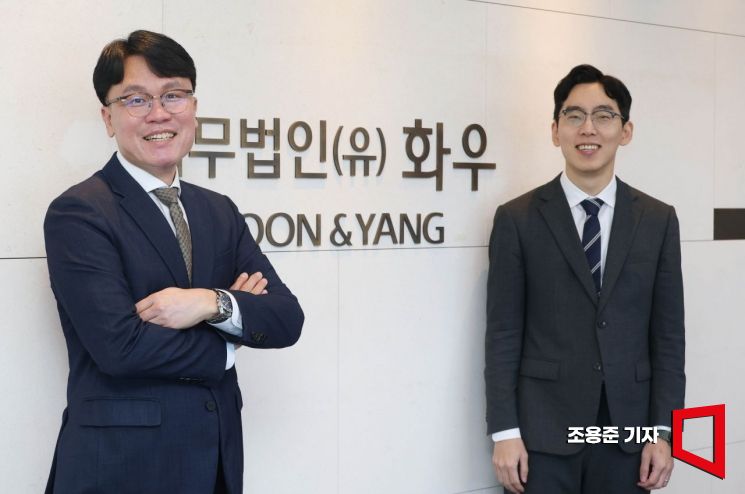 Partner Lawyer Sihoon Yang of the Labor Group at Hwawoo Law Firm (left) and Lawyer Choongun Lee are being interviewed by Asia Economy at Hwawoo Law Firm in Asem Tower, Samseong-dong, Gangnam-gu, Seoul. Photo by Jo Yongjun
Sihoon Yang, a partner lawyer at Hwawoo Law Firm (Judicial Research and Training Institute, 32nd class), shared this perspective regarding the recent appellate court victory in a labor lawsuit filed by employees of Freezon, a subcontractor of Celltrion, who claimed illegal dispatch and demanded direct employment by Celltrion. Hwawoo, representing Celltrion?one of Korea's largest pharmaceutical companies?overturned the first-instance ruling that had partially accepted the plaintiffs' claims, securing a reversal in the appellate court.
Celltrion had outsourced to Freezon the cleaning and disinfection of walls and floors in clean rooms at its biopharmaceutical production plant during nighttime hours, after its own employees had finished work. However, in 2019, Freezon employees filed a lawsuit, asserting that Celltrion should directly employ them. They argued that, although Celltrion had formally signed a subcontract with Freezon, the actual arrangement amounted to dispatching workers. The first-instance court ruled in favor of some plaintiffs, ordering Celltrion to express its intent to hire the Freezon employees.
However, with the appellate court overturning the ruling, Celltrion was able to breathe a sigh of relief. Asia Economy met directly with Sihoon Yang and Choongun Lee (6th bar exam), lawyers from Hwawoo's labor group, to hear about the behind-the-scenes efforts that led to this reversal.
Reversal in Appellate Court... Highlighting Work Differences with On-Site Video Footage
Hwawoo took on Celltrion's illegal dispatch lawsuit after the first-instance verdict. The opportunity arose purely by chance. Lawyer Yang explained, "At the time, I was at Incheon District Court for another illegal dispatch lawsuit, and coincidentally, Celltrion's first-instance verdict was being delivered there. Although I had handled numerous illegal dispatch cases as a judge at the Seoul High Court, I had never encountered one involving a pharmaceutical company like Celltrion. I was very curious about the specifics of the case, and after actively reaching out to Celltrion and proposing litigation strategies, Hwawoo was entrusted with the case."
However, overturning the first-instance verdict seemed challenging. The first-instance court had acknowledged, point by point, the existence of elements indicative of dispatch in its assessment of illegal dispatch factors. In particular, the court found that Freezon's clean room cleaning and disinfection work was closely linked to Celltrion's pharmaceutical production operations, concluding that Celltrion had, in effect, substantially dispatched and used the plaintiffs as workers. If a dispatched worker works at the same business site for more than two years, the employer is required to directly hire the worker.
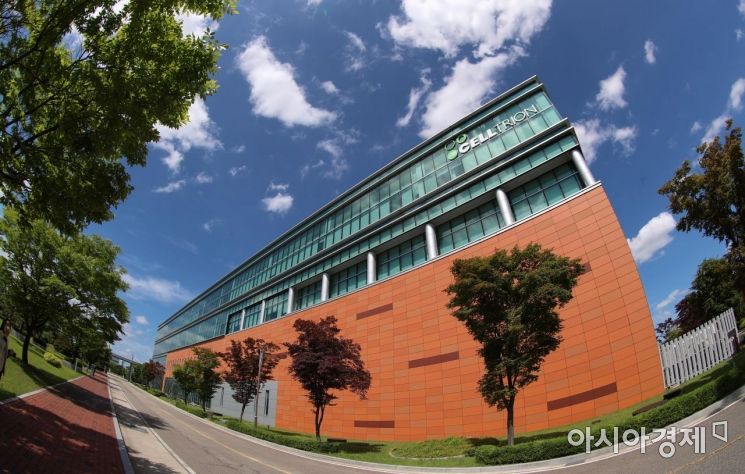
In the appellate court, Hwawoo actively employed visual elements to emphasize the clear distinction between the work of Celltrion and its subcontractor. This was because the court believed it would be difficult to clearly recognize the separation of duties between the two companies through written arguments alone. From the early stages of the appeal, Hwawoo filmed the actual work processes inside the Celltrion plant and incorporated this footage into their oral argument presentations.
Lawyer Lee explained, "I personally donned protective clothing and filmed Celltrion employees performing their duties in the afternoon, and then recorded the subcontractor's night cleaning operations until 1 a.m. The result was a six-minute video with narration and subtitles. The footage clearly showed that the subcontractor mainly disinfected and cleaned ceilings, walls, and floors, while Celltrion employees worked exclusively on pharmaceutical production equipment, highlighting that their work targets were completely separate."
Additionally, during the trial, a comparative table contrasting the duties of the subcontractor and Celltrion was created for the court to intuitively grasp that the two types of work were entirely different and could not influence or substitute for each other. Ultimately, it was demonstrated that night cleaning was an intangible "service" aimed at maintaining cleanliness, whereas Celltrion's main business was the "manufacturing and production" of biopharmaceuticals?proving that the nature and purpose of the two jobs were fundamentally different. The appellate court accepted this argument, concluding that the business types of Freezon and Celltrion were distinct.
Emphasizing the Distinct SOP Characteristics of Bio/Pharmaceuticals Compared to Manufacturing
Whether Celltrion exercised "significant direction and command" over the subcontractor was another major issue. The first-instance court found that "Freezon workers were bound by Celltrion's Standard Operating Procedures (SOPs)" and thus were effectively under Celltrion's direction and command. SOPs are part of the Good Manufacturing Practice (GMP) requirements established by the U.S. Food and Drug Administration (FDA).
In the appellate court, Hwawoo adopted a strategy of emphasizing the unique nature of GMP and SOPs in biopharmaceutical manufacturing. They believed that treating SOPs as equivalent to general procedures in other manufacturing sectors would not yield a favorable outcome. Therefore, they highlighted that the types and uses of solutions used in night cleaning, the detailed tasks, and procedures specified in Celltrion's SOPs were all designed to comply with GMP. Since night cleaning team workers are obliged to observe GMP, merely following SOPs in their work could not be considered "direction and command" from Celltrion. Lawyer Lee stated, "Celltrion's SOPs are nothing more than unavoidable guidelines for performing cleaning work. Since SOPs provide objective information to ensure GMP compliance, they do not constitute excessive direction or command."
Furthermore, through new witness testimony in the appellate court, it was proven that night cleaning workers actively participated in revising Celltrion's SOPs and that the subcontractor independently established and decided work schedules on a monthly and weekly basis.
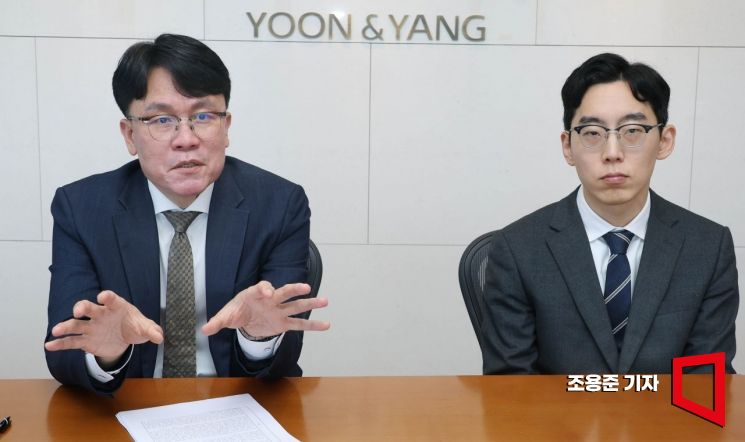 Partner Lawyer Sihoon Yang of the Labor Group at Hwawoo Law Firm (left) and Lawyer Choongun Lee are being interviewed by Asia Economy at Hwawoo Law Firm in Asem Tower, Samseong-dong, Gangnam-gu, Seoul. Photo by Yongjun Cho
Expansion of Illegal Dispatch Lawsuits... "Reducing Illegal Dispatch Risks in Bio/Pharmaceuticals"
Lawyer Yang noted that he sensed a shift in the landscape of illegal dispatch lawsuits while handling this case. Previously, such lawsuits were mostly filed in traditional manufacturing sectors like automobiles, steel, tires, and cement. Recently, however, illegal dispatch lawsuits have been spreading to high-precision industries such as pharmaceuticals, biotechnology, and semiconductors.
Lawyer Yang stated, "The first-instance verdict raised concerns that illegal dispatch issues could expand to high-precision industries like pharmaceuticals and biotechnology, which use SOPs. With this ruling, I expect that much of the illegal dispatch risk associated with using in-house subcontractors for essential tasks such as cleaning and disinfection?which are less directly related to manufacturing?can be alleviated." Meanwhile, this case is currently pending before the Supreme Court following an appeal by the plaintiffs.
© The Asia Business Daily(www.asiae.co.kr). All rights reserved.
![Clutching a Stolen Dior Bag, Saying "I Hate Being Poor but Real"... The Grotesque Con of a "Human Knockoff" [Slate]](https://cwcontent.asiae.co.kr/asiaresize/183/2026021902243444107_1771435474.jpg)

















