Xi Jinping Skips Summit for the First Time Since Taking Office
Putin Stresses 'De-dollarization' in Video Address
The BRICS member countries, an alliance of non-Western emerging economies including Russia and China, strongly criticized the United States for its strike on Iran's nuclear facilities and its tariff policies.
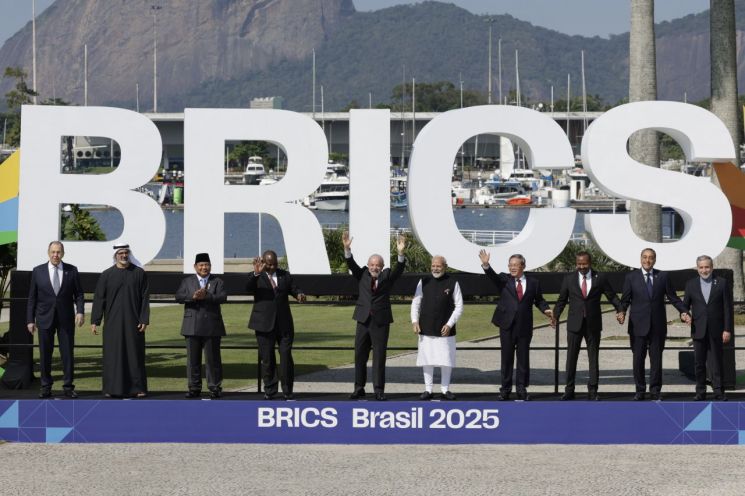 On the 6th (local time), the leaders of each country attending the 17th BRICS Summit held in Rio de Janeiro, Brazil, are taking a commemorative photo. Photo by EPA Yonhap News
According to AFP and other sources, the 11 BRICS member states issued a pre-coordinated joint declaration at the 17th BRICS Summit, which was held on the 6th (local time) at a special venue in the Museum of Modern Art in Rio de Janeiro, Brazil.
In the declaration, the BRICS leaders condemned the "military attack on Iran's peaceful nuclear facilities," which are under full supervision of the International Atomic Energy Agency (IAEA). They also warned against the disruption of the global trading order caused by the "indiscriminate imposition of increased tariffs." Although the declaration did not specifically mention "Trump," foreign media reported that it was, in effect, a direct criticism of the major policies of the Donald Trump administration, accusing them of "threatening the world order."
BRICS also expressed "serious concern" for the Palestinian residents of the Gaza Strip, who are under attack by Israel. In addition, the group pledged full support for a pilot guarantee initiative aimed at reducing funding costs and promoting investment within the New Development Bank (NDB), often referred to as the "BRICS version of the World Bank."
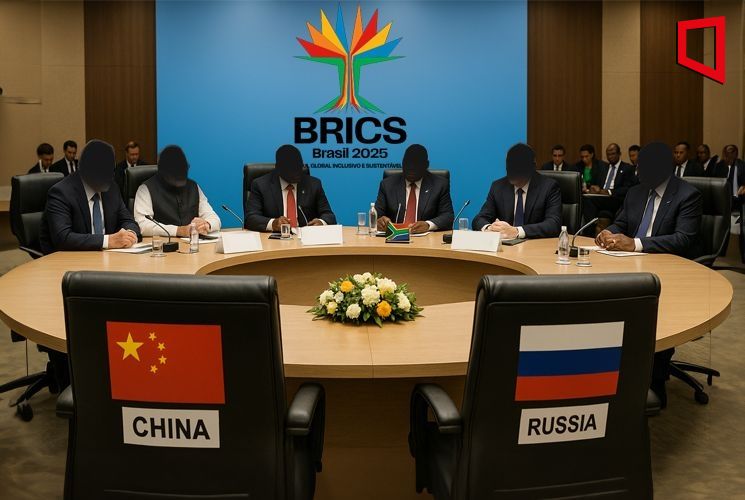
This multilateral diplomatic event, held over two days through July 7, marks the first time the membership has expanded from the original five countries (Brazil, Russia, India, China, South Africa) to 11 countries, with the addition of Egypt, Ethiopia, Iran, Saudi Arabia, the United Arab Emirates (UAE), and Indonesia.
However, the level of international attention was somewhat diminished due to the absence of key national leaders from face-to-face meetings. Chinese President Xi Jinping skipped the BRICS summit for the first time since taking office, and Russian President Vladimir Putin, who is wanted by the International Criminal Court (ICC) for alleged war crimes in Ukraine, participated via video address. Brazil is a member of the ICC.
China was represented by Premier Li Qiang, and Russia by Foreign Minister Sergey Lavrov. Iran, which has experienced armed conflict with Israel, was represented by President Masoud Pezeshkian. Egypt, which is mediating ceasefire negotiations in Gaza alongside Qatar, sent a delegation on behalf of President Abdel Fattah el-Sisi.
In his video address, President Putin emphasized that "the liberal model of globalization is outdated, and BRICS member states must strengthen cooperation in various fields, including natural resource development and financial transactions." He further called for "rapidly growing emerging markets to expand the use of their own national currencies in trade," reiterating the push for "de-dollarization." Russian media such as TASS reported that he also claimed BRICS wields "greater influence in terms of purchasing power parity (PPP)" compared to other international blocs like the Group of Seven (G7), and stressed that "especially in today's global situation, the unified agenda shared by BRICS countries is more urgently needed."
Brazilian President Luiz Inacio Lula da Silva, who chose the Rio Museum of Modern Art?also the venue for last year's Group of Twenty (G20) summit?as the site for this BRICS summit, stated, "This summit is being held amid the worst global situation among the four international conferences recently hosted in Brazil." He emphasized that "if international governance does not reflect the multipolar reality of the 21st century, BRICS must take the lead in reform in the face of threats to multilateralism." President Lula also criticized the North Atlantic Treaty Organization (NATO) for fueling an arms race, referring to its plan to spend 5% of GDP on defense by 2035.
Next year's BRICS summit is scheduled to be held in India.
© The Asia Business Daily(www.asiae.co.kr). All rights reserved.
![Clutching a Stolen Dior Bag, Saying "I Hate Being Poor but Real"... The Grotesque Con of a "Human Knockoff" [Slate]](https://cwcontent.asiae.co.kr/asiaresize/183/2026021902243444107_1771435474.jpg)
















