Korea Federation of SMEs Forms Advisory Group to Gather Opinions
Over Half Say "Implementation Is Difficult"
Different Reactions by Industry... Need for Tailored Approach
President Lee Jae Myung has once again expressed his commitment to implementing the 4.5-day workweek, prompting small and medium-sized enterprises (SMEs), which will be directly affected by the policy, to quickly begin preparing countermeasures. Experts emphasize that the system should be introduced gradually and over the long term, taking into account SMEs that lack sufficient resources, and that meticulous support tailored to the characteristics of each industry must be provided.
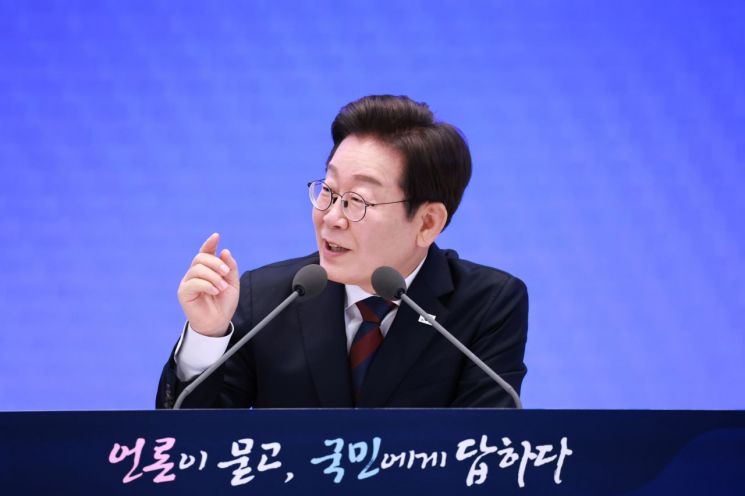 President Lee Jae Myung is speaking at the press conference titled "The President's 30 Days, The Media Asks and the People Answer," held on the 3rd at the Blue House State Guesthouse.
According to industry sources on July 7, the Korea Federation of SMEs recently formed an advisory group of about 30 people, including SME representatives, HR and labor managers, and legal experts, to gather opinions on the new government’s labor policies. At this meeting, there was a wide-ranging discussion on President Lee’s major labor policy pledges, including the implementation of the 4.5-day workweek, the abolition of the comprehensive wage system, and the extension of the retirement age. The advisory group plans to hold regular meetings in the future and communicate the position of Korean SMEs to the relevant authorities. A representative from the Korea Federation of SMEs stated, “We are considering various ways to represent the position of SMEs to the government, including preparing written proposals based on the content of the meetings.”
Recently, following President Lee’s comment at his first press conference since taking office that the 4.5-day workweek is “ultimately the path we must take,” tension has risen in the industry as the possibility of implementation is becoming more real. Although President Lee emphasized “gradual implementation through social dialogue,” many interpret this as a clear expression of his determination to pursue the policy. The 4.5-day workweek is essentially a plan to reduce the current 52-hour workweek to 48 hours. The prevailing concern in the industry is that SMEs, which generally have fewer resources and less funding than large corporations, will be hit the hardest by this change.
An HR manager from an SME who attended the meeting explained, “More than half of the practitioners representing their companies said they are hardly prepared for the introduction of the 4.5-day workweek, and realistically, it would be difficult to implement given various circumstances.” The manager added, “Many cited concerns that shortening working hours would make it difficult to meet deadlines or cover labor costs.” Another HR manager from an SME commented, “There were differences depending on the industry, but in technology-based sectors such as IT, some felt that the 4.5-day workweek could be considered if sufficient government support is provided.”
Experts stress that, given the wide variety of working patterns across SME sectors, the government must develop countermeasures by distinguishing between industries and job types. Rather than a uniform approach, they point out that customized responses reflecting the working methods and organizational cultures of each industry are necessary.
Roh Min Sun, a research fellow at the Korea Small Business Institute, stated, “In the case of manufacturing, more than half operate as subcontractors, making it difficult to flexibly adjust working hours. However, industries such as information and communications, finance, and insurance have relatively more flexibility.” Roh emphasized, “When considering the impact of the 4.5-day workweek and preparing countermeasures, the approach itself must differ according to these industry-specific characteristics.” Roh added, “Rather than mandating the 4.5-day workweek by law from the outset, it would be preferable to initially encourage adoption by offering incentives to participating companies and then gradually expand the policy.”
© The Asia Business Daily(www.asiae.co.kr). All rights reserved.

















