Accelerated Organization of Policy Tasks Following the President's Press Conference
Constitutional Reform Led by the People; Meetings Held with Related Groups
Reviewing Incentive-Based Approaches for Easing Economic Penalties and Fostering New Industries
AI Features Introduced to the Moduui Gwangjang Policy Proposal Platform
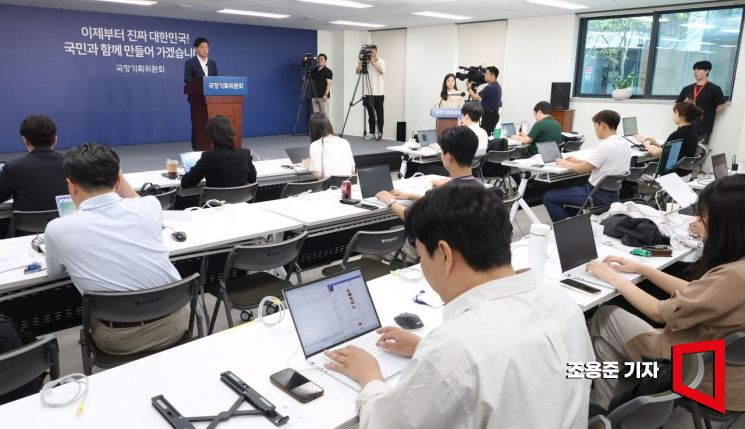 Jo Seungrae, spokesperson for the National Planning Committee, is briefing on current issues at the Changseongdong Annex of the Seoul Government Complex in Jongno-gu, Seoul on the 23rd. 2025.6.23 Photo by Jo Yongjun
The National Planning Committee has announced its intention to complete the organization of national policy tasks ahead of its scheduled activity deadline in mid-August. Following President Lee Jaemyung's press conference on July 3, the administration has entered a phase of accelerated governance.
On July 6, Jo Seungrae, spokesperson for the National Planning Committee, stated at a briefing, "Although the activity deadline is August 14, we are working to finish much earlier than that." He explained, "We are establishing the national vision, goals, strategies, and implementation strategies, while also organizing detailed action items and reviewing fiscal plans."
On the same day, the committee held a meeting with the constitutional amendment advocacy group, 'Nationally-Led Constitutional Reform for Coexistence.' Jo emphasized, "We shared the view that the people must be at the center of constitutional reform," and added, "The President has also expressed his commitment to constitutional reform for national unity through the May 18 Democratization Movement commemoration ceremony and on social networking services (SNS)." He noted, "Since the President's pledges have already been concretized, there is little left to organize in detail," and stated, "The timing and procedures for pursuing constitutional reform are actually the core topics of discussion."
Meanwhile, the Regulatory Rationalization Task Force (TF) within the committee discussed ways to ease economic criminal penalties. Regarding this, Jo explained, "There was a consensus that while regulations necessary for public safety and life should be maintained, it is desirable to design regulations for new industries using an incentive-based approach."
He added, "We believe that market-friendly approaches, rather than punishment-centered regulations, are more advantageous for fostering new industries," and said that specific cases and directions will be announced after further discussion.
The committee is also enhancing operational efficiency and accessibility by equipping the public proposal platform 'Moduui Gwangjang' with artificial intelligence (AI) capabilities. Citizens can now submit policy proposals not only through text but also via voice or images, and the AI will automatically classify and summarize these proposals before forwarding them to the relevant ministries.
'Moduui Gwangjang,' which was launched on June 18, has served as the government's online policy communication channel, receiving around 5,000 policy proposals and 600,000 civil complaints in just about two weeks. Jo stated, "The newly added AI features include automatic classification, multi-modal input, and core summarization," and explained, "The most significant change is that citizens can now submit proposals via speech or photos."
Previously, thousands of proposals had to be manually classified by staff, but with AI now handling this task, processing speed is expected to improve significantly. Jo added, "Since the AI automatically summarizes the key content and classifies the appropriate ministry, the management efficiency of the policy proposal process will also be enhanced."
© The Asia Business Daily(www.asiae.co.kr). All rights reserved.
![Clutching a Stolen Dior Bag, Saying "I Hate Being Poor but Real"... The Grotesque Con of a "Human Knockoff" [Slate]](https://cwcontent.asiae.co.kr/asiaresize/183/2026021902243444107_1771435474.jpg)















