More Than 10% Increase in "Golden Pig Year" High School Seniors Compared to Last Year
19,000 to 20,000 Repeat Test-Takers Expected, Intensifying University Admission Competition
Application Period Begins August 21
Online Application Entry Available This Year... Registration Confirmation Must Be Collected On-Site After Completion
This year's high school seniors will take the 2026 College Scholastic Ability Test (CSAT) on November 13. Although the plan to increase medical school admissions has been scrapped, the number of repeat test-takers continues to rise each year, and the number of current high school seniors?born in the Year of the Golden Pig?has increased by more than 10% compared to last year. As a result, competition for university admission is expected to be even fiercer.
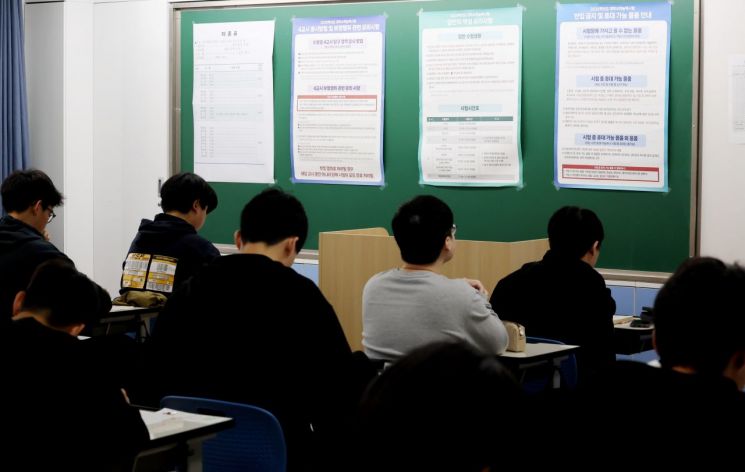
On July 6, the Korea Institute for Curriculum and Evaluation (KICE) announced the "Detailed Implementation Plan for the 2026 CSAT." KICE stated, "We plan to ensure an appropriate level of differentiation, taking into account the results of the mock exams held in June and September, as well as the characteristics of each test section."
In the mock exam held in June, the proportion of students achieving Grade 1 in the English section?which is graded on an absolute scale?reached 19.10%, leading to criticism that the difficulty level was not properly managed. Therefore, it is highly likely that the actual CSAT will be designed to ensure greater differentiation. Education authorities and college admissions experts generally consider an appropriate difficulty level for English to be a Grade 1 rate of around 7%. In last year's CSAT, the proportion of students achieving Grade 1 in English was 6.22%.
The phenomenon of science-track students choosing social studies as their elective subject (known as "Satam Run") is also being highlighted as a variable. "Satam Run" refers to the trend, since the introduction of the integrated CSAT in 2022, of students opting for social studies?which is perceived as less burdensome to prepare for compared to science?over science subjects. In the June mock exam, the social studies participation rate reached a record high of 58.5%. This represents an increase of 8.2 percentage points compared to the 50.2% participation rate in the June mock exam last year. In contrast, the proportion of students taking science subjects during the same period dropped by 15 percentage points to 24.6%. Some analysts have pointed out that a decrease in the number of test-takers may make it more difficult to meet the minimum grade requirements for university admissions, so there is keen interest in whether the "Satam Run" phenomenon will intensify in this year's CSAT.
Meanwhile, the number of CSAT applicants is expected to increase significantly compared to last year. The current high school seniors, who were born in 2007 (the Year of the Golden Pig), number more than 450,000?an increase of over 10% from last year. The number of repeat test-takers continues to rise each year, and it is expected that the total number of repeaters could reach up to 200,000. In addition, the number of medical school admissions for the 2026 academic year has reverted to the pre-increase level of 3,058, which is expected to further intensify competition for university places.

The CSAT test sections remain the same as last year: Korean, Mathematics, English, Korean History, Electives (Social Studies, Science, Vocational), and Second Foreign Language/Chinese Characters. The Korean, Mathematics, and Vocational Electives sections use a "common subject + elective subject" structure. For the Social Studies and Science Electives, students can choose up to two subjects from a total of 17 options, regardless of whether they are social or science subjects. The English, Korean History, and Second Foreign Language/Chinese Characters sections are graded on an absolute scale. For the Korean History and Electives sections, answer sheets for Korean History and Electives are provided separately to each test-taker.
KICE stated, "We will link the CSAT questions to EBS textbooks and lectures, focusing on key concepts and principles emphasized in the curriculum to enhance the sense of relevance." The linkage between EBS materials and the CSAT will be indirect, with the intention of increasing perceived relevance by utilizing tables, diagrams, and passages included in the linked materials. The linkage rate will be maintained at around 50% based on the number of questions in each section and subject.
The on-site registration period for this year's CSAT application is from August 21 to September 5.
Starting this year, test-takers can upload their application photo and enter their application details directly via PC or mobile phone. Afterward, they must pay the application fee to the issued virtual account. However, in order to complete the registration, applicants must visit the registration site in person to verify their identity and receive the registration confirmation slip. Score reports will be distributed by December 5 of this year.
© The Asia Business Daily(www.asiae.co.kr). All rights reserved.
![Clutching a Stolen Dior Bag, Saying "I Hate Being Poor but Real"... The Grotesque Con of a "Human Knockoff" [Slate]](https://cwcontent.asiae.co.kr/asiaresize/183/2026021902243444107_1771435474.jpg)
















