NAND, HBM, and Foundry Strategies in the Second Half
Hold the Key to a Performance Rebound
Samsung Electronics will announce its preliminary results for the second quarter on July 8. With the KOSPI having recovered the 3000 mark, the market's attention is focused on whether the semiconductor division's operating profit will rebound and on the company's strategies for a performance turnaround in the second half of the year.
According to consensus estimates from the securities industry, Samsung Electronics is expected to post an operating profit of approximately 6.3 trillion won and revenue of around 76 trillion won for the second quarter. The Device Solutions (DS) division, which is responsible for semiconductors, is projected to record an operating profit of about 2 trillion won, more than double the 1.1 trillion won posted in the first quarter. Within this, the memory segment has led the improvement in results, but the NAND and foundry segments remain sluggish.
Second-quarter DS division revenue is estimated at 26 to 28 trillion won, with memory revenue expected to be about 20 to 22 trillion won. Operating profit from the memory segment is projected to reach up to 4.6 trillion won.
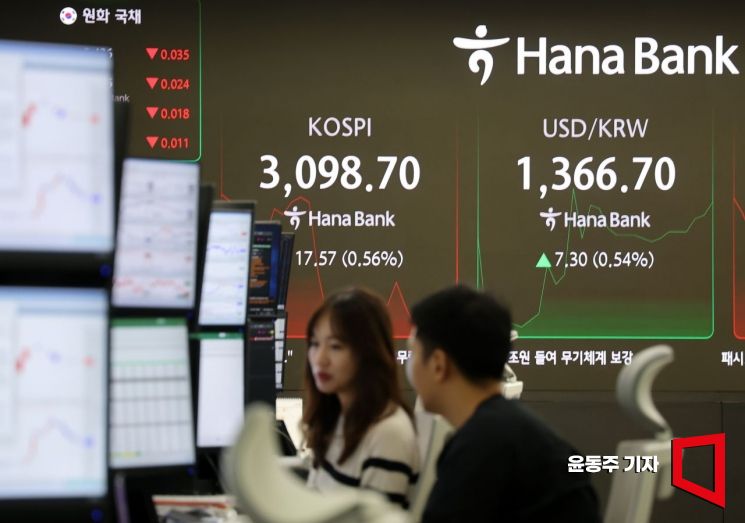 On the 4th, as the KOSPI, which started rising, fell below the 3100 mark amid selling pressure from foreigners and institutions, the index status board displaying KOSPI, KOSDAQ, and exchange rate information is shown in the Hana Bank dealing room in Jung-gu, Seoul, where the battle continues. 2025.07.04 Photo by Dongju Yoon
Starting in the second half of the year, Samsung Electronics plans to focus on restoring competitiveness in memory and recovering profitability in the foundry business. In the NAND segment, a rebound began in the first quarter as customer inventory adjustments and weak demand hit bottom, and Samsung is maintaining production cuts while expanding its lineup of high-value SSD products.
In the HBM segment, Samsung is negotiating supply agreements for its HBM3E (5th generation) 12-layer products with US-based companies such as Nvidia, AMD, and Broadcom. The company also plans to accelerate supply expansion by beginning mass production of HBM4 (6th generation) within the second half of the year. Samsung has already completed PRA (Production Readiness Approval) for its 10-nanometer-class 6th generation (1c) DRAM, establishing a foundation for mass production of HBM4 core dies.
In the foundry segment, Samsung has shifted its strategy from a "speed race" to strengthening fundamentals amid intensifying competition. The company is aiming to begin mass production of advanced 2-nanometer processes by the end of this year, while simultaneously enhancing mature processes of 28 nanometers and above. However, the roadmap for the 1.4-nanometer process has been adjusted from the original target of 2027 to 2029.
For System LSI, Samsung plans to equip the upcoming 'Galaxy Z7 Flip,' scheduled for release in the second half, with its in-house application processor (AP), the Exynos 2500, and will also focus on follow-up projects such as the Exynos 2600, which is scheduled for mass production by the end of the year. The industry is closely watching how much Samsung Electronics can improve semiconductor profitability through regaining leadership in memory and responding to advanced process technologies.
© The Asia Business Daily(www.asiae.co.kr). All rights reserved.
![Clutching a Stolen Dior Bag, Saying "I Hate Being Poor but Real"... The Grotesque Con of a "Human Knockoff" [Slate]](https://cwcontent.asiae.co.kr/asiaresize/183/2026021902243444107_1771435474.jpg)
















