Secured 650 Billion Won Through the Ministry of Land, Infrastructure and Transport's Second Supplementary Budget
1.4 Billion Won Less Than Planned... SOC Budget Also Cut by 1 Trillion Won
With the passage of this year's second supplementary budget on July 5, the annual budget for the Ministry of Land, Infrastructure and Transport has increased to 59.9601 trillion won. The ministry's original budget for this year was 58.176 trillion won, which rose to 59.3112 trillion won after the first supplementary budget, and has now increased by an additional 648.9 billion won. Initially, the plan for this second supplementary budget was to increase the budget by about 790.6 billion won, but this amount was slightly reduced during the review process.
Compared to the second supplementary budget plan prepared in mid-June, the government's contribution to the Project Financing (PF) Advancement Seed Development Anchor REITs was reduced from 300 billion won to 200 billion won. The Anchor REITs initiative is designed to provide initial funding to high-potential construction projects that are unable to transition from bridge loans to main PF loans. The original plan was to operate it at a total scale of 1 trillion won, with approximately 300 billion won in government funding. The government projected that, if realized, this would normalize PF projects worth 5 trillion won annually. It also anticipated that the ability to recover and reinvest funds would increase apartment supply.
However, during the Special Committee on Budget and Accounts review, concerns were raised about whether the government should assume financial institutions' risks, and whether it was appropriate for the state to bear the entire burden for a 1 trillion won REITs structure, considering the involvement of the Housing and Urban Guarantee Corporation. There were also concerns, mainly from opposition party members, that the projects supported by these REITs might be operated by large construction companies, raising the possibility of preferential treatment. As a result, the amount was reduced.
Previously, the National Assembly Budget Office also anticipated that it would be difficult to establish criteria for assessing the business feasibility of specific projects, making the selection process challenging. The PF guarantee support budget for small and medium-sized construction companies was maintained at the originally requested 200 billion won.
The budget for repurchase agreements to purchase unsold housing units in regional areas and provide liquidity was initially set at 300 billion won (200 billion won in equity and 100 billion won in loans), but was reduced to 250 billion won. The government's requested loan amount was halved due to criticism that this measure only temporarily resolves construction companies' moral hazard and short-term liquidity problems.
The government has maintained its plan to purchase 10,000 housing units by 2028, as initially announced. The development anchor REITs, special PF guarantees, and unsold housing repurchase projects were not included in the original annual budget but were added in this second supplementary budget. The government pursued these measures to provide liquidity support for the struggling construction industry, but the opposition party cut 150 billion won from the proposal.
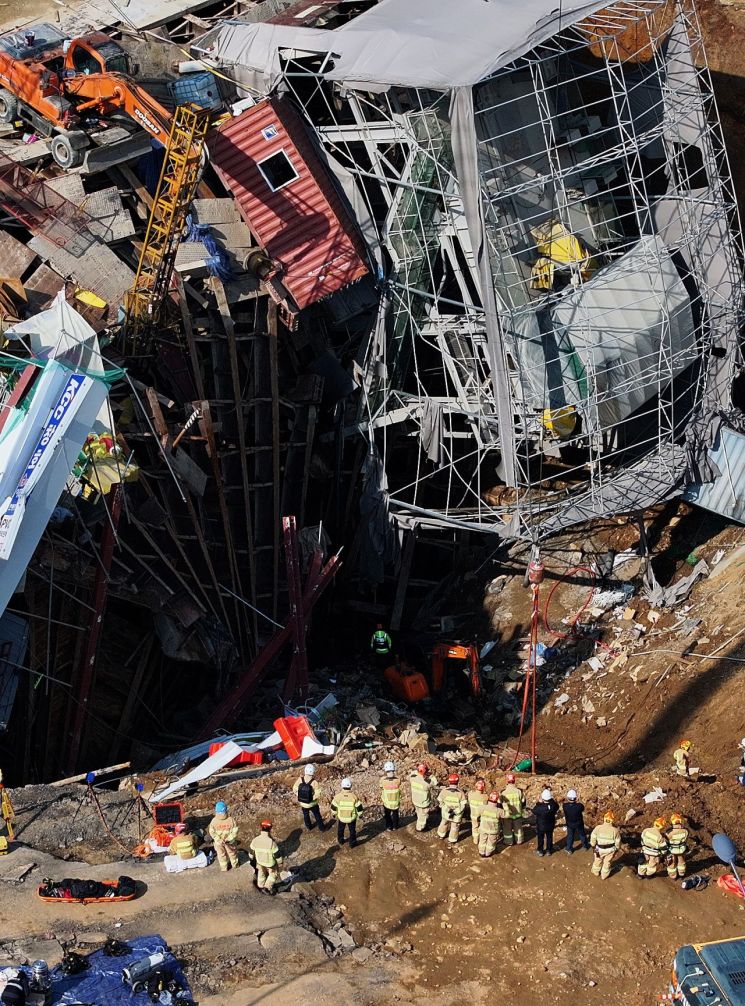 The Gwangmyeong construction site of the Sinansan Line underground tunnel, which collapsed in April this year. Photo by Yonhap News
In this second supplementary budget, the allocation for social overhead capital (SOC) investment increased by 847.5 billion won. The government requested additional funding of 121 billion won for roads, 658.6 billion won for railways, 8 billion won for aviation and airports, and 59.9 billion won for the housing sector. Most of these requests were approved as submitted by the government.
The 377.9 billion won requested for housing stabilization was also finalized as the government proposed. For the temporary special support program for youth monthly rent, an additional 57.2 billion won was allocated due to higher-than-expected applications. Although there were concerns during the review process about inefficient fiscal execution, the increase was ultimately approved.
Through this second supplementary budget, the Ministry of Land, Infrastructure and Transport secured an additional 1.8754 trillion won. However, budget adjustments for projects with slow or inefficient progress resulted in a reduction of 1.2265 trillion won. Looking only at SOC, the budget was cut by over 100 billion won. The budget for the new Gadeokdo Airport, which had been set at over 960 billion won, was reduced by more than half. For the Donggwangju-Gwangsan Expressway, the entire 36.7 billion won allocation was initially cut, but half was restored during the review. The budgets for the Pohang-Yeongdeok Expressway and the Chungbuk Line high-speed rail project were also reduced by more than half.
© The Asia Business Daily(www.asiae.co.kr). All rights reserved.
![Clutching a Stolen Dior Bag, Saying "I Hate Being Poor but Real"... The Grotesque Con of a "Human Knockoff" [Slate]](https://cwcontent.asiae.co.kr/asiaresize/183/2026021902243444107_1771435474.jpg)












