1,300 Small Earthquakes in Two Weeks
Past Cases Show Seismic Activity Lasted for Months
At around 6:29 a.m. on July 5, a magnitude 5.3 earthquake struck the Tokara Islands in Kagoshima Prefecture, Kyushu, Japan, according to the Japan Meteorological Agency. Over the past two weeks, more than 1,300 small-scale earthquakes have occurred in the Tokara Islands, and growing anxiety is being fueled by rumors of a "July Great Earthquake in Japan" spreading mainly through social networking services (SNS).
The Tokara Islands consist of seven inhabited islands and five uninhabited islands located south of Kyushu. In December 2021 and September 2023, each period saw more than 300 small-scale earthquakes occur consecutively in this area. However, this time, the number of earthquakes is much higher than before, and there have also been stronger quakes with more intense shaking.
 More than 1,300 small-scale earthquakes have occurred over the past two weeks in the Tokara Islands of Japan. The photo shows Akusekijima Island, part of the Tokara Islands. Photo by Yonhap News
On July 5, the Asahi Shimbun reported that Japanese earthquake experts cited the region's unique topography and its connection to submarine volcanoes as reasons for the ongoing earthquakes in the Tokara Islands.
Hiroshi Yakiwara, a professor at Kagoshima University, stated, "The heterogeneous and complex topography may have influenced the earthquakes." Takuya Nishimura, a professor at the Disaster Prevention Research Institute at Kyoto University, suggested, "Forces such as the movement of underground magma, which continue to push the ground, may be having an effect." He also pointed out that the current earthquake swarm in the Tokara Islands is unusual because the duration is long and the magnitude is gradually increasing. This is different from the typical pattern, where small aftershocks continue after a major earthquake and the crustal movement gradually subsides.
On July 2, more than ten days after the earthquake swarm began in the Tokara Islands, a magnitude 5.6 earthquake occurred, followed by a magnitude 5.5 earthquake on July 3. In terms of seismic intensity, the earthquake on July 3 was the strongest, with an intensity of lower 6. Seismic intensity lower 6 is strong enough to break wall tiles or window glass and topple bookshelves. Professor Nishimura predicted that as long as earthquakes below magnitude 6 continue in the Tokara Islands, the likelihood of a tsunami (seismic sea wave) occurring is very low.
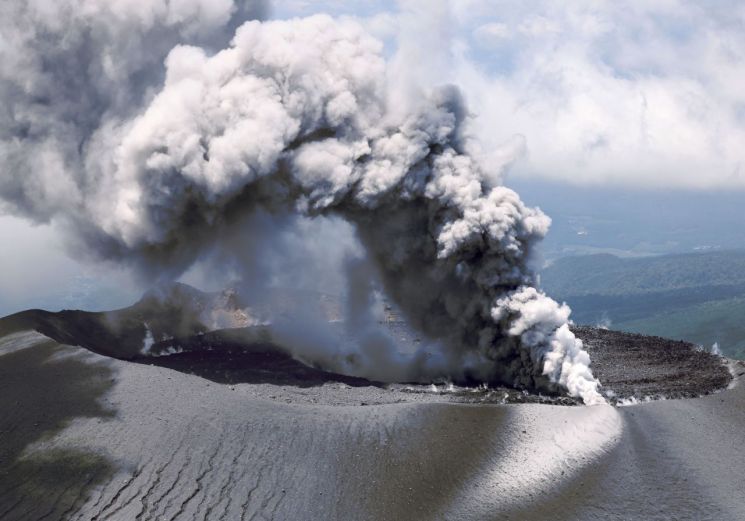 On the 3rd, smoke from Shinmoedake, an active volcano in Kyushu, Japan, rose up to 5,000 meters high. The photo shows the eruption of Shinmoedake on the 28th of last month. Photo by Yonhap News
Naoshi Hirata, chair of the Japanese government's Earthquake Research Committee, stated at a meeting the previous day that there have been cases in the past where earthquakes in the Tokara Islands continued for several months, so it is unlikely to end in just a week.
Leo Kimura, a professor at Hyogo Prefectural University who studies disaster psychology, commented to the Asahi Shimbun regarding the spread of great earthquake rumors online, saying, "Anxiety is fueling more anxiety, which is a very bad situation." He explained, "Not everyone who encounters this information will truly believe it," but added, "Even people with some scientific understanding may find it hard to ignore if they keep seeing or hearing such information." He emphasized, "Anxiety cannot be relieved through SNS. Since there is always a possibility of a major earthquake, it is most important to prepare thoroughly for disasters to alleviate anxiety." He further advised, "If you cannot stop using SNS, you should frequently visit reliable sources such as the Meteorological Agency's website and replace the information you see on your smartphone with trustworthy information."
© The Asia Business Daily(www.asiae.co.kr). All rights reserved.
![Clutching a Stolen Dior Bag, Saying "I Hate Being Poor but Real"... The Grotesque Con of a "Human Knockoff" [Slate]](https://cwcontent.asiae.co.kr/asiaresize/183/2026021902243444107_1771435474.jpg)
















