Twenty-Eight Ancient Burial Mounds from the 5th and 6th Centuries
Maintaining Independence While Localizing Foreign Artifacts
The Cultural Heritage Administration announced on July 7 that it has designated the 'Yeongam Sijong Burial Mounds,' which illustrate the social and cultural changes of the Mahan regional society, as a National Historic Site.
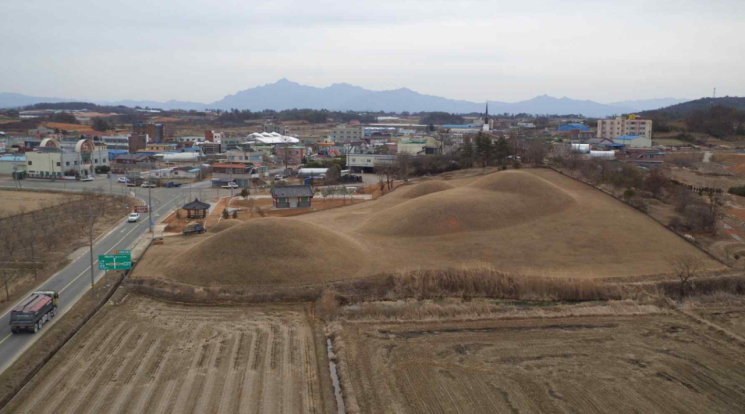
Sijong-myeon is an area where the Yeongsan River, the Sampogang River, and southern tributaries can all be viewed. As a strategic location situated at the gateway between the West Sea and the inland, it has long served as a hub for maritime transportation, accepting advanced cultures from outside. Thanks to this, the Mahan powers in this region were able to create a complex and original culture, influenced by Baekje, Gaya, and China.
A representative example is the Yeongam Sijong Burial Mounds. Comprising twenty-eight ancient tombs built in the 5th and 6th centuries, these mounds demonstrate social and cultural changes in the Mahan communities along the Yeongsan River through their construction techniques. Over time, the burial style evolved from the traditional Mahan jar coffins to large-scale Bangdaehyeong mounds with stone chambers and stone cists. The tombs were constructed in a planned manner, using clay to divide the area into radial or concentric sections and building up the separated zones with earth.
Artifacts excavated here include pottery typical of the period, gilt-bronze crown ornaments associated with Baekje, Chinese celadon cups, and Southeast Asian glass beads. Cylindrical pottery and animal-shaped clay figures, used as decorations on the mound exteriors, have also been found. These foreign artifacts are believed to have been localized, and are considered evidence that the indigenous powers of the time maintained both independence and cultural identity while interacting with various neighboring countries.
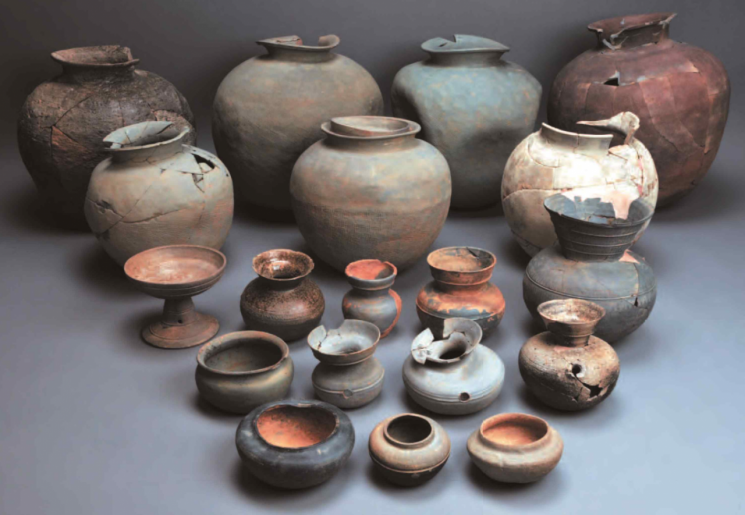
The Cultural Heritage Administration stated, "This is the result of localizing the traditional elements of Mahan with the addition of cultures from Baekje, Gaya, China, and Wa," adding, "It has significant historical and academic value."
© The Asia Business Daily(www.asiae.co.kr). All rights reserved.
![Clutching a Stolen Dior Bag, Saying "I Hate Being Poor but Real"... The Grotesque Con of a "Human Knockoff" [Slate]](https://cwcontent.asiae.co.kr/asiaresize/183/2026021902243444107_1771435474.jpg)
















