[The Path to a Just Transition]
Ⅰ. Conflicts Arising from the Energy Transition
Those Left Behind in the Shift from Coal to Renewable Energy
The international community has established the principle of a "just transition" for energy transition, emphasizing that no one should be left behind amid the opportunities and crises arising from the transformation of industry and labor. In 2015, the International Labour Organization (ILO) adopted guidelines stating that the major transition required to address the climate crisis should proceed fairly, with cooperation among governments, businesses, and workers, so that the burden is not placed on only certain groups. The Framework Act on Carbon Neutrality, enacted in 2021, also explicitly includes the principle of a just transition.
Through the special series "The Path to a Just Transition," Asia Economy plans to examine the conflicts encountered during the government's coal phase-out and offshore wind farm installation, and to report on how the UK, France, and Poland have addressed such conflicts through their own just transition experiences.
"It feels like working with an expiration date hanging over me."
Park Jonghyun, a 37-year-old manager at Geumhwa PSC, a first-tier subcontractor at the Taean Thermal Power Plant in South Chungcheong Province, has worked there for 14 years and is constantly anxious that the upcoming closure of the plant may lead to unemployment. Park, who has been responsible for pump maintenance on the turbine team, has replaced bearings when pumps malfunctioned and changed oil when it became discolored. There was a time when thermal power plants were at the core of domestic electricity production, requiring emergency shifts during the summer, but the era of decarbonization has brought about a period of transition.
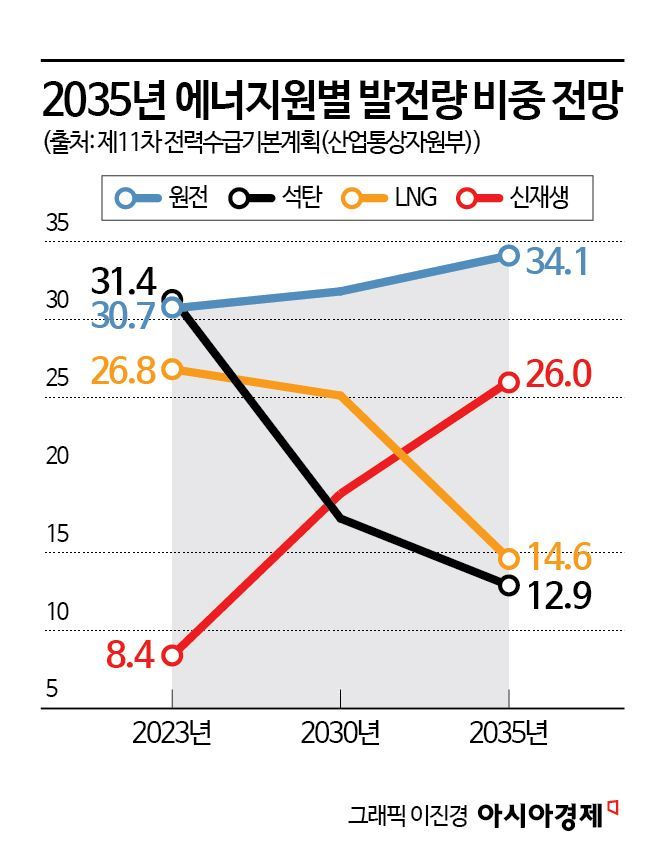
The government, after officially joining the Paris Agreement in 2016, set a goal of reducing greenhouse gas emissions by 40% compared to 2018 levels by 2030. To achieve this, it plans to begin shutting down coal-fired power plants in succession, starting with Taean Unit 1 in December this year. Once the plants are closed, it will become difficult for both first- and second-tier subcontractors to continue operations. According to the 11th Basic Plan for Electricity Supply and Demand (2024?2038), announced by the Ministry of Trade, Industry and Energy in March, coal and nuclear power each accounted for 31% of power generation in 2023, with liquefied natural gas (LNG) at 27% and renewables at 10%. The goal is to reduce coal to 12.9% and increase renewables to 26.0% by 2038.
There have been transition measures for power plant and subcontractor workers, but the problem has been their effectiveness. Park said, "I attended job transition training provided by the Ministry of Employment and Labor, but it was useless," adding, "I even went from Taean to Boryeong out of hope, but was simply told to try working at an ice cream factory or a car factory, which have nothing to do with my current job. The training was not systematic at all."
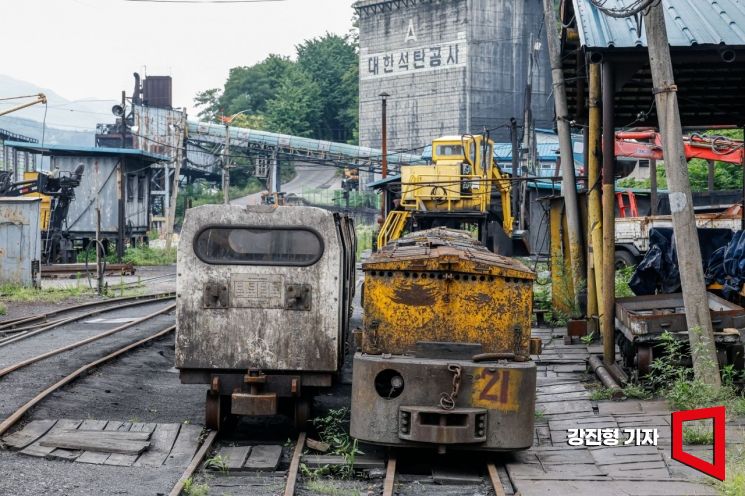 June 30, 2025, Do-gye Mining Office of Korea Coal Corporation in Samcheok City, Gangwon Province, a closed coal mine. Photo by Kang Jinhyung
Kim Younggu, head of the Hadong branch of Korea Plant Service & Engineering (HPS) and a worker at the Hadong Thermal Power Plant in South Gyeongsang Province, is fearful that the plant's closure, set to begin in March 2027, could force him to separate from his family. Kim said, "If we are simply told to move to another region with a thermal power plant, it would be a huge burden for employees who live with their families," adding, "My daughter, who just turned twenty, has been worrying about me after reading books about the climate crisis." He emphasized that if reemployment is not guaranteed, the government should provide countermeasures such as unemployment benefits and livelihood support.
Those left behind by the end of the industry are standing at a crossroads of survival. Workers report that, due to the closure of power plants, new hires are not being made, leading to chronic understaffing and increased risk of accidents. Non-regular workers at thermal power plants have been holding weekly rallies in Seoul since the industrial accident death of subcontracted worker Kim Chunghyun.
After the closure of the last state-run coal mine at the Do-gye Mining Office in Samcheok, Gangwon Province on June 30, 2025, residents who have lost their jobs are gradually leaving their hometowns. The government has been conducting a preliminary feasibility study for 18 months on establishing a designated duty-free shop and a heavy ion accelerator cluster in the Samcheok mining area, but has yet to reach a conclusion. Kim Gwangtae, head of the Samcheok Dogye-eup Prosperity Association, said, "With the closure of Korea Coal Corporation, local residents are now fighting for their right to survive without workers," adding, "Government measures that do not reflect the local reality only bring despair."
As coal-fired power plants are being shut down, renewable energy projects, especially those centered on offshore wind power, are accelerating. The expansion of renewable energy is essential in the process of energy transition to achieve carbon neutrality. According to the 11th Basic Plan for Electricity Supply and Demand, the government plans to increase wind power generation capacity by 540.2% and solar power generation capacity by 75% by 2029. The passage of the Special Act on Offshore Wind Power in the National Assembly in February has further boosted the industry.
However, fishermen fear losing the sea, which has been their lifelong source of livelihood. With Goheung County in South Jeolla Province selected for the "2025 Large-Scale Offshore Wind Farm Development Support Project" led by the Ministry of Trade, Industry and Energy and the Korea Energy Agency, a preliminary feasibility study is underway to build a 2-gigawatt (GW) offshore wind power complex in the nearby waters. Kim Seongsu, a 49-year-old seaweed farmer off the coast of Sisan Island in Goheung County, said, "Despite expressing our opposition hundreds of times at dozens of briefings, the Ministry of Industry granted development permits based only on the signatures of a few representatives, completely ignoring the opinions of residents." He added, "There has been no sincere dialogue with fishermen, and under the pretext of environmental surveys, developers have been going around the villages, even fueling conflicts among residents."
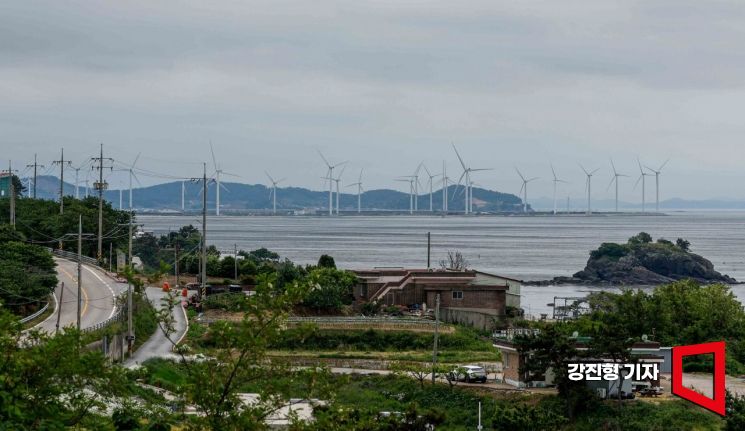 Yeonggwang Wind Power Complex viewed from Baeksu Coastal Road, Yeonggwang County, Jeollanam-do. Photo by Hyung Kang
This special report was supported by the Press Promotion Fund, which is financed by government advertising fees.
© The Asia Business Daily(www.asiae.co.kr). All rights reserved.
![Clutching a Stolen Dior Bag, Saying "I Hate Being Poor but Real"... The Grotesque Con of a "Human Knockoff" [Slate]](https://cwcontent.asiae.co.kr/asiaresize/183/2026021902243444107_1771435474.jpg)

















