Attended Seminar on the 3rd, Criticizes Local Political Reality
Female Council Members in Provincial Assembly Only 16%, Below National Average
No Female Metropolitan Council Members in Mokpo, Yeosu, Naju, and Others
Network-Based Practices Identified as Barrier to Women's Political Entry
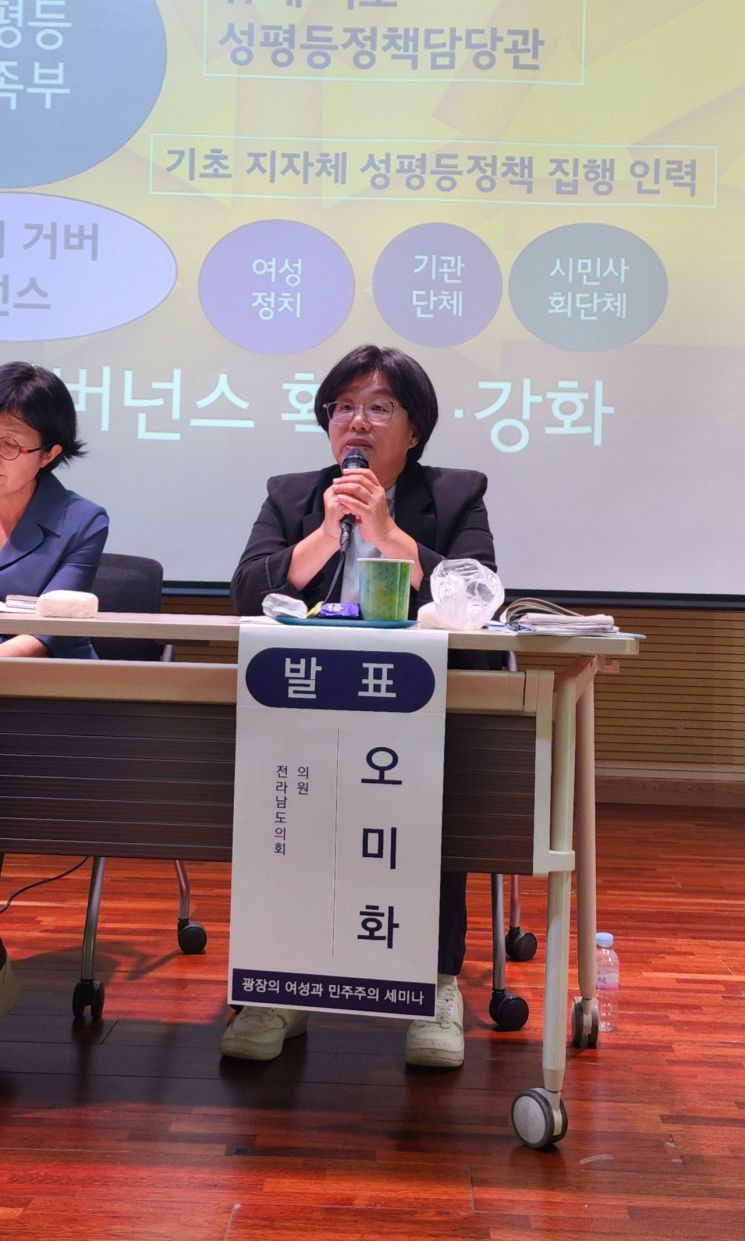 On the 3rd, at the Convention Hall on the 1st floor of the Production-Type Startup Support Center at Mokpo National University Namak Campus, Assemblywoman Oh Mihwa is giving a keynote presentation at the seminar titled "Women in the Square and Democracy." Provided by Jeonnam Provincial Council
Assemblywoman Oh Mihwa of the Jeonnam Provincial Council (Progressive Party, Yeonggwang 2) pointed out that a major transformation is needed in Jeonnam's regional politics. She specifically stated that the established practices that have blocked the entry of women politicians must be reformed.
On the 3rd, Assemblywoman Oh attended the seminar "Women in the Square and Democracy" held at Mokpo National University Namak Campus as a panelist, where she gave a presentation on "The Role and Challenges of Women Politicians for Creating a Gender-Equal Region."
On that day, Assemblywoman Oh delivered the message that empowering women politically is key to achieving gender equality and democracy in the region, drawing from her own experiences and the local realities.
Assemblywoman Oh pointed out, "As of the 2022 local elections, the proportion of female council members in the Jeonnam Provincial Council was 16%, falling short of the national average of 19.8%. In basic local councils, the figure was also only 23.5%, significantly lower than the national average of 33.4%." She added, "Jeonnam ranks 16th among the 17 metropolitan cities and provinces nationwide, making it a region with extremely poor female political representation."
She specifically mentioned that among the five cities in Jeonnam, there are no female council members in the metropolitan councils of urban areas such as Mokpo, Yeosu, and Naju. She emphasized, "It has long been thought that women in rural areas face difficulties entering politics, but it is important to recognize that urban areas do not necessarily provide more political opportunities for women."
She further analyzed, "The proportion of female heads of metropolitan and basic local governments remains around 3% nationwide, and this lack of women leaders with decision-making power is a factor that hinders gender equality in the region."
She cited several obstacles that block women's entry into politics, including "exclusion from regionally networked, relationship-based social circles," "restrictions on pursuing politics within the family," "the financial burden of election costs," and "the difficulty of balancing childcare with legislative activities."
Referring to a survey by the Jeonnam Women's Family Foundation, she also highlighted, "There is a gap in perception, as most women politicians still experience gender discrimination, but male council members are often not aware of this."
In conclusion, Assemblywoman Oh added, "Gender equality is not achieved by systems alone, but through practice," and stated, "Politics is the most powerful tool for realizing democracy. Only when women themselves become the main agents in politics can the region change and true democracy advance."
© The Asia Business Daily(www.asiae.co.kr). All rights reserved.
![Clutching a Stolen Dior Bag, Saying "I Hate Being Poor but Real"... The Grotesque Con of a "Human Knockoff" [Slate]](https://cwcontent.asiae.co.kr/asiaresize/183/2026021902243444107_1771435474.jpg)















