South Korea and China's Shandong Province sought new horizons for cooperation in the maritime industry amid a period of geopolitical upheaval.
The Korea Maritime Institute (KMI), led by President Cho Jeonghee, held the '4th Korea-Shandong Province Exchange and Cooperation Forum' in Qingdao, China on July 3. The event was hosted by the Consulate General of the Republic of Korea in Qingdao and the Shandong Provincial Department of Commerce, and co-organized by KMI and the Shandong Academy of Social Sciences' Institute of Marine Economy and Culture.
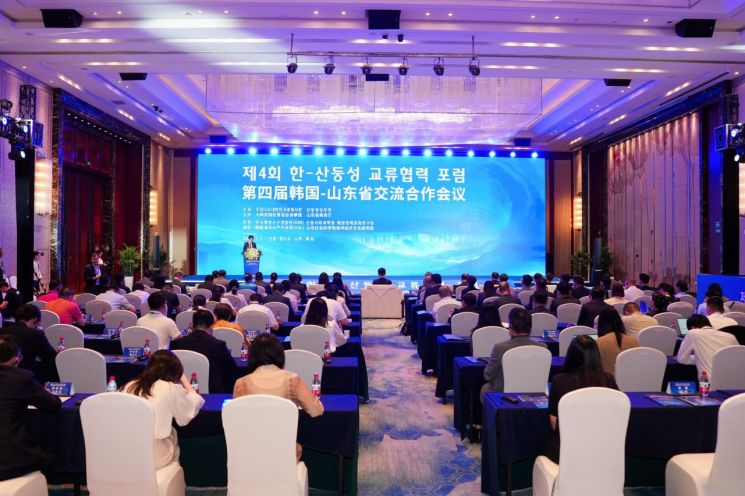 KMI is holding the 'Korea-Shandong Province Exchange and Cooperation Forum' in Qingdao, China. Photo by KMI
The event brought together more than 100 experts and stakeholders from both countries, representing fields such as maritime affairs and fisheries, port logistics, marine energy, and tourism, including participants from industry, academia, research, and government, for in-depth discussions.
The forum was divided into four sessions: maritime affairs and fisheries, shipping and port logistics, marine tourism, and marine energy. In each session, Korean and Chinese experts presented case studies and shared insights.
In the maritime affairs and fisheries session, Lee Yosep, Director at the Korea Fisheries Infrastructure Promotion Agency, proposed strategies for establishing a sustainable aquaculture foundation and enhancing fishery resilience through the 'Clean Fishery Regeneration Project.' Meanwhile, Pei Shoucheng, Vice President of Shandong Meijia Group, discussed the potential for joint distribution and development cooperation in the marine food processing industry.
In the port logistics session, Choi Nayounghwan, Director of Strategic Planning at KMI, presented measures to expand digital logistics cooperation and inter-port transport connectivity. Wang Sheng, Deputy Director of the Shandong Academy of Social Sciences, emphasized the need for a joint data platform and integration of automation systems to improve the efficiency of Korea-China shipping routes.
Focusing on the cruise industry, the marine tourism session featured Shim Sangjin, Vice Chairman of the Korea Cruise Forum, who highlighted that launching regular routes with Shandong and developing integrated tourism content would elevate marine tourism between the two countries. Chi Yongjie, Director of China Kaisa Group, proposed the creation of a comprehensive marine tourism belt based on Shandong's marine cultural content.
In the marine energy session, Jung Yeo-jin, Associate Research Fellow at KMI, introduced the carbon reduction effects of blue carbon ecosystems and strategies for linking with international carbon credits. Chen Fengyun, Researcher at the First Institute of Oceanography in China, discussed the current state of marine energy technology development in Shandong and stressed the need to expand technical cooperation with Korea.
During the general discussion, KMI Associate Research Fellow Hwang Jinhoe and Xu Guangping, President of the Shandong Academy of Social Sciences, served as moderators, summarizing the key points from each session and building consensus on the need to institutionalize maritime cooperation and establish a long-term framework.
In his congratulatory remarks, KMI President Cho Jeonghee stated, "Shandong Province and Korea are maritime strategic partners sharing the Yellow Sea," and added, "KMI will actively provide platforms for cooperation in areas such as port logistics, fisheries processing, blue carbon, and marine tourism."
He further emphasized, "I hope this forum will serve as a milestone for comprehensive cooperation in policy, technology, and industry beyond short-term exchanges. Based on our friendship with Shandong, we will work to realize a future-oriented maritime partnership."
Based on the outcomes of this forum, the Korea Maritime Institute plans to identify sustainable cooperative projects with Shandong Province and to officially launch practical channels for joint research and expanded technological exchange.
© The Asia Business Daily(www.asiae.co.kr). All rights reserved.
![Clutching a Stolen Dior Bag, Saying "I Hate Being Poor but Real"... The Grotesque Con of a "Human Knockoff" [Slate]](https://cwcontent.asiae.co.kr/asiaresize/183/2026021902243444107_1771435474.jpg)















