Held at a Large-Scale Restaurant in Pyongyang
Central TV: "Over 200 Chefs Participated"
In contrast to South Korea, where a ban on the sale of dog meat is imminent, North Korea is actively encouraging the consumption of dog meat. Ahead of the hottest days of summer, a large-scale dog meat cooking contest held in Pyongyang has drawn attention.
On July 4, Yonhap News quoted Chosun Central TV's July 3 report, stating, "A 'Pyongyang City Dog Meat Cooking Contest' was recently held at Hwaseonggak, a large-scale restaurant in Pyongyang." In North Korea, dog meat is called "dangogi" because it is said to taste sweeter the more you chew it.
 On the 3rd, Chosun Central TV reported that a "Pyongyang City Dog Meat Cooking Contest" was recently held at Hwaseonggak, a large-scale restaurant in Pyongyang. In Jangsugak, Pyeongsong City, South Pyongan Province, the South Pyongan Province Dog Meat Cooking Contest was also held. Screenshot from Chosun Central TV
According to Yonhap News, Jang Youngmi, an official from the Pyongyang City People's Committee, introduced, "More than 200 chefs from 63 units in the city's public catering and food procurement sectors participated, which is twice as many units as last year." Jang explained the significance of the event, saying, "This contest serves as a good opportunity to further improve the processing level of dangogi dishes, including dangogi soup, which has traditionally been considered a health food during the hottest days of summer, and to share skills and experiences among the participating units."
The contest was held at Hwaseonggak, a restaurant located in the Hwaseong District, a new town in Pyongyang completed in 2023. With a site area of over 26,000 square meters and more than 1,000 seats, the event took place at a landmark restaurant in the Hwaseong District, suggesting that a significant number of visitors attended. Central TV also reported that a South Pyongan Province Dog Meat Cooking Contest was held at Jangsugak in Pyeongsong City, with many chefs from Pyeongsong City, Jungsan County, Ryongwon County, and Songchon County participating.
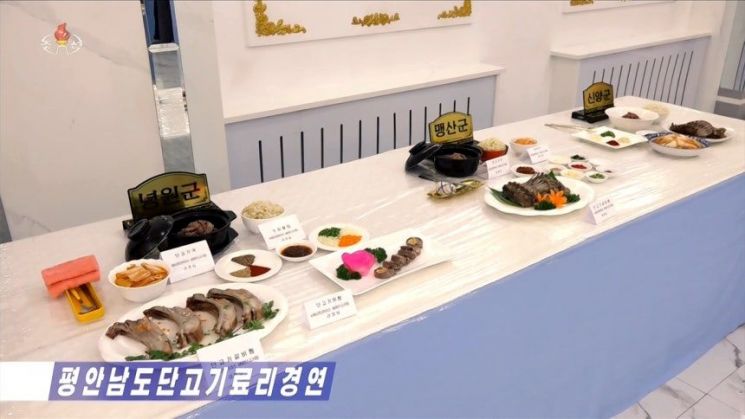 On the 3rd, Chosun Central TV reported that a "Pyongyang City Dog Meat Cooking Contest" was recently held at Hwaseonggak, a large-scale restaurant in Pyongyang. In Jangsugak, Pyeongsong City, South Pyongan Province, the South Pyongan Province Dog Meat Cooking Contest was also held. Screenshot from Chosun Central TV
North Korea holds nationwide cooking contests every year to promote dog meat. North Korean chefs prepare dog meat in a variety of ways, including not only boshintang (dog meat soup) and dog meat stew, but also dangogi sirloin jjim (braised dog meat sirloin), dangogi galbijjim (braised dog meat ribs), dangogi tomakjjim (braised dog meat chunks), and dangogi naepo bokkeum (stir-fried dog meat offal).
North Korea claims that dog meat dishes have flourished under the leadership of Kim Il-sung and Kim Jong-il during the era of the Workers' Party. In fact, Kim Il-sung and Kim Jong-il are known to have held dog meat in special regard. In 2022, North Korea registered Gyeongseong Dangogi-guk from North Hamgyong Province as an Intangible Local Cultural Heritage, stating that "it fully demonstrates the wisdom and talent of our people."
The reason North Korea encourages dog meat consumption is due to a lack of protein sources. Beef is scarce in North Korea, and it is difficult for ordinary households to raise pigs. In contrast, dogs can be raised in rural households without significant financial burden, making them a source of animal protein.
This stands in stark contrast to the trend in South Korea, where in February last year, a "Special Act on Ending the Breeding, Slaughter, and Distribution of Dogs for Human Consumption" (Dog Meat Ban Act) was enacted. Under this law, starting in 2027, breeding, slaughtering, distributing, or selling dogs for human consumption will be prohibited. Anyone who slaughters dogs for consumption may face up to three years in prison or a fine of up to 30 million won, while those who breed, propagate, or distribute dogs for this purpose may face up to two years in prison or a fine of up to 20 million won.
© The Asia Business Daily(www.asiae.co.kr). All rights reserved.
![Clutching a Stolen Dior Bag, Saying "I Hate Being Poor but Real"... The Grotesque Con of a "Human Knockoff" [Slate]](https://cwcontent.asiae.co.kr/asiaresize/183/2026021902243444107_1771435474.jpg)
















