The government has launched control measures against the mass outbreak of Plecia nearctica, commonly known as lovebugs, on Gyeyangsan Mountain in Incheon.
On July 4, the Ministry of Environment announced that it had begun on-site support for pest control and the removal of dead insects on Gyeyangsan Mountain in Incheon Metropolitan City, where the massive emergence of lovebugs has caused severe inconvenience to residents.
Lovebugs are an invasive species believed to have originated in southern China. Since they were first identified in Korea in 2015, they have experienced mass outbreaks annually from June to July, mainly in the Seoul metropolitan area, starting in 2022. This year, in particular, Gyeyangsan Mountain in Incheon has seen an unusually large outbreak, making on-site intervention urgent.
On this day, 37 personnel from the Ministry of Environment, including staff from the headquarters and the National Institute of Biological Resources, were deployed to the site. They are working in collaboration with about 10 pest control workers from the Gyeyang District Office, using equipment such as blowers, insect nets, and spraying devices for the control operations.
Additionally, three units of "light source trapping devices," developed based on the lovebugs' tendency to be attracted to light, will be newly deployed at the site. Previously, on July 2, the National Institute of Biological Resources under the Ministry of Environment had urgently installed four light source trapping devices on Gyeyangsan Mountain in Incheon as part of a test-bed process. The results confirmed that these devices are effective in attracting and capturing lovebugs.
The Ministry of Environment has determined that other insect species may also experience mass outbreaks this year and plans to strengthen its response system in cooperation with local governments. This is because, in addition to lovebugs, species such as stick insects, Ephemera orientalis, Metcalfa pruinosa, and chironomids could also see large-scale outbreaks after July.
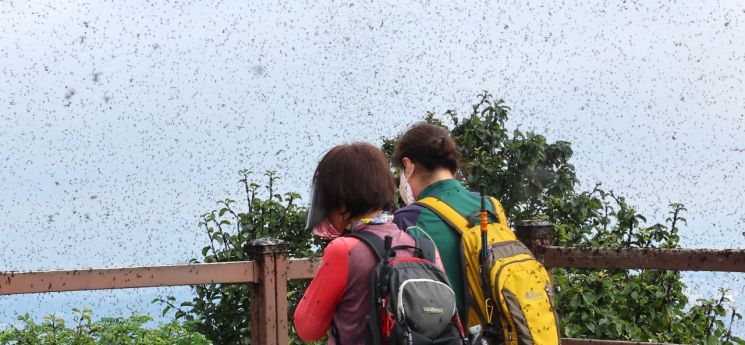 Lovebugs Cover the Summit of Gyeyangsan Mountain
(Incheon=Yonhap News) Reporter Soonseok Lim = On the morning of the 30th, the summit of Gyeyangsan Mountain in Gyeyang District, Incheon, was covered with lovebugs (Plecia nearctica), causing inconvenience to hikers. 2025.6.30
soonseok02@yna.co.kr (End)
The "Ministry of Environment-Seoul Metropolitan Government-National Institute of Biological Resources Collaboration System," which has been in operation since last year, will be expanded to include Incheon, Gyeonggi Province, and relevant local governments, and, if necessary, a consultative body encompassing neighboring municipalities will also be activated. The Ministry of Environment will establish a task force operating 24 hours a day and involve an advisory panel of experts to ensure that the latest research findings are quickly applied in the field.
Mid- to long-term research and development (R&D) investments related to mass insect outbreaks will also be increased. The Ministry will expand R&D on "AI-based prediction and control technology for mass insect outbreaks" to study the impact of climate crisis-induced ecological changes on insect habitats. There will also be focused investment in technologies and equipment to secure environmentally friendly and species-specific control methods.
The Ministry plans to compile a list of insect species that are likely to appear in Korea due to climate change and will begin full-scale research on species characteristics and control methods. Institutional measures will also be prepared to manage insects that cause significant inconvenience to the public. Currently, there is no legal basis for managing mass outbreak insects such as lovebugs, resulting in difficulties in securing budget support and funding for technology development for local governments. To address this, the Ministry plans to designate legally managed species and develop systematic response measures through discussions with experts, local governments, and civic groups.
Kim Taeo, Director General of the Nature Conservation Bureau at the Ministry of Environment, stated, "This year's mass insect outbreaks are extremely serious, and with the increasing uncertainty in ecosystems due to climate change, we cannot afford to let our guard down during the summer. We will closely monitor the situation, respond in cooperation with local governments from the initial stages of any outbreak, and actively support with Ministry personnel, equipment, and emergency control budgets."
© The Asia Business Daily(www.asiae.co.kr). All rights reserved.
![Clutching a Stolen Dior Bag, Saying "I Hate Being Poor but Real"... The Grotesque Con of a "Human Knockoff" [Slate]](https://cwcontent.asiae.co.kr/asiaresize/183/2026021902243444107_1771435474.jpg)















