10-Year U.S. Treasury Yields Edge Up Slightly
Driven by Employment Data
Greater Focus on Monetary Policy and Tariff Negotiations
Long-Term Burden for Bonds and the Dollar
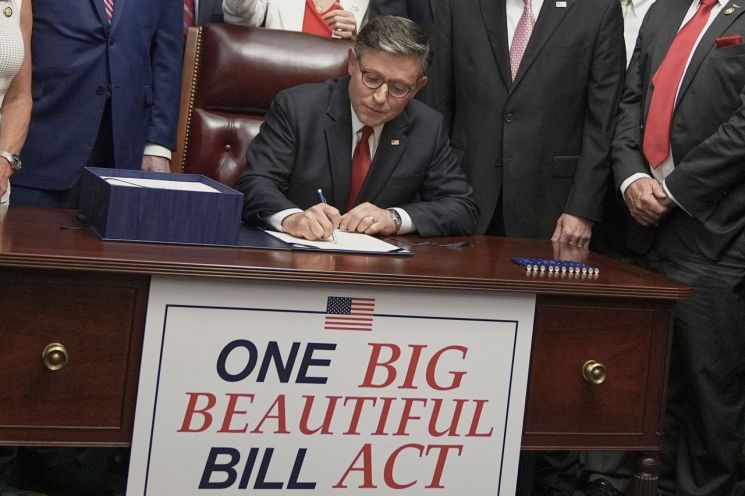
On the 3rd (local time), the tax cut package bill pushed by President Donald Trump passed the threshold of the U.S. Congress. What impact will it have on the markets? Experts believe that the so-called "Trump tax cut plan" will not have an immediate effect on the U.S. stock market, as it is a policy that had already been anticipated. Instead, they see the upcoming July 8 deadline for reciprocal tariff negotiations, the Federal Reserve's monetary policy direction, and corporate earnings announcements as the main variables that will determine the future course of the stock market. However, concerns have been raised that an increase in the fiscal deficit and a surge in government bond issuance resulting from the implementation of the bill could weaken demand for U.S. Treasuries in the long term.
Tim Murray, chief strategist at T. Rowe Price, told the Nihon Keizai Shimbun that "most of the tax cuts included in this bill are merely an extension of the tax benefits from Trump's first term," and assessed that "the impact on the bond market will also be limited, and there will be no extreme reactions such as a sharp rise in interest rates."
The analysis is that the market has already sufficiently priced in the tax-cutting stance following President Donald Trump's return to power, so the short-term shock from the implementation of this tax cut bill will be limited. Structural risks such as an increased fiscal deficit and rising national debt are also not seen as factors that will immediately shake the asset markets.
The foreign exchange market also showed little reaction. Marc Chandler, chief market strategist at Bannockburn Global Forex, said, "The passage of the bill was already a foreseen event, and it also happened just ahead of the U.S. Independence Day (July 4) holiday."
In fact, after the bill passed, the yield on 10-year U.S. Treasuries rose only slightly to 4.346%. The rise in Treasury yields was not due to the tax cut bill. It was the result of stronger-than-expected employment data, which dampened expectations for a rate cut.
Reuters reported, "The bond market showed a generally limited reaction to the passage of the bill," adding, "The possibility of Trump’s return to power and an expansion of fiscal spending had already been priced in, and recently, investors' attention has shifted more toward the outlook for U.S. economic growth."
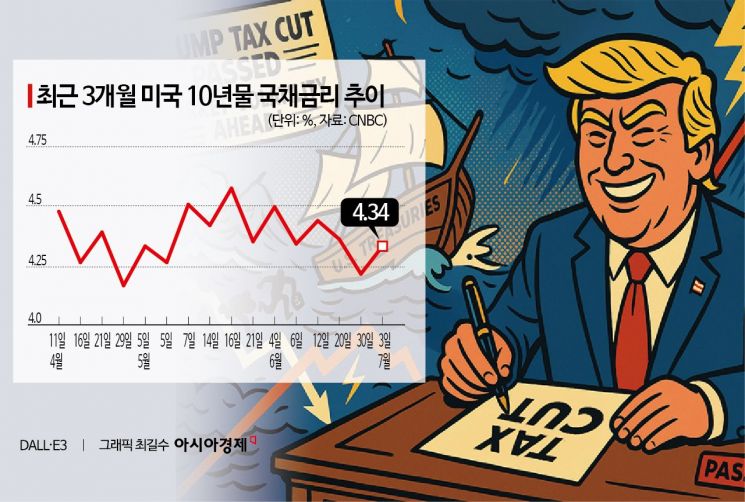
The stock market also closed higher. On this day, the S&P 500 index on the New York Stock Exchange once again hit a record high. The strong employment data eased concerns about a slowdown in the U.S. economy and fueled expectations that the Fed's policy rate cut could be delayed. In the futures market, as of 8:54 p.m. (U.S. Eastern Time), S&P 500 index futures were up about 0.07%, continuing their upward trend.
In the market, more attention is being paid to corporate earnings, Fed moves, and the outcome of tariff negotiations than to the tax cut bill itself. Robert Pavlik, senior portfolio manager at Dakota Wealth, said, "This bill will not be the main driver of the market," emphasizing, "The market's focus is first on corporate earnings, and next on the Fed's monetary policy." Vice President Chandler also added, "The bigger source of uncertainty for the market is the July 8 tariff negotiation deadline," and said, "This will be a key factor that could trigger future volatility and instability."
However, in the bond market, concerns are growing about the long-term fiscal soundness of the United States. With the fiscal deficit expected to reach $3.3 trillion over the next 10 years following the passage of the tax cut bill, the U.S. Treasury plans to issue a large volume of short-term Treasury bills (T-bills). While this could lower the government's funding costs in the short term, it could become a burden for the market in the long run. BlackRock warned in a recent report, "Foreign investors' preference for U.S. Treasuries is weakening, and a lack of demand could ultimately lead to higher borrowing costs."
Some point out that despite rising Treasury yields, if concerns about inflation or declining trust in U.S. fiscal management outweigh these factors, a "reverse effect" could emerge in which global investors avoid dollar assets. Idanna Appio, portfolio manager at First Eagle Investments, said, "If concerns about a widening fiscal deficit grow further, it could become even more difficult for the U.S. government to raise funds," and added, "In this case, the government would have no choice but to raise Treasury yields to attract investors, which could result in a widening gap between short- and long-term interest rates and an accelerated weakening of the dollar."
© The Asia Business Daily(www.asiae.co.kr). All rights reserved.
![Clutching a Stolen Dior Bag, Saying "I Hate Being Poor but Real"... The Grotesque Con of a "Human Knockoff" [Slate]](https://cwcontent.asiae.co.kr/asiaresize/183/2026021902243444107_1771435474.jpg)
















