Average Order Size per Ship Is Twice That of China
Maintaining Competitiveness in High Value-Added Vessels
Last month, global ship orders dropped by more than 80% compared to the same period last year. However, South Korea maintained its competitiveness in high value-added vessels by securing 41% of the total orders.
According to Clarkson Research, a British shipbuilding and shipping market analysis firm, global ship orders in June amounted to 2.56 million CGT (84 ships). This represents a 44% increase from the previous month (1.78 million CGT), but an 81% decrease compared to the same month last year (13.26 million CGT).
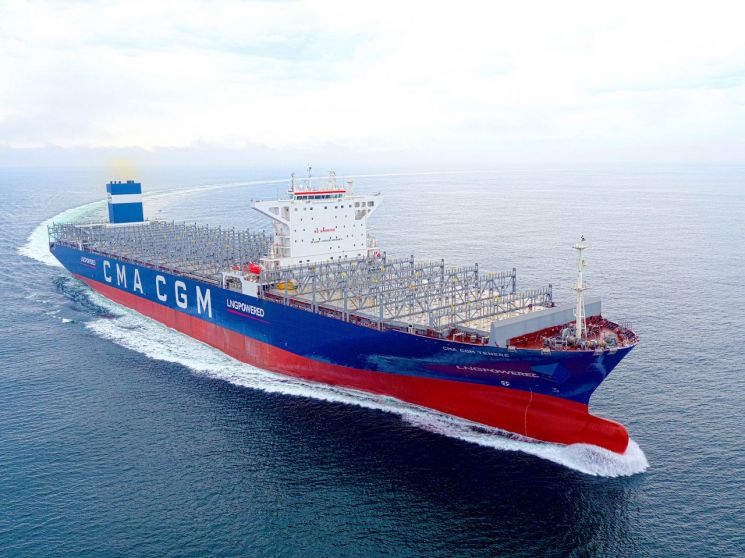 Sea trial scene of a large LNG-powered container ship built by Hyundai Heavy Industries. Unrelated to the main text. Asia Economy DB Yonhap News
By country, China ranked first with 1.37 million CGT (50 ships), accounting for 53% of the orders, while South Korea recorded 1.05 million CGT (18 ships), with a market share of 41%. Notably, South Korea's average order size per ship was 58,000 CGT, more than double that of China (27,000 CGT), indicating the effectiveness of a strategy focused on high value-added vessels.
Cumulative orders for the first half of this year amounted to 19.38 million CGT (647 ships), a 54% decrease compared to the same period last year (42.58 million CGT). Of this, China recorded 10.04 million CGT (370 ships, 52% share) and South Korea 4.87 million CGT (113 ships, 25% share), representing decreases of 65% and 33%, respectively.
As of the end of last month, the global order backlog stood at 163.74 million CGT, a decrease of 1.58 million CGT from the previous month. By country, China accounted for 96.82 million CGT (59%), while South Korea held 35.42 million CGT (22%). Compared to the previous month, South Korea and China saw decreases of 890,000 CGT and 990,000 CGT, respectively. Compared to the same period last year, South Korea's backlog decreased by 3.18 million CGT, while China's increased by 20.44 million CGT.
New ship prices continued to rise. The Clarkson Newbuilding Price Index reached 187.11 points, up 0.42 points from the previous month (186.69), returning to the level seen in April. Compared to June 2020 (126.93), this represents a 47% increase.
By ship type, the average price for LNG carriers (174,000 cubic meters or larger) was $255 million, very large crude carriers (VLCCs) were $126 million, and ultra-large container ships (22,000-24,000 TEU) were $273 million.
© The Asia Business Daily(www.asiae.co.kr). All rights reserved.
![Clutching a Stolen Dior Bag, Saying "I Hate Being Poor but Real"... The Grotesque Con of a "Human Knockoff" [Slate]](https://cwcontent.asiae.co.kr/asiaresize/183/2026021902243444107_1771435474.jpg)















